WEEKEND LIGHT SHOW OVER THE US EAST COAST: Early risers along the Atlantic Coast of the USA might see see a light show before sunrise on Sunday, June 4th. A sounding rocket scheduled to launch from NASA's Wallops Flight Facility in Virginia between 4:26 am and 4:41 am EDT will deploy ten chemical-filled canisters, creating a network of red and blue-green vapors 96 to 124 miles high. Researchers will track the motions of the colorful gases to study the dynamics of Earth's ionosphere. (Note: This launch was originally scheduled for Saturday morning, then postponed until Sunday because boats intruded on the rocket's second stage impact zone.) Visit the mission blog for updates.
ACTIVE SUNSPOT: Sunspot AR2661 has more than doubled in size since it appeared on June 1st and it is still crackling with C-class solar flares. Using a backyard solar telescope in Prescott Valley, Arizona, amateur astronomer Randy Shivak photographed the maelstrom around the sunspot's primary dark core:

"I kept my eye on AR 2661 in hopes that it would flare--and it did," says Shivak. "I took this picture using a a 228mm F9 refracting telescope and a Daystar Quantum PE 0.5 angstrom filter."

AR2661 is turning toward Earth, and the sunspot will soon be in a position to hurl CMEs in our direction. Indeed, a pair of CMEs recorded by SOHO on June 1st shows that AR2661 has the ability to produce such clouds. Now it's just a matter of targeting. Stay tuned! Free: Solar Flare Alerts

Realtime Space Weather Photo Gallery
RED SPRITES OVER EUROPE: High above thunderstorms in eastern Europe, red sprites are dancing across the cloudtops, reaching up to the edge of space itself. Martin Popek of Nýdek, Czech republic, photographed these specimens on June 1st:

"The transient forms were shooting up from a storm in Slovenia," says Popek.
Sprites are a true space weather phenomenon, inhabiting the upper reaches of Earth's atmosphere alongside noctilucent clouds, meteors, and auroras. Some researchers believe they are linked to cosmic rays: subatomic particles from deep space striking the top of Earth's atmosphere produce secondary electrons that, in turn, provide the spark that triggers sprites. If this is true, then sprites could multiply in the years ahead as cosmic rays intensify.
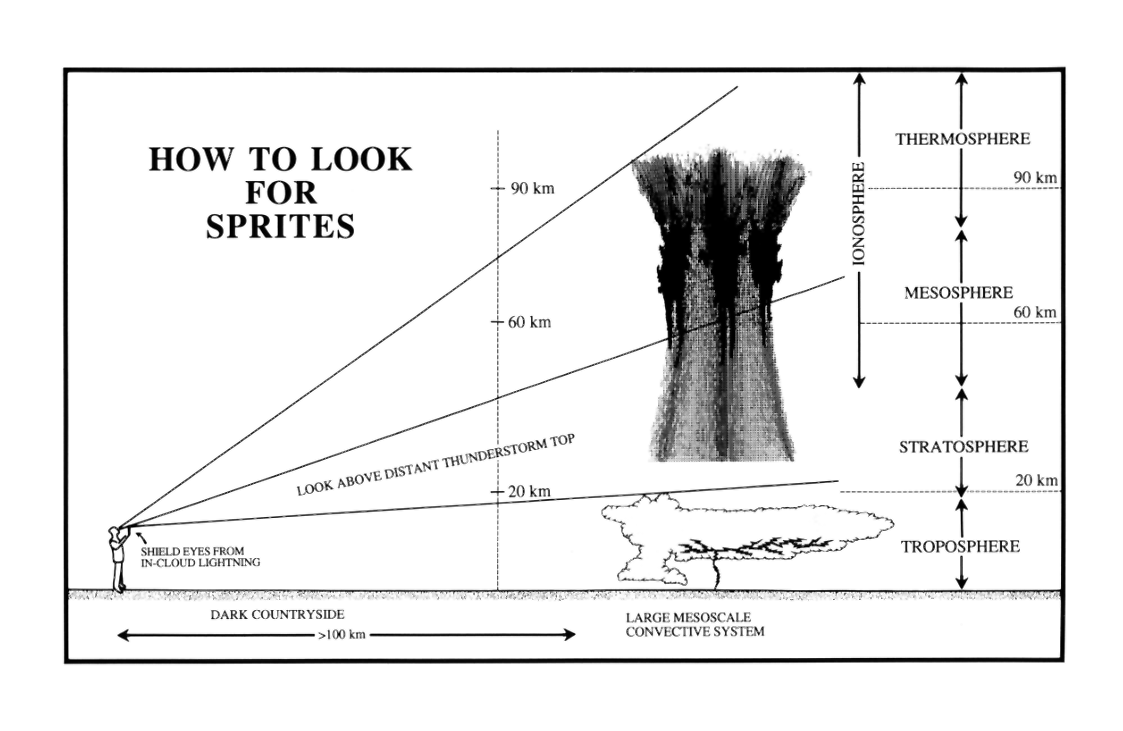
Although sprites have been seen for at least a century, most scientists did not believe they existed until after 1989 when sprites were photographed by cameras onboard the space shuttle. Now "sprite chasers" routinely photograph sprites from their own homes. "I used up a Watec 910HX security camera with UFOCapture software to catch my sprites," says Popek. Give it a try!
diagram: How to Look for Sprites
THE SPACE HAMMER FOR FATHER'S DAY: Just in time for Father's Day: The Space Hammer. On June 2nd, the students of Earth to Sky Calculus flew a payload of hammers to the edge of space, 35.0 km (115,000 feet) above Earth's surface on board a high altitude helium balloon. You can have one for $99.95:

These compact 8 oz. hammers are light enough to fly on a balloon yet dense enough to deliver a powerful blow. The magnetic head holds a nail for one-handed starting, and the stubby 6 in. length is perfect for tight work areas.
Each space hammer comes with a unique gift card showing the tool floating at the top of Earth's atmosphere. The interior of the card tells the story of the flight and confirms that this gift has been to the edge of space and back again.
More edge of space Father's Day gifts may be found in the Earth to Sky Store.
Far Out Gifts: Earth to Sky Store
All proceeds support hands-on STEM education
Realtime Noctilucent Cloud Photo Gallery