SLIGHT CHANCE OF FLARES: Today, NOAA forecasters say there is a 10% chance of M-class solar flares from sunspot AR2661, which has an unstable 'delta-class' magnetic field. If AR2661 does explode, the resulting flare would be geoeffective because the sunspot is directly facing our planet. Free Solar Flare Alerts
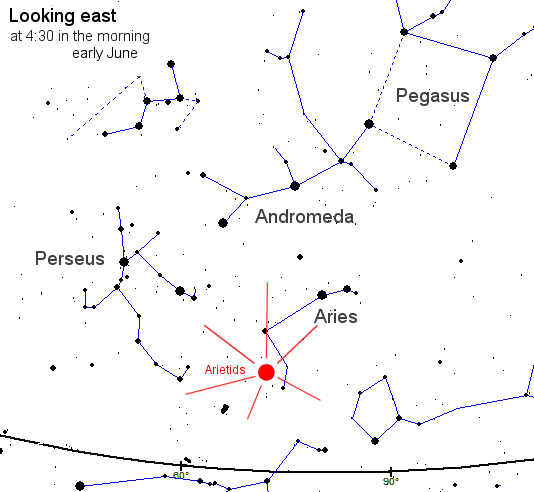
DAYTIME METEOR SHOWER: This week, Earth is passing through a stream of debris from an unknown source, and the encounter is causing a meteor shower in broad daylight. The shooting stars are mostly invisible to the human eye. Astronomers know the shower is underway because the meteors reflect radio waves. According to data from Canada's Meteor Orbit Radar (CMOR), there is a hot spot of activity right now in the constellation Aries not far from the sun:

This happens every year in early June, and the resulting Arietid meteor shower typically peaks on June 7th. If you could turn off the sun, you would see more than 60 meteors per hour, making it one of the most active showers of the year. No one is sure where Arietid meteoroids come from, although some astronomers suspect they are debris from sungrazing asteroid 1566 Icarus. Another candidate is comet 96P/Machholz.
In fact, there is way to see a few of these meteors. Try looking just before sunrise. The shower's radiant (labeled ARI in the radar map above) rises in the east about 45 minutes before the sun. At that time of day, Arietids tend to be "Earthgrazers," i.e., meteors that skim horizontally through the upper atmosphere from radiants near the horizon. Spectacular Earthgrazers are usually slow and bright, streaking far across the sky--a real eye-opener. Sky maps: northern hemisphere, southern hemisphere.

Realtime Space Weather Photo Gallery
RED SPRITES OVER EUROPE: High above thunderstorms in Europe, red sprites are dancing across the cloudtops. Martin Popek of Nýdek, Czech republic, photographed these specimens on June 1st:

"The transient forms were shooting up from a storm in Slovenia," says Popek.
Reaching up to the edge of space, sprites are a true space weather phenomenon. Some researchers believe they are linked to cosmic rays: subatomic particles from deep space striking the top of Earth's atmosphere produce secondary electrons that, in turn, provide the spark that triggers sprites. If this is true, then sprites could multiply in the years ahead as cosmic rays intensify due to the decline of the solar cycle.
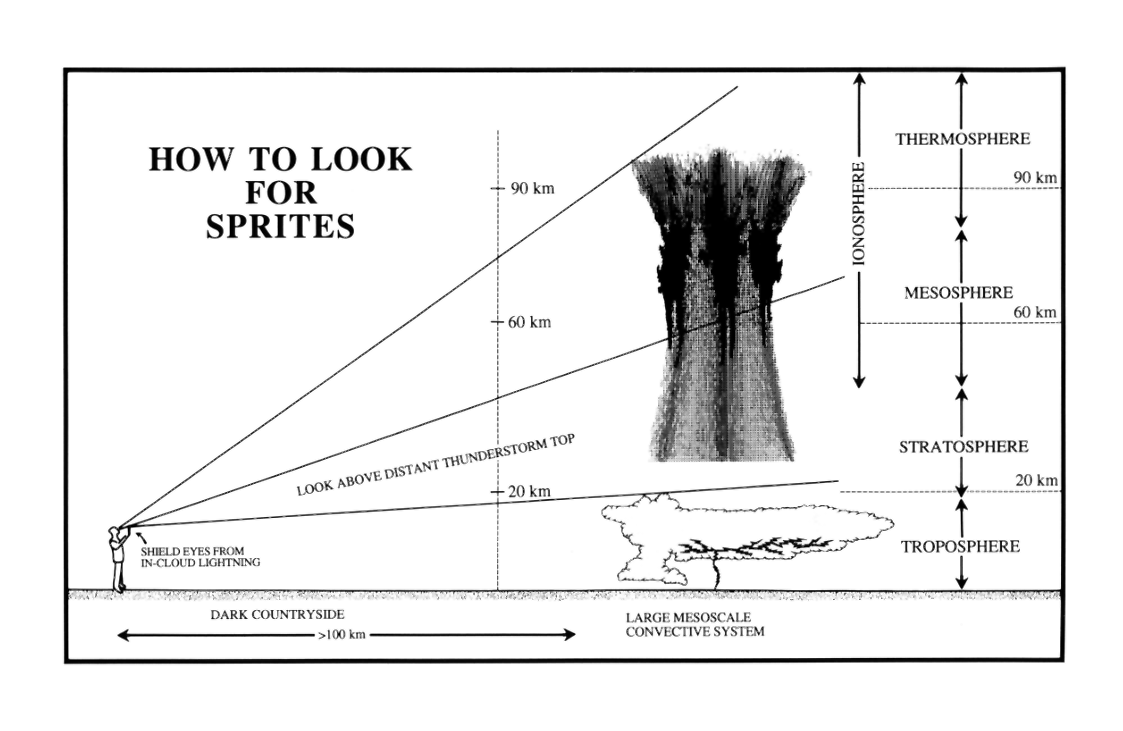
Although sprites have been seen for at least a century, most scientists did not believe they existed until after 1989 when sprites were photographed by cameras onboard the space shuttle. Now "sprite chasers" routinely photograph sprites from their own homes. "I used up a Watec 910HX security camera with UFOCapture software to catch my sprites," says Popek. Give it a try!
diagram: How to Look for Sprites
THE SPACE HAMMER FOR FATHER'S DAY: Just in time for Father's Day: The Space Hammer. On June 2nd, the students of Earth to Sky Calculus flew a payload of hammers to the edge of space, 35.0 km (115,000 feet) above Earth's surface on board a high altitude helium balloon. You can have one for $99.95:

These compact 8 oz. hammers are light enough to fly on a balloon yet dense enough to deliver a powerful blow. The magnetic head holds a nail for one-handed starting, and the stubby 6 in. length is perfect for tight work areas.
Each space hammer comes with a unique gift card showing the tool floating at the top of Earth's atmosphere. The interior of the card tells the story of the flight and confirms that this gift has been to the edge of space and back again.
More edge of space Father's Day gifts may be found in the Earth to Sky Store.
Far Out Gifts: Earth to Sky Store
All proceeds support hands-on STEM education
Realtime Noctilucent Cloud Photo Gallery