STRAWBERRY MOON: There's a full Moon this Friday, June 9th. According to folklore it has a special name: the "Strawberry Moon." It gets its name from June-bearing strawberry plants, which have a short (three week) harvest season that begins about now. Sink your teeth into a Fragaria ananassa, and enjoy the strawberry moonlight.
SLOW SOLAR FLARE: Solar flares occur when magnetic fields get tangled. Lines of magnetic force above sunspots criss, cross, and explode in a flash of electromagnetic radiation. This process, called "magnetic reconnection", usually happens in a matter of minutes. Earlier today, NASA's Solar Dynamics Observatory witnessed an explosion that took two hours to unfold:
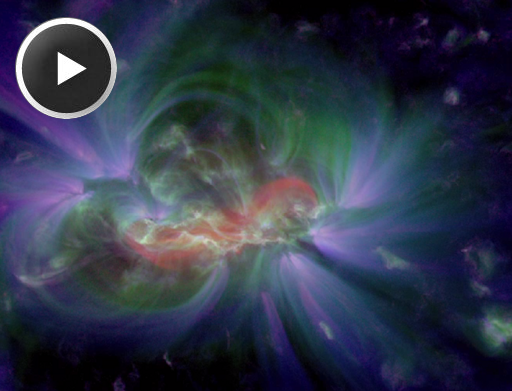
This leisurely C1-class solar flare happened in the magnetic canopy of sunspot AR2661. Often, slow explosions like this one use their time to gather momentum and hurl a CME into space. Not this time, though. No one knows why a fraction of slow flares fail to produce CMES. It's a minor mystery that underscores the continued unpredictability of space weather.
Realtime Space Weather Photo Gallery
DOUBLE SOLAR ECLIPSE ON JUPITER: Millions of people are looking forward to a total eclipse of the sun on Aug. 21, 2017. That's nothing. Jupiter just had TWO solar eclipses at the same time. On June 3rd, Ed Lomeli of Sacramento, California, video-recorded the shadows of Io and Ganymede lancing across the giant planet's cloudtops:
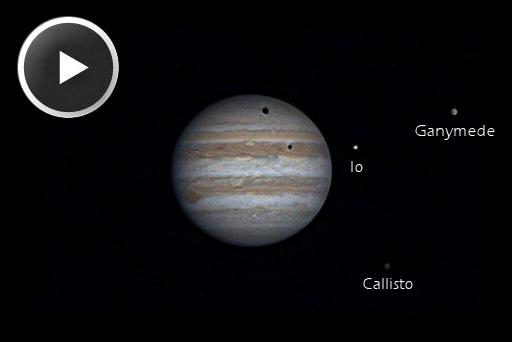
Within those dark circular shadows, Jovian day turned to night as the moons overhead blocked the sun. Two total eclipses were underway at the same time.
Envious Earthlings can take solace: Eclipses on Jupiter aren't nearly as beautiful as they are on our planet. Here on Earth, the Moon and sun are almost precisely the same size--an incredible coincidence that produces phenomena such as Baily's Beads and the Diamond ring. When the disk of the sun is so precisely covered, we can see the ghostly tendrils of the sun's outer atmosphere (the corona) shimmering across the sky.
On Jupiter, however, local moons appear to be much larger than the distant sun. Io, for example, is 6 times wider than the solar disk; it completely swallows the sun's corona. This mismatch in size mitigates the beauty of the occasion. The best eclipses are homegrown, after all.

THE SPACE HAMMER FOR FATHER'S DAY: Just in time for Father's Day: The Space Hammer. On June 2nd, the students of Earth to Sky Calculus flew a payload of hammers to the edge of space, 35.0 km (115,000 feet) above Earth's surface on board a high altitude helium balloon. You can have one for $99.95:
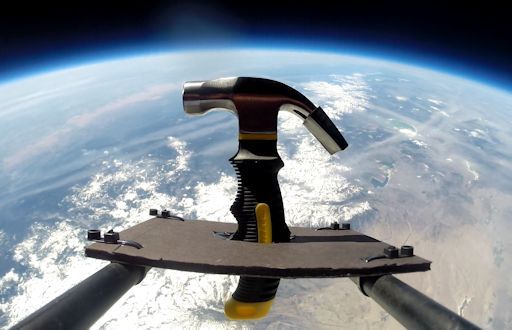
These compact 8 oz. hammers are light enough to fly on a balloon yet dense enough to deliver a powerful blow. The magnetic head holds a nail for one-handed starting, and the stubby 6 in. length is perfect for tight work areas.
Each space hammer comes with a unique gift card showing the tool floating at the top of Earth's atmosphere. The interior of the card tells the story of the flight and confirms that this gift has been to the edge of space and back again.
More edge of space Father's Day gifts may be found in the Earth to Sky Store.
Far Out Gifts: Earth to Sky Store
All proceeds support hands-on STEM education