STRAWBERRY MOON: There's a full Moon this Friday, June 9th. According to folklore it has a special name: the "Strawberry Moon." It gets its name from June-bearing strawberry plants, which have a short (three week) harvest season that begins about now. Sink your teeth into a Fragaria ananassa, and enjoy the strawberry moonlight.
DID A SPY SATELLITE JUST VISIT THE ISS? On May 1st at Cape Canaveral, SpaceX launched a classified satellite (USA 276) for the US National Reconnaissance Office. Watching the spysat circle the Earth, analysts around the world soon realized something interesting. The orbit of USA 276 was similar to that of the International Space Station and could theoretically make close approaches to the orbiting outpost.
On June 3rd, that's exactly what happened. "USA 276 made a close approach and effectively circled the ISS," reports Marco Langbroek of Leiden, the Netherlands. He prepared this diagram showing the circumstances of the encounter:
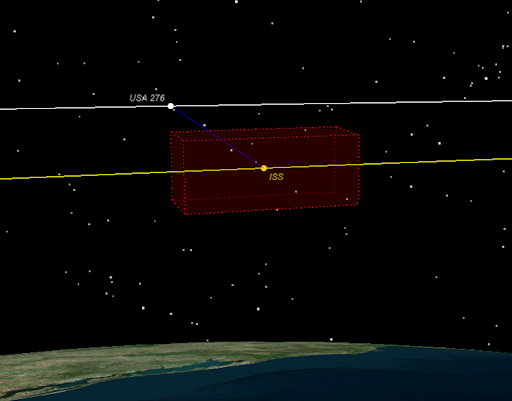
Amateur satellite watchers have been tracking USA 276 ever since it launched, and their observations have resulted in ever-improving estimates of the satellite's orbit. "With the latest data included, we can establish the moment of closest approach as 3 June 2017, 14:01:52 UT. It happened in daylight over the southern Atlantic north of the Falklands, near 43o.75 S, 45o.45 W, with a miss distance of only 6.4 ± 2 km."
In the diagram above, the brick-colored box has dimensions of 4 x 4 x 10 km. Whenever an object looks like it is going to pass through that box, ISS mission controllers evaluate the possibility of a collision avoidance maneuver. "USA 276 remained just outside the 4 x 4 x 10 km box at closest approach," notes Langbroek. "As a result, collision avoidance maneuvers were not required."
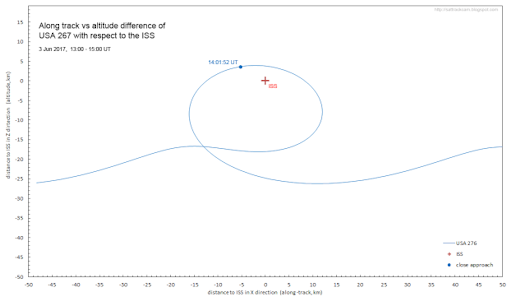
USA 276 looped around the ISS, according to an analysis by Langbroek
Why is an American spy satellite buzzing the ISS? One possibility is coincidence. Maybe it's a chance encounter. Senior satellite analyst Ted Molczan has published arguments for and against that possibility. "I am inclined to believe that the close conjunctions between USA 276 and ISS are intentional," he says.
Molczan points out that USA 276 might be visiting the ISS to test Raven--a technology demonstration project on the ISS researchers are using to develop spacecraft autopilot systems. Raven has visible, infrared, and lidar sensors that can track incoming spacecraft, feeding the data to an onboard processor for decision-making about rendezvous and docking.
"I imagine that USA 276 could add to the Raven data set as follows," speculates Molczan. "If it can rendezvous, then it could keep station for long periods, during which it could change its attitude to present the sensors with a variety of views, under a variety of lighting conditions. The total data collected could potentially far exceed that from the other visiting spacecraft."
If USA 276 does return to the ISS, observers will probably know about it. Langbroek has photographed the spysat in the night sky and it is visible to the unaided eye. Stay tuned for updates.
SLOW SOLAR FLARE: Solar flares occur when magnetic fields get tangled. Lines of magnetic force above sunspots criss, cross, and explode in a flash of electromagnetic radiation. This process, called "magnetic reconnection", usually happens in a matter of minutes. On June 6th, NASA's Solar Dynamics Observatory witnessed an explosion that took two hours to unfold:
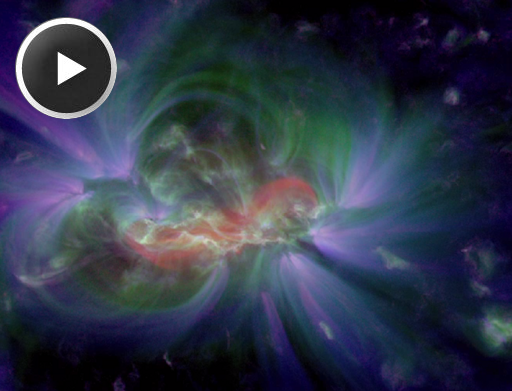
This leisurely C1-class solar flare happened in the magnetic canopy of sunspot AR2661. Often, slow explosions like this one use their time to gather momentum and hurl a CME into space. Not this time, though. No one knows why a fraction of slow flares fail to produce CMEs. It's a minor mystery that underscores the continued unpredictability of space weather.
Realtime Space Weather Photo Gallery
THE SPACE HAMMER FOR FATHER'S DAY: Just in time for Father's Day: The Space Hammer. On June 2nd, the students of Earth to Sky Calculus flew a payload of hammers to the edge of space, 35.0 km (115,000 feet) above Earth's surface on board a high altitude helium balloon. You can have one for $99.95:
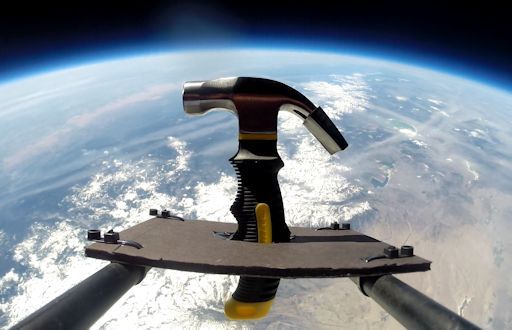
These compact 8 oz. hammers are light enough to fly on a balloon yet dense enough to deliver a powerful blow. The magnetic head holds a nail for one-handed starting, and the stubby 6 in. length is perfect for tight work areas.
Each space hammer comes with a unique gift card showing the tool floating at the top of Earth's atmosphere. The interior of the card tells the story of the flight and confirms that this gift has been to the edge of space and back again.
More edge of space Father's Day gifts may be found in the Earth to Sky Store.
Far Out Gifts: Earth to Sky Store
All proceeds support hands-on STEM education