MINOR GEOMAGNETIC STORM: A minor G1-class geomagnetic storm is in progress on June 11th as Earth enters a stream of disturbed solar wind. High latitude sky watchers should be alert for auroras, especially in the southern hemisphere where autumn darkness favors visibility. Free: Aurora Alerts

CORONAL MASS EJECTIONS: Despite the lack of sunspots, the sun is active today. SOHO (the Solar and Heliospheric Observatory) has observed two coronal mass ejections (CMEs) on June 11th, a faint one on the sun's western limb and a bright one on the sun's eastern limb: movie. NOAA analysts are working to determine if either of these solar storm clouds will affect Earth in the days ahead. Stay tuned. Free: Aurora Alerts

CRESCENT SUPERMOON VS. FULL MINI-MOON: The Moon's orbit is an ellipse, with one side 50,000 km closer to Earth than the other. This has an effect on the apparent size of the Moon. The lunar disk grows larger when the Moon is nearby and smaller when far away. In the past two weeks we have witnessed two extremes--a crescent supermoon followed by a full 'mini-Moon.' Peter Lowenstein of Mutare, Zimbabwe, photographed them both:

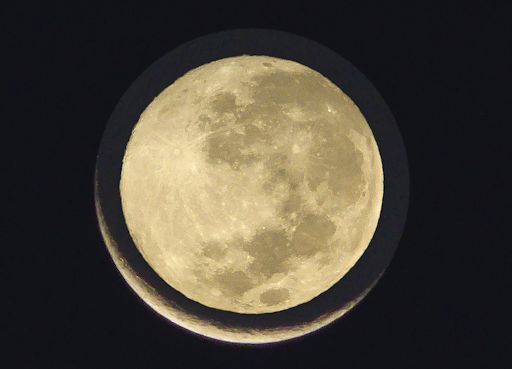
"The size difference was so great, the crescent Moon of May 27th could hold the full Moon of June 9th with room to spare!" says Lowenstein. "I took these photographs from the same location in Mutare using the same optical zoom setting (x60) on the same Panasonic Lumix DMC TZ-60 camera within two hours of moonset."
Some people say that mini-Moons and supermoons all appear to be the same size. After all, there are no rulers floating in the sky to measure lunar diameters, and without reference points to provide a sense of scale, one Moon can indeed look much like any other. However, Lowenstein's photo shows there is a real difference.
Realtime Space Weather Photo Gallery
SPACE BALLS FOR FATHER'S DAY: What do you give the Father who has everything? Space Balls! The students of Earth to Sky Calculus have flown a basket of space-helmeted golf balls to the edge of space, 36.3 km (119,000 feet) above Earth's surface on board a high altitude helium balloon: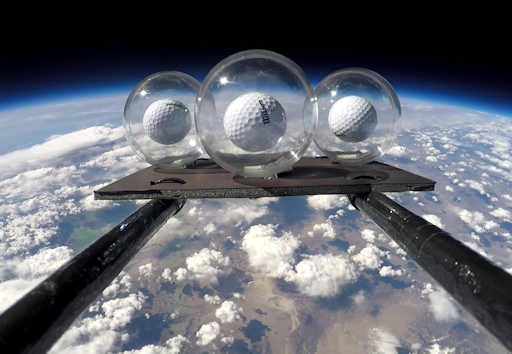
After the balloon exploded, the balls parachuted back to Earth, landing in the volcanic tablelands north of Bishop CA. For $49.95 you can have one of these balls (space helmet included) along with a unique Father's Day card showing the balls floating at the top of Earth's atmosphere. The interior of the card tells the story of the flight and confirms that this gift has been to the edge of space and back again.
More edge of space Father's Day gifts may be found in the Earth to Sky Store.
Far Out Gifts: Earth to Sky Store
All proceeds support hands-on STEM education
DID A SPY SATELLITE JUST VISIT THE ISS? On May 1st at Cape Canaveral, SpaceX launched a classified satellite (USA 276) for the US National Reconnaissance Office. Watching the spysat go into orbit, analysts around the world quickly realized something odd. The orbit of USA 276 was similar to that of the International Space Station and could theoretically make close approaches to the orbiting outpost.
On June 3rd, that's exactly what happened. "USA 276 made a close approach and effectively circled the ISS," reports Marco Langbroek of Leiden, the Netherlands. He prepared this diagram showing the circumstances of the encounter:
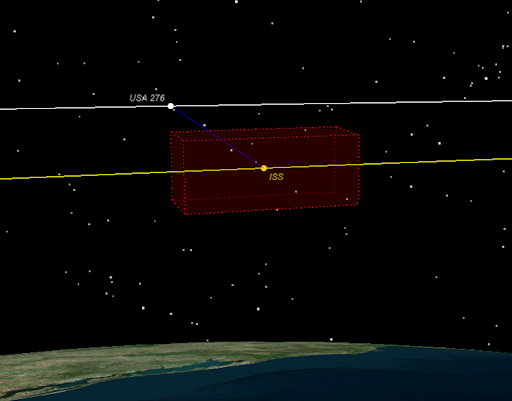
Amateur satellite watchers have been tracking USA 276 since late May, and their observations have resulted in ever-improving estimates of the satellite's orbit. "With the latest data included, we can establish the moment of closest approach as 3 June 2017, 14:01:52 UT. It happened in daylight over the southern Atlantic north of the Falklands, near 43o.75 S, 45o.45 W, with a miss distance of only 6.4 ± 2 km."
In the diagram above, the brick-colored box has dimensions of 4 x 4 x 10 km. Whenever an object looks like it is going to pass through that box, ISS mission controllers evaluate the possibility of a collision avoidance maneuver. "USA 276 remained just outside the 4 x 4 x 10 km box at closest approach," notes Langbroek. "As a result, collision avoidance maneuvers were not required."
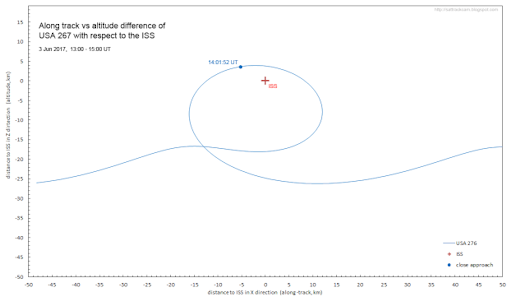
USA 276 looped around the ISS, according to an analysis by Langbroek
Why is an American spy satellite buzzing the ISS? Maybe it's a chance encounter. Senior satellite analyst Ted Molczan has published arguments for and against that possibility. "I am inclined to believe that the close conjunctions between USA 276 and ISS are intentional," he says.
Molczan points out that USA 276 might be visiting the ISS to test Raven--a technology demonstration project on the ISS researchers are using to develop spacecraft autopilot systems. Raven has visible, infrared, and lidar sensors that can track incoming spacecraft, feeding the data to an onboard processor for decision-making about rendezvous and docking.
"I imagine that USA 276 could add to the Raven data set as follows," speculates Molczan. "If it can rendezvous, then it could keep station for long periods, during which it could change its attitude to present the sensors with a variety of views, under a variety of lighting conditions. The total data collected could potentially far exceed that from the other visiting spacecraft."
If USA 276 does return to the ISS, observers will probably know about it. Langbroek has photographed the spysat in the night sky and it is visible to the unaided eye, like a dim 3rd magnitude star. Interested observers can get local flyby times from Heaven's Above or N2YO.
Realtime Space Weather Photo Gallery