NASA PREPARES ARTIFICIAL CLOUD DISPLAY (UPDATED): Monday's launch of a sounding rocket from Wallops Flight Facility in Virginia was postponed because of weather. NASA plans to try again on Tuesday, June 13th. Sometime between 9:04 and 9:19 p.m. Eastern Time, the Terrier-Improved Malemute rocket will blast off and release a network of red and blue-green vapors more than 100 miles high. Tracking the motions of the colorful gases will help researchers study the dynamics of Earth's ionosphere. The vapor tracers may be visible from New York to North Carolina and westward to Charlottesville, Virginia. Free: Aurora Alerts
ANTARCTIC MOONDOGS: At Germany's Neumayer III Research Station in Antarctica, the polar night began on May 21st and no one has seen the sun in weeks. "Hence, I could not believe my eyes on June 12th when I opened the station's weather monitor and suddenly could see a sundog," reports Stefan Christmann, who is visiting as part of a BBC film crew working on a documentary about emperor penguins. "I quickly grabbed my camera, got dressed and ran outside." This is what he saw:
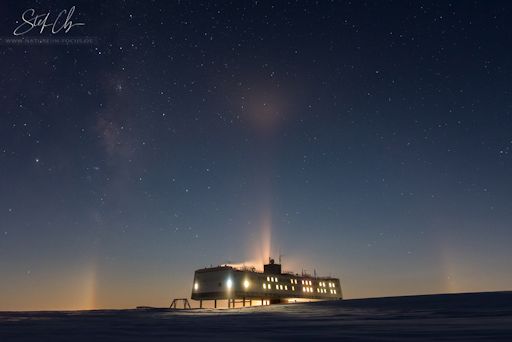
"In fact," he says, "it was a moondog--the lunar equivalent of a sundog."
As the waning full Moon rose behind the station, it shone through crystals of ice floating above the frozen terrain. These crystals bent and shaped the moonbeams into moondogs, a moon pillar and even an upper tangent arc.
"In combination with a clear and starry sky, this was quite the sight," says Christmann. "Antarctica is an awesome place, full of little miracles and incredible nature - this needed to be shared with every space weather enthusiast." (Agreed!)
Realtime Space Weather Photo Gallery\
FOR THE FATHER WHO HAS EVERYTHING: Yes, that really is a Vulcan rubber duck. The students of Earth to Sky Calculus flew the pointy-eared water bird to the stratosphere as part of their ongoing program to monitor cosmic rays, and you can have him for $79.95. He makes a great Father's Day gift:
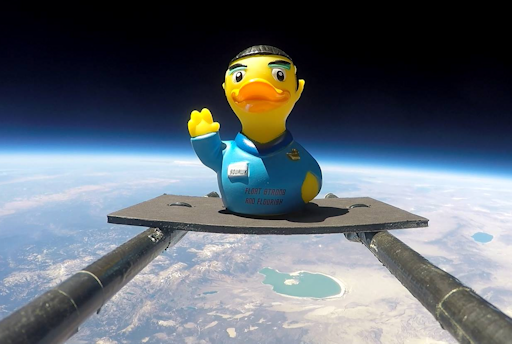
"Mr Squawk" hitchhiked on a helium balloon payload that carried an array of X-ray/gamma-ray sensors. By launching these sensors 3 or 4 times a month, the students have shown that cosmic rays are intensifying--a trend that affects mountain climbers, air travelers, high-altitude drones and astronauts on the International Space Station.
This research is crowd funded. Would you like to support it? Buy a duck! Mr. Squawk comes with unique Father's Day card showing the duck at the top of Earth's atmosphere. The interior of the card tells the story of the flight and confirms that this gift has been to the edge of space and back again.
Far Out Gifts: Earth to Sky Store
All proceeds support hands-on STEM education
RADIO STORM ON JUPITER: On June 6th, amateur astronomer Thomas Ashcraft pointed his shortwave radio telescope at Jupiter, which was shining brightly high overhead in the New Mexico night sky. Soon, the loudspeakers began to roar with strange-sounding swooshes of static. A Jovian radio storm was underway. Click to listen to a sample of the audio:
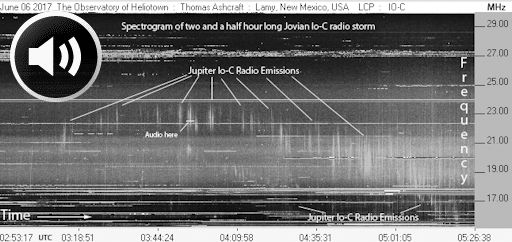
"This is a one minute long audio recording captured on two short wave radios tuned at 29.0 MHz and 29.5 MHz," explains Ashcraft. "The storm produced sustained emissions that lasted over two and a half hours."

Jupiter is a powerful source of shortwave radio bursts. They come from natural radio lasers in the giant planet's magnetosphere. Electrical currents flowing between Jupiter's upper atmosphere and the volcanic moon Io can boost these emissions to power levels easily detected by ham radio antennas on Earth. To learn more about radio storms on Jupiter, and how you can observe them yourself, visit NASA's RadioJove web site.