GEOMAGNETIC STORM WATCH: NOAA forecasters say there is a 20% chance of G1-class geomagnetic storms today, June 16th, when a fast-moving stream of solar wind is expected to buffet Earth's magnetic field. The gaseous stream is flowing from a large hole in the sun's atmosphere. High-latitude sky watchers should be alert for auroras, especially in the southern hemisphere where deepening autumn darkness favors visibility. Free: Aurora Alerts


THEY'RE BAAAAACK: A mesospheric heat wave that wiped out noctilucent clouds (NLCs) in early June is subsiding. As temperatures drop 83 km above Earth's surface, summertime wisps of water vapor are rapidly crystallizing around specks of meteor smoke with visible results. The NLCs are back. In Hertfordshire UK, Dr. Sandy Robertson photographed their silvery tendrils just before midnight on June 15th:
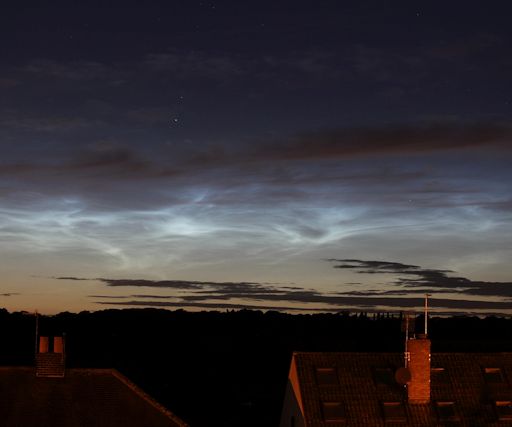
"Great to see that the NLCs are back, and visible this far south," he says. "There was some nice structure in these specimens seen around 2300 UT."
This is an unusually late start to the summer season for NLCs, and no one can say for sure what will happen next. However, researchers working with NASA's AIM spacecraft, which studies NLCs from Earth orbit, believe the clouds will quickly intensify as the 2nd half of June unfolds--that is, provided upper atmospheric temperatures return to normal. Monitor the NLC photo gallery for developments.
Realtime Noctilucent Cloud Photo Gallery
MYSTERY OF THE MISSING NOCTILUCENT CLOUDS: In late May 2017, observers in Europe began seeing electric-blue tendrils snaking over the western horizon at sunset. The summer season for noctilucent clouds (NLCs) was apparently beginning. Normally, the strange-looking clouds surge in visibility in the weeks immediately after their first sighting. This year, however, something mysterious happened. Instead of surging, the clouds vanished. During the first two weeks of June 2017, Spaceweather.com received ZERO images of NLCs -- something that hasn't happened in nearly 20 years.
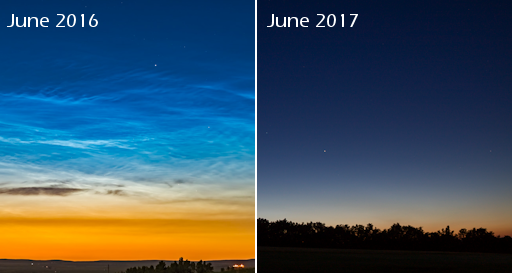
Where did they go? Researchers have just figured it out: There's been a "heat wave" in the polar mesosphere, a region in Earth's upper atmosphere where NLCs form. Relatively warm temperatures have wiped out the clouds.
Lynn Harvey of the University of Colorado's Laboratory for Atmospheric and Space Physics made the discovery using temperature data from the Microwave Limb Sounder onboard NASA's Aura satellite. "In early May, the summer mesosphere was cooling down as usual, approaching the low temperatures required for NLCs," she says. "But wouldn't you know it? Right after May 21st the temperature stopped cooling over the pole! In fact, it warmed a degree or two over the next week. The warming resulted in 2017 being the WARMEST summer mesopause in the last decade."
She is describing the red curve in this 10-year plot of polar mesospheric temperature trends:
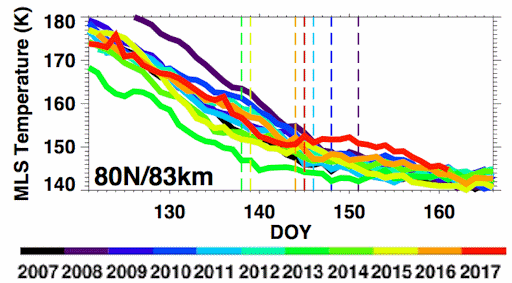
Warm temperatures are an anathema to NLCs. The icy clouds form 83 km above Earth when the air temperature drops below 145 K (-128 C), allowing scarce water molecules to get together and crystallize on specks of meteor smoke. Even a couple of degrees of warming is enough to obliterate the fragile clouds.
"We don't know why the mesosphere warmed up," says Cora Randall, Professor and Chair of the University of Colorado Department of Atmospheric and Oceanic Sciences. "It's probably a complex process involving the propagation of atmospheric gravity waves, which affect the flow of air and heat in the upper atmosphere. We're looking into it."
Meanwhile, the heat wave may be coming to an end. "In the last week, the north polar mesopause has started cooling again," says Harvey. This means NLCs should soon return, bouncing back to normal as temperatures drop. High latitude sky watchers should be alert for electric-tendrils creeping out of the sunset in the nights ahead--and if you see anything, submit your pictures here!
Realtime Space Weather Photo Gallery
SPACE WEATHER BALLOON LAUNCH: A team of students from Earth to Sky Calculus and Spaceweather.com has arrived in Maine for a transcontinental space weather balloon launch. On June 15th and 16th, we'll be launching balloons simultaneously from California and New Hampshire:
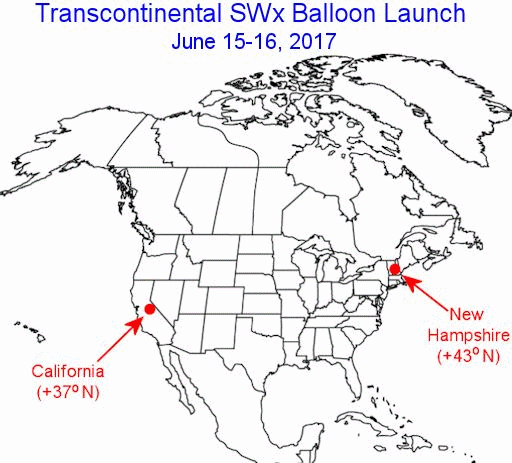
The purpose of this activity is two-fold:
1. We are training a team from the Southern Maine Community College to participate in our Solar Eclipse Balloon Network.
2. We will measure cosmic rays over both launch sites as part of our monitoring program of atmospheric radiation. Flying simultaneously, the balloons will ascend all the way to the stratosphere, sampling X-rays and gamma-rays at altitudes of interest to aviation, space tourism, and climate science. This is the 4th time since July 2015 that we've conducted this transcontinental experiment, and it is telling us some very interesting things about the variable shielding of Earth's magnetic field across North America.
Stay tuned for launch updates in the busy two days ahead.
Far Out Gifts: Earth to Sky Store
All proceeds support hands-on STEM education