ARTIFICIAL CLOUD DISPLAY POSSIBLE TONIGHT: Tonight, June 19th, NASA will try for the 9th time to launch a sounding rocket from Wallops Flight Facility in Virginia, creating a colorful display of artificial clouds high above the eastern seaboard of the USA. Previous launches have been aborted because of, e.g., high winds, clouds, and boats in the hazard area. The launch window is from 9:06 to 9:21 pm Eastern Time. Blue-green and red vapors may be visible from New York to North Carolina between 4 and 5.5 minutes after launch. Free: Aurora Alerts
HYPERBOLIC COMET JOHNSON: Comet Johnson (C/2015 V2) has just entered the galaxy-rich constellation Virgo, and it is passing by a spectacular array of star systems. Amateur astronomer Rolando Ligustri used a remotely controlled telescope in New Mexico to photograph the flyby on June 18th:

"Comet Johnson is close to many galaxies!" he says. And it will probably pass by many more in the weeks ahead as the comet continues its journey past the Virgo Cluster.
This beautiful comet made its closest approach to the sun (1.6 AU) just a few days ago--an encounter that set the stage for its departure. Comet Johnson is on a hyperbolic orbit, which means the sun's gravity is flinging the the comet into deep space. After this visit to the inner solar system, it will probably disappear forever.
Now is the time to look. The comet is about as bright as an 8th magnitude star--invisible to the naked eye, but an easy target for backyard telescopes. On June 22nd, Comet Johnson will cross the celestial equator heading south, giving astronomers in Australia, New Zealand, South Africa and South America a front row seat as the comet recedes into interstellar space. Resources: 3D orbit, ephemeris, magnitudes.
RETURN OF THE NOCTILUCENT CLOUDS: A mesospheric heat wave that wiped out noctilucent clouds (NLCs) in early June is subsiding. As temperatures drop 83 km above Earth's surface, summertime wisps of water vapor are rapidly crystallizing around specks of meteor smoke with visible results. The NLCs are back. Allan Trow photographed their silvery tendrils over Anglesey, N. Wales, UK, on June 16th:

"The clouds were so expansive, I had to stitch two images together to capture the complete display," says Trow.
This is an unusually late start to the summer season for NLCs, and no one can say for sure what will happen next. However, researchers working with NASA's AIM spacecraft, which studies NLCs from Earth orbit, believe the clouds will quickly intensify as the 2nd half of June unfolds.
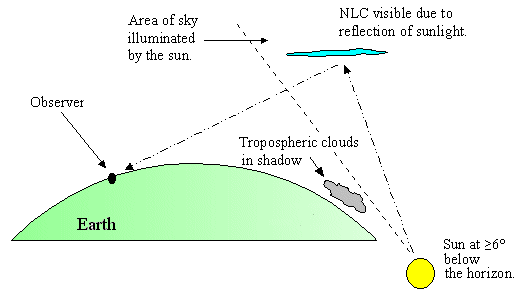
When noctilucent clouds first appeared in the 19th century, you had to travel to Arctic latitudes to see them. In recent years, however, they have intensified and spread with sightings as far south as Colorado and Kansas--a development that might be related to climate change. Observing tips: Look west 30 to 60 minutes after sunset when the sun has dipped ~10 degrees below the horizon. If you see luminous blue-white tendrils spreading across the sky, you may have spotted a noctilucent cloud.
Realtime Noctilucent Cloud Photo Gallery
POLAR MESOSPHERIC SUMMERTIME ECHOES: High above the Arctic Circle in Lofoten, Norway, researcher Rob Stammes cannot see noctilucent clouds through the glare of the midnight sun. Nevertheless, he knew they had returned. How? He heard them! "On June 15th, my VHF radio system recorded polar mesospheric summertime echoes (PMSEs)--a sign of noctilucent cloud activity," he explains.

PMSEs are terrestrial radio stations reflected from an altitude of 80 km to 90 km. That part of Earth's upper atmosphere is the mesosphere--the same place noctilucent clouds are found. The exact cause of PMSEs is not yet known; theorists have proposed explanations ranging from steep electron density gradients and "dressed aerosols" to gravity waves and turbulence. The echoes are often accompanied by visible NLCs.
"I normally use my VHF receiving system for signals from auroras and meteors," says Stammes. But there were no meteor showers or geomagnetic storms in progress at the time. "This event was much more like a PMSE, which I have detected many times in previous seasons."
He detected another episode of radio echoes on June 16th--confirming what is now obvious to the naked eye for many northern sky watchers: NLC season is finally underway. Stay tuned for more PMSEs.Realtime Space Weather Photo Gallery
Far Out Gifts: Earth to Sky Store
All proceeds support hands-on STEM education