HAPPY SOLSTICE: Tonight is the shortest night of the year in the northern hemisphere, a brief stretch of darkness that heralds the beginning of summer on the morning of June 21st (4:24 UT). Meanwhile, in the southern hemisphere, winter begins at the same time. Wherever you live, Happy Solstice! Free: Space Weather Alerts
RAINBOW BREATHING WHALES: "Rainbow breathing whale" sounds like a mythical creature. On June 18th, Mila Zinkova of San Francisco saw one ... for real. "Humpback whales are back in San Francisco Bay, and they are breathing out rainbows."
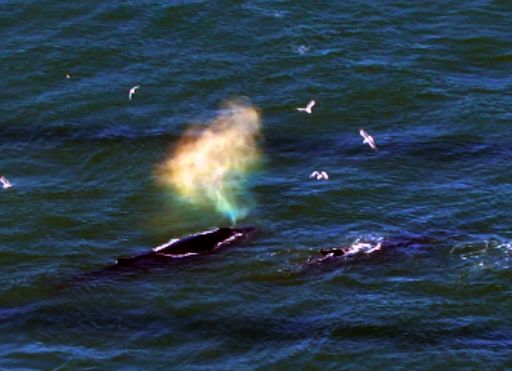
This is not mythology. It's physics. When Zinkova took the picture, the sun was behind her back shining down into the droplet-filled exhaust of the whale's spout. Sunbeams reflecting from the water droplets produced a prismatic spray of color just like an ordinary rainbow.
Of course it didn't look ordinary. "The full video," says Zinkova, "may be found here. At 2:10 into the video there are anchovies jumping out of the water, escaping a feeding whale."
Realtime Space Weather Photo Gallery
HOTTER THAN THE SUN: Everyone knows that lightning loves heat. Summertime air, warm and laden with moisture, rises into the sky. Airborne droplets of water and other hydrometeors rub together, creating static electricity in much the same way as woolen socks rubbed against carpet. The charge builds until ... this:
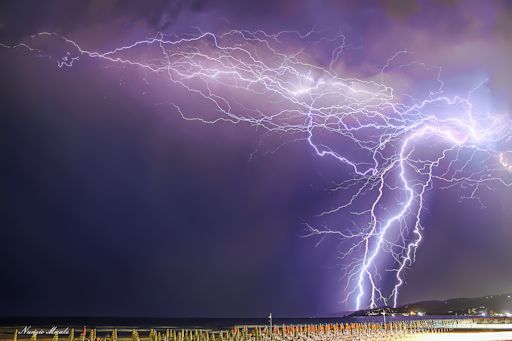
"The sky erupted," says photographer Nunzio Micale, who took this picture on June 6th from Vieste(FG), ITALY. "I opened the shutter for 30 seconds and the heavens were filled with electricity."
The blue color of the bolts in Micale's picture is not a digital accent; it's an authentic sign of incredible heat. Electric currents in lightning can heat the air to 30,000o C or more, far hotter than the 5,500o C surface of the sun. The high temperature of the lightning's plasma (ionized air) gives it the same blue color as a massive newborn O-type star. That's hot.
Realtime Noctilucent Cloud Photo Gallery
HYPERBOLIC COMET JOHNSON: Comet Johnson (C/2015 V2) has just entered the galaxy-rich constellation Virgo, and it is passing by a spectacular array of star systems. Amateur astronomer Rolando Ligustri used a remotely controlled telescope in New Mexico to photograph the flyby on June 18th:
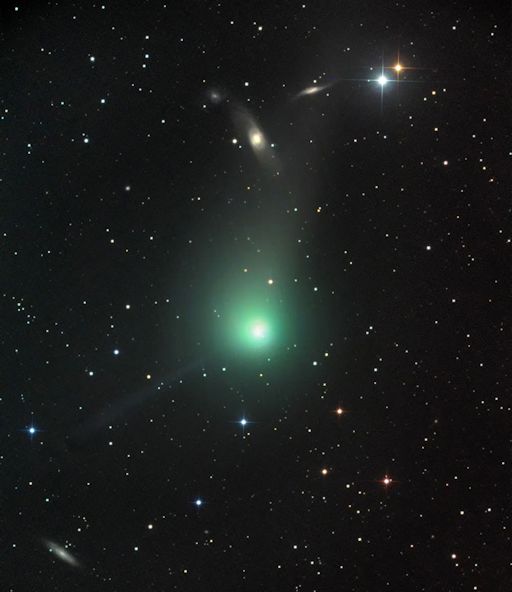
"Comet Johnson is close to many galaxies!" he says. And it will probably pass by many more in the weeks ahead as the comet continues its journey past the Virgo Cluster.
This beautiful comet made its closest approach to the sun (1.6 AU) just a few days ago--an encounter that set the stage for its departure. Comet Johnson is on a hyperbolic orbit, which means the sun's gravity is flinging the the comet into deep space. After this visit to the inner solar system, it will probably disappear forever.
Now is the time to look. The comet is about as bright as an 8th magnitude star--invisible to the naked eye, but an easy target for backyard telescopes. On June 22nd, Comet Johnson will cross the celestial equator heading south, giving astronomers in Australia, New Zealand, South Africa and South America a front row seat as the comet recedes into interstellar space. Resources: 3D orbit, ephemeris, magnitudes.
Far Out Gifts: Earth to Sky Store
All proceeds support hands-on STEM education