CO-ROTATING INTERACTION REGION: NOAA forecasters say that a co-rotating interaction region (CIR) might brush against Earth's magnetic field on June 22nd or 23rd. CIRs are transition zones between slow- and fast-moving streams of solar wind. They contain enhanced magnetic fields and plasma density gradients that sometimes spark geomagnetic storms when they reach Earth. Chance of storms this week: 20%. Free: Space Weather Alerts
6 MONTHS IN A BEER CAN: Northern summer has arrived, and to Jan Koeman of the Netherlands this means one thing: It's time to open a can of beer. Koeman is an astronomer at the Philippus Lansbergen Observatory. Every year in December he empties a can of beer and refills it with photo paper. A pin hole punched in the side turns the contraption into a camera. Yesterday, after six months in the field, he opened the can, and this is what it revealed:


"This shows the movement of the sun with 1 single shot of 6 months exposure time," explains Koeman. The lowest arcs were traced by the winter sun of Dec. 2016. The highest arc was made by the sun on the eve of the 2017 summer solstice. Occasional gaps are caused by clouds.
Such cameras are called solargraphs. They're usually made of cylindrical cans, but not always. Olivér Nagy of Budapest, Hungary, decided to try something different:

"I have cut out a football shape from light sensitive paper, glued it together, and created a spherical solargraphy image," he explains. "I had to wait 6 months to see if it would work."
Indeed it did work, proving that 6 months can be fit not only in a beer can, but also in a football. More ideas for solargraphs may be found at these URLs: #1, #2, #3
Realtime Space Weather Photo Gallery
RAINBOW BREATHING WHALES: "Rainbow breathing whale" sounds like a mythical creature. On June 18th, Mila Zinkova of San Francisco saw one ... for real. "Humpback whales are back in San Francisco Bay, and they are breathing out rainbows."

This is not mythology. It's physics. When Zinkova took the picture, the sun was behind her back shining down into the droplet-filled exhaust of the whale's spout. Sunbeams reflecting from the water droplets produced a prismatic spray of color just like an ordinary rainbow.
Of course it didn't look ordinary. "The full video," says Zinkova, "may be found here. At 2:10 into the video there are anchovies jumping out of the water, escaping a feeding whale."
Realtime Space Weather Photo Gallery
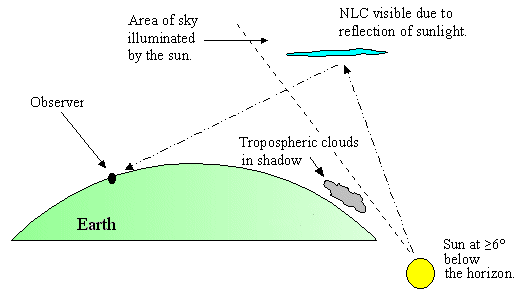
NOCTILUCENT CLOUDS: Think of them as frosted meteoroids. Noctilucent clouds (NLCs) form when summertime wisps of water vapor rise to the top of Earth's atmosphere and wrap themselves around specks of meteor smoke. The resulting crystals of ice glow silvery-blue in the night sky. Karoly Jonas witnessed this apparition of NLCs just before sunrise on June 21st in Budapest, Hungary:

"The crescent Moon and Venus were there as well," says Jonas. "They were completely surrounded by noctilucent clouds."
When noctilucent clouds first appeared in the 19th century, you had to travel to Arctic latitudes to see them. In recent years, however, they have intensified and spread with sightings as far south as Colorado and Kansas--a development that might be related to climate change. Observing tips: Look west 30 to 60 minutes after sunset when the sun has dipped ~10 degrees below the horizon. If you see luminous blue-white tendrils spreading across the sky, you may have spotted a noctilucent cloud.
Realtime Noctilucent Cloud Photo Gallery
Far Out Gifts: Earth to Sky Store
All proceeds support hands-on STEM education