SLIGHT CHANCE OF STORMS TODAY: NOAA forecasters say that a co-rotating interaction region (CIR) might brush against Earth's magnetic field on June 23rd. CIRs are transition zones between slow- and fast-moving streams of solar wind. They contain enhanced magnetic fields and plasma density gradients that sometimes spark geomagnetic storms when they reach Earth. Chance of storms today: 20%. Free: Space Weather Alerts
JELLYFISH SPRITES OVER EUROPE: On June 20th, a thunderstorm in Austria unleashed a spectacular display of lightning. Observers on the ground witnessed blinding flashes of crackling light. The most amazing aspect of the outburst, however, was to be found high above the clouds. 80 km high, to be exact, in the realm of the sprites:

Martin Popek photographed the display from his private observatory in Nýdek, Czechia, more than 500 km away from the storm. Such distances are ideal for seeing above the tops of towering thunderclouds: diagram.
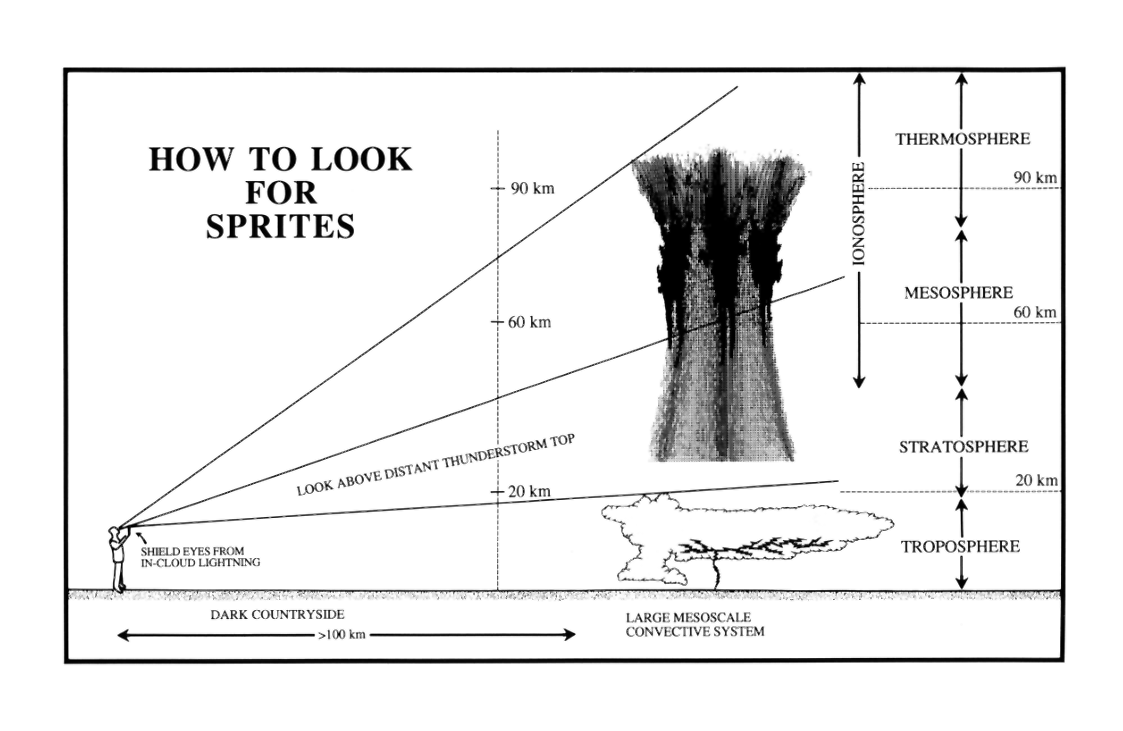
"Jellyfish sprite events like these are produced by very impulsive cloud-to-ground lightning flashes draining positive charge from the stratiform rain region in large thunderstorms," explains lightning scientist Oscar van der Velde of the Technical University of Catalonia, Spain. Somehow, in a process that researchers only partially understand, the resulting electric fields draw jellyfish forms out of the cloudtops.
The tops of the sprites were surrounded by a saucer-like halo of red light, notes van der Velde. "The halo is evidence of intense electric fields at 80-90 km shaking up the electrons (colliding with nitrogen to produce light) for such a short time that sprite streamers cannot form. At lower altitudes the field exists longer, allowing the jellyfish sprite streamers to grow from electron avalanches."
Although sprites have been seen for at least a century, most scientists did not believe they existed until after 1989 when sprites were photographed by cameras onboard the space shuttle. Now "sprite chasers" routinely photograph sprites from their own homes. "I used up a Watec 910HX security camera with UFOCapture software to catch my sprites," says Popek. Give it a try!
Realtime Space Weather Photo Gallery
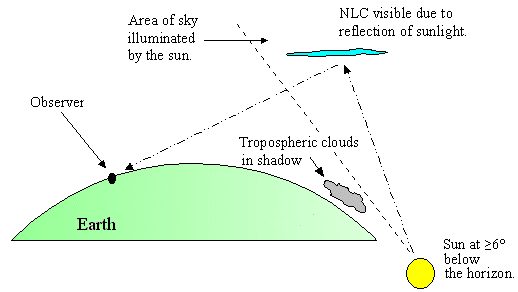
CLOUDS OF FROSTED METEOROIDS: Think of them as frosted meteoroids. Noctilucent clouds (NLCs) form when summertime wisps of water vapor rise to the top of Earth's atmosphere and wrap themselves around specks of meteor smoke. Winds in the mesosphere gather the resulting ice crystals into luminous filaments that glow electric-blue in the night sky ... like these:

Marek Nikodem photographed these NLCs from Szubin, Poland, on the night of the summer solstice. "The clouds were visible all night, from dusk to dawn," he says. "Their structure changed dynamically in the direction of the waves. It was a good start to summer."
When noctilucent clouds first appeared in the 19th century, you had to travel to Arctic latitudes to see them. In recent years, however, they have intensified and spread with sightings as far south as Colorado and Kansas--a development that might be related to climate change. Observing tips: Look west 30 to 60 minutes after sunset when the sun has dipped ~10 degrees below the horizon. If you see luminous blue-white tendrils spreading across the sky, you may have spotted a noctilucent cloud.
Realtime Noctilucent Cloud Photo Gallery
THESE BOW TIES HAVE TOUCHED SPACE: To support their cosmic ray ballooning program, on June 10th the students of Earth to Sky Calculus flew a payload of psychedelic blue space bow ties to the stratosphere, 29 km (91,000 feet) above Earth's surface. You can have one for $79.95:

Each bow tie comes with a unique gift card showing the neckwear floating at the top of Earth's atmosphere. The interior of the card tells the story of the flight and confirms that this gift has been to the edge of space and back again. All proceeds support high-altitude balloon launches and student space weather research.
Far Out Gifts: Earth to Sky Store
All proceeds support hands-on STEM education