DEEP-SKY AURORA WATCH: This weekend, a minor solar wind stream is brushing against Earth, causing just enough magnetic activity for deep-sky auroras. Such auroras are invisible to the human eye, but easily detectable by cameras with nighttime ISO settings and 10+ second exposures. Tonight's New Moon provides ideal darkness for this kind of deep-sky aurora photography. Free: Aurora Alerts
NEW ATMOSPHERIC RADIATION RESULTS: For the past two+ years, Spaceweather.com and the students of Earth to Sky Calculus have been monitoring cosmic rays in the atmosphere above California using high-altitude space weather balloons. After more than 100 flights, they find that dose rates have increased over the Golden State by 13% since March 2015.
Now we know the same thing is happening over New England--only more so.

The Earth to Sky team has flown balloons over Maine and New Hampshire four times since 2015, most recently on June 15, 2017. Although the data are relatively sparse compared to the better-sampled west coast, the results are clear. Radiation in the stratosphere over the northeastern corner of the USA is not only stronger than California, but also intensifying much faster--a 19% increase in New England vs. 13% in California.
What's happening? Generally speaking, cosmic rays are increasing throughout the entire solar system. This is because of the sunspot cycle. The sun is currently plunging toward a deep Solar Minimum. As it descends, the sun's weakening magnetic field and flagging solar wind provides less and less shielding against high-energy particles from deep space. Every planet in the Solar System is getting an extra dose.
The difference we see between California and New England is telling us something local about Earth. After the sun's magnetosphere deflects many cosmic rays, Earth's magnetic field and atmosphere provide another line of defense. Our data show that central California is better defended by geomagnetism than New England.
Cosmic rays penetrate commercial airlines, dosing passengers and flight crews enough that pilots are classified as occupational radiation workers. Some research shows that cosmic rays can seed clouds and trigger lightning, potentially altering weather and climate. Furthermore, there are studies ( #1, #2, #3, #4) linking cosmic rays with cardiac arrhythmias in the general population.
Far Out Gifts: Earth to Sky Store
All proceeds support hands-on STEM education
'TWINNED RAINBOW' SPLITS DOWN THE MIDDLE: "On 17th June, we had some very unsettled weather in Bucharest, Romania, with rain showers in the morning and a big storm in the afternoon," reports local resident Corlaci Nicolae-Adrian. "After the storm passed, a beautiful rainbow appeared, but it was strange..." The rainbow was split down the middle:
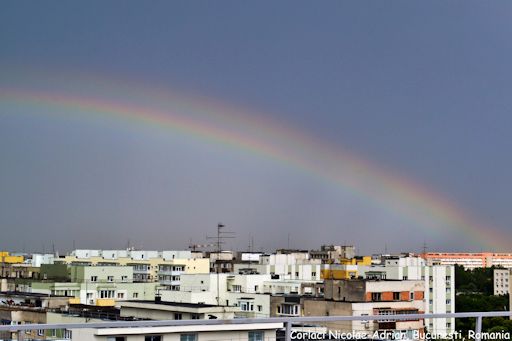
"At first I thought I was seeing supernumerary arcs," says Nicolae-Adrian, "but I soon realized that I had seen something more rare and less understood: a twinned rainbow."
Atmospheric optics expert Les Cowley, who invented the term 'twinned rainbow' about ten years ago, explains: "Sometimes, especially in stormy weather, a rainbow will split into two. It's rare and may last for only a few seconds. We think, but are not sure, that raindrops of different sizes make the twins. The upper bow is from nearly spherical smaller drops. Larger drops, more flattened by air resistance as they fall, make the lower bow. The two kinds of drops might be in separate rainsheets. Support for the 'two drop' proposal is that theory predicts that the outer secondary bow would not split – as in Nicolae-Adrian's picture."

"Another idea, also consistent with an un-split secondary, is that one of the twins is from ice balls, a kind of upmarket hail. Though it's hard to see how they could ever be sufficiently smooth and transparent to make a rainbow. But there are always exceptions; this bow might just be from ice spheres."
Rainbows are a source of wonder with many seldom-seen features. "Look carefully at rainbows," urges Cowley. "Get wet!"
Realtime Space Weather Photo Gallery
Realtime Noctilucent Cloud Photo Gallery