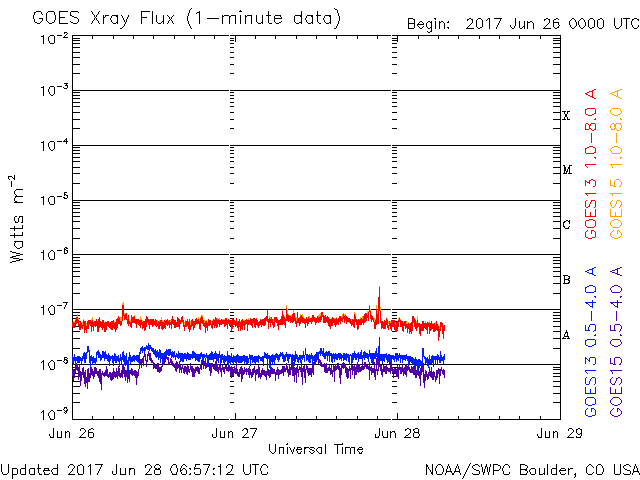
THE SUN IS FLATLINING: Lonely sunspot AR2664 is decaying and no longer poses a threat for even minor explosions. As a result, the sun's X-ray output is low and flatlining. NOAA forecasters say the chance of a strong solar flare on June 28th is no more than 1%. Free: Aurora Alerts
WHERE WILL YOU BE ON AUG. 21, 2017? The Great American Solar Eclipse is less than two months away. Do you know where you will be? The map below shows the path of totality (the narrow zone where the Moon completely covers the sun) overlaid on a statistical map of cloudiness for the month of August. The best places to be are blue:
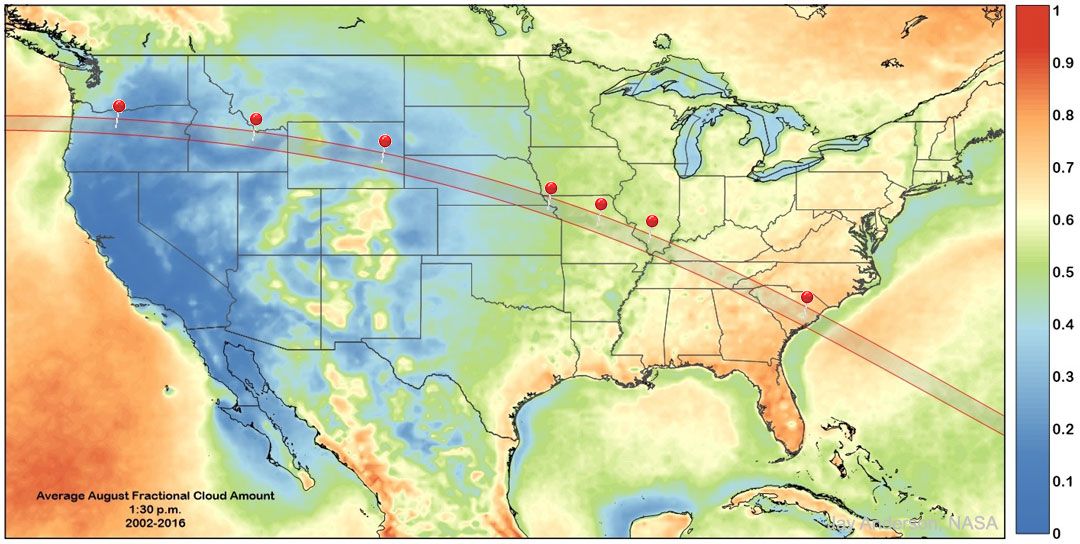
Canadian meteorologist Jay Anderson and colleague Jennifer West made the map based on data from NASA's Terra and Aqua satellites. It shows that people in western states, where fractional cloud cover dips as low as 15%, are most likely to witness the precious two and a half minutes of totality. Overcast is more of a problem east of Missouri. As the Moon's shadow approaches the Atlantic Coast of the USA, there is a better than 50% chance that it will be hitting the tops of clouds instead of the landscape below.
Pushpins in the map show confirmed launch sites for the our Solar Eclipse Balloon Network. Using space weather balloons, teams of student researchers will launch cameras to the stratosphere for a unique view of the eclipse high above any obscuring clouds. There's more to their mission, however, than photography: Each balloon will also be equipped with an array of cosmic ray sensors. By the time the eclipse is finished, we will have gained a snapshot of how deep-space radiation is penetrating Earth's atmosphere across the entirety of North America. Want to join us? Click here.
Realtime Solar Eclipse Photo Gallery
SUNSET RAINBOW: On June 25th, Brad Timerson of Newark NY stepped outside after a brief rain shower and witnessed a remarkably tall--and remarkably red--rainbow. "It was about as big as a rainbow can be," marveled Timerson. "I had to use my iPhone in panorama mode to catch it all."
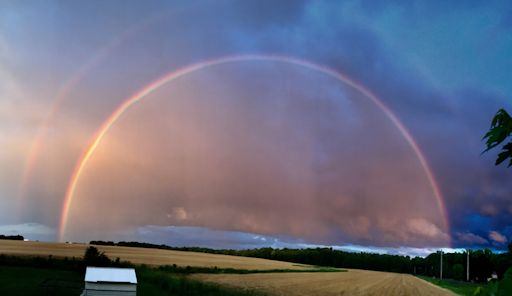
What made this rainbow so tall? And so red? The answer to both questions is the sunset. Atmospheric optics expert Les Cowley explains:
"Sunset rainbows ride high in the sky because their centers are exactly opposite the sun. Like a see-saw, the lower the sun, the higher is the bow. Sunset light making up the 'bow is highly reddened by its long travel through the lower atmosphere where air and dust preferentially scatter away blues and greens."
"Timerson's 'bow shows something more, that rainbows are disks with colored rims," adds Cowley. "When you next see a bow, look for the contrast between the bright sky inside and the dark of Alexanders dark band immediately outside."
Realtime Space Weather Photo Gallery
NEW ATMOSPHERIC RADIATION RESULTS: For the past two+ years, Spaceweather.com and the students of Earth to Sky Calculus have been monitoring cosmic rays in the atmosphere above California using high-altitude space weather balloons. After more than 100 flights, they find that dose rates have increased over the Golden State by 13% since March 2015.
Now we know the same thing is happening over New England--only more so.
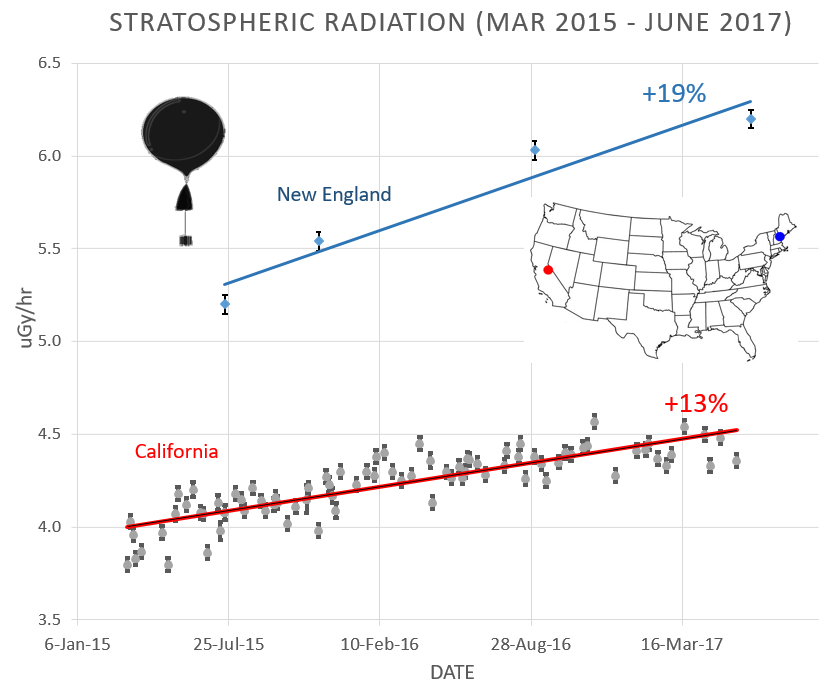
The Earth to Sky team has flown balloons over Maine and New Hampshire four times since 2015, most recently on June 15, 2017. Although the data are relatively sparse compared to the better-sampled west coast, the results are clear. Radiation in the stratosphere over the northeastern corner of the USA is not only stronger than California, but also intensifying much faster--a 19% increase in New England vs. 13% in California.
What's happening? Generally speaking, cosmic rays are increasing throughout the entire solar system. This is because of the sunspot cycle. The sun is currently plunging toward a deep Solar Minimum. As it descends, the sun's weakening magnetic field and flagging solar wind provides less and less shielding against high-energy particles from deep space. Every planet in the Solar System is getting an extra dose.
The difference we see between California and New England is telling us something local about Earth. After the sun's magnetosphere deflects many cosmic rays, Earth's magnetic field and atmosphere provide another line of defense. Our data show that central California is better defended by geomagnetism than New England.
Cosmic rays penetrate commercial airlines, dosing passengers and flight crews enough that pilots are classified as occupational radiation workers. Some research shows that cosmic rays can seed clouds and trigger lightning, potentially altering weather and climate. Furthermore, there are studies ( #1, #2, #3, #4) linking cosmic rays with cardiac arrhythmias in the general population.
Far Out Gifts: Earth to Sky Store
All proceeds support hands-on STEM education