HERE COMES A CME: A coronal mass ejection (CME) left the sun on June 28th and it is expected to reach Earth on July 2nd. NOAA forecasters estimate a 45% chance of G1-class geomagnetic storms when the CME arrives. High latitude sky watchers should be alert for auroras, especially in the southern hemisphere where winter darkness favors visibility. Free: Aurora Alerts

NASA CREATES ARTIFICIAL 'SPACE CLOUDS': After multiple scrubbed launch attempts over the last 30 days, a Terrier-Improved Malemute sounding rocket finally blasted off from NASA's Wallops Flight Facility in Virginia at 4:25 a.m. on June 29th. The resulting display of "space clouds" was worth the wait:

Christopher Becke captured this star-trailed image from Williamsburg, Virginia. "I was 82 miles from the launch site but had no trouble seeing the rocket or the clouds," he says.
During the 8-minute flight, the rocket deployed 10 canisters about the size of soft drink cans more than 100 miles above Earth's surface. The canisters dispensed barium, strontium and cupric-oxide, which interacted to form blue-green and red vapors visible from New York to North Carolina. According to the space agency, the chemicals "pose[d] no hazard to residents along the mid-Atlantic coast."
"As the canisters fired, the erupting colors were vivid and brilliantly apparent," reports onlooker Susan Milligan of Williamsburg VA. "The photos hardly do them justice."
Such clouds allow scientists on the ground to visually track particle motions at the edge of space, giving them new insights into the dynamics of Earth's ionosphere.
Realtime Space Weather Photo Gallery
WHERE WILL YOU BE ON AUG. 21, 2017? The Great American Solar Eclipse is less than two months away. Do you know where you will be? The map below shows the path of totality (the narrow zone where the Moon completely covers the sun) overlaid on a statistical map of cloudiness for the month of August. The best places to be are blue:

Canadian meteorologist Jay Anderson and colleague Jennifer West made the map based on data from NASA's Terra and Aqua satellites. It shows that people in western states, where fractional cloud cover dips as low as 15%, are most likely to witness the precious two and a half minutes of totality. Overcast is more of a problem east of Missouri. As the Moon's shadow approaches the Atlantic Coast of the USA, there is a better than 50% chance that it will be hitting the tops of clouds instead of the landscape below.
Pushpins in the map show confirmed launch sites for the our Solar Eclipse Balloon Network. Using space weather balloons, teams of student researchers will launch cameras to the stratosphere for a unique view of the eclipse high above any obscuring clouds. There's more to their mission, however, than photography: Each balloon will also be equipped with an array of cosmic ray sensors. By the time the eclipse is finished, we will have gained a snapshot of how deep-space radiation is penetrating Earth's atmosphere across the entirety of North America. Want to join us? Click here.
Realtime Solar Eclipse Photo Gallery
THESE PENDANTS HAVE TOUCHED SPACE: Looking for a far-out gift? On April 15, 2017, the students of Earth to Sky Calculus flew a payload-full of heart-shaped Venus pendants to the stratosphere onboard a high-altitude helium balloon. Here's one floating 111,550 feet above the Sierras of central California:
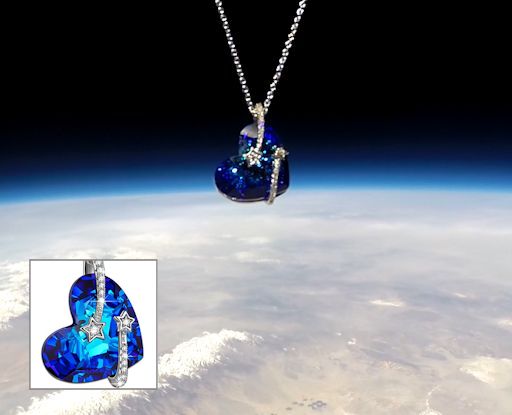
You can have one for $129.95. Each glittering pendant comes with a greeting card showing the jewelry in flight and telling the story of its journey to the stratosphere and back again.
More items from the edge of space may be found in the Earth to Sky Store. All proceeds support atmospheric radiation monitoring and hands-on STEM education.
Far Out Gifts: Earth to Sky Store
All proceeds support hands-on STEM education