SOLAR WIND STREAM APPROACHES EARTH: A high-speed stream of solar wind is approaching Earth. Estimated time of arrival: July 8th or 9th. Minor G1-class geomagnetic storms are possible during the weekend ahead when the solar wind makes first contact with Earth's magnetic field. Bright moonlight will interfere with the visibility of auroras. Free: Aurora Alerts

SUNSPOTS ARE VANISHING: Today, July 5th, the sun is blank--no sunspots. White light images from NASA's Solar Dynamics Observatory show no dark cores anywhere on the solar disk:

This marks the 44th day in 2017 without sunspots. So many blank suns is a clear sign that Solar Minimum is approaching. The last time the solar cycle shifted in this way, ~10 years ago, the sun plunged into the deepest Solar Minimum in a century. Between 2008 and 2009, sunspots were absent almost all the time; cosmic rays from deep space penetrated the solar system in record numbers; and Earth's upper atmosphere collapsed. We are on the verge of this happening again.
Yesterday, July 4th, at a meeting in the UK, researchers led by Prof. Yvonne Elsworth at the University of Birmingham reported that acoustic waves inside the sun shifted frequencies during the previous Solar Minimum (2008-2009), and those frequency shifts have persisted to the present day. "This lends weight to speculation that a fundamental change in the nature of the [sun's magnetic] dynamo may be in progress," they stated in a paper recently published in the Monthly Notices of the Royal Astronomical Society. These findings suggest that another deep Solar Minimum could be in the offing. Stay tuned for more blank suns.
THESE PENDANTS HAVE TOUCHED SPACE: Looking for a far-out gift? On April 15, 2017, the students of Earth to Sky Calculus flew a payload-full of heart-shaped Venus pendants to the stratosphere onboard a high-altitude helium balloon. Here's one floating 111,550 feet above the Sierras of central California:
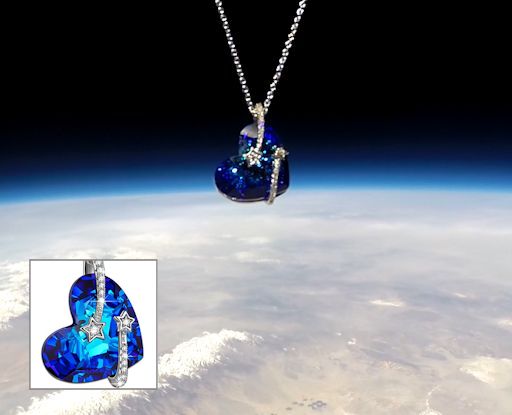
You can have one for $129.95. Each glittering pendant comes with a greeting card showing the jewelry in flight and telling the story of its journey to the stratosphere and back again.
More items from the edge of space may be found in the Earth to Sky Store. All proceeds support atmospheric radiation monitoring and hands-on STEM education.
Far Out Gifts: Earth to Sky Store
All proceeds support hands-on STEM education
NOCTILUCENT CLOUD ACTIVITY: Nightfall is supposed to bring darkness. This week in parts of Europe, nightfall has brought something different: Bright ripples of electric-blue. "Wow, I witnessed an absolutely spectacular display of noctilucent clouds on July 3rd," says Ruslan Merzlyakov, who sends this self-portrait from Nykøbing Mors, Denmark:

""The whole sky was filled with the shining silver, stretching from west to east and even right above my head!" he adds. "The display lasted so long, I had plenty of time to make a video of it."
This and other outbreaks like it are telling us something about the weather in Earth's mesosphere: It's very cold up there. Noctilucent clouds form when summertime wisps of water vapor rise to the top of the atmosphere, coating specks of meteor smoke with fragile crystals of ice. This process requires temperatures as low as 145 K (-128 C). In early June, an unexpected heat wave in the mesosphere temporarily wiped out noctilucent clouds. Their return proves that the heat wave is over.
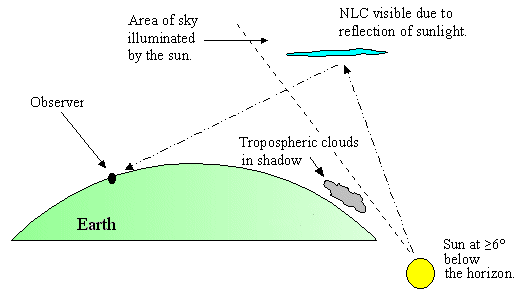
Noctilucent clouds are usually confined to near-Arctic latitudes. In recent years, however, they have been sighted as far south as Utah and Kansas in the United States. The ongoing apparition in Europe could herald such a widespread display in the nights ahead. Observing tips: Look west 30 to 60 minutes after sunset when the sun has dipped ~10 degrees below the horizon. If you see blue-white tendrils spreading across the sky, you may have spotted a noctilucent cloud: diagram.
Realtime Noctilucent Cloud Photo Gallery
NOCTILUCENT RADIO ECHOES: Around the Arctic Circle, you can't see noctilucent clouds. Glare from the midnight sun overwhelms their blue glow. Even though Rob Stammes can't see the clouds from Lofoton, Norway, he knows they are there. They show themselves as squiggles on a chart recorder, the signature of polar summertime mesospheric echoes (PSMEs):

"I detected strong PMSEs on 02-03 July 2017," reports Stammes. "This is related to widespread noctilucent clouds visible south of us in Europe."
PMSEs are terrestrial radio stations reflected from an altitude of 80 km to 90 km. That part of Earth's upper atmosphere is called the "mesosphere." It is, coincidentally, the same place noctilucent clouds are found. The exact cause of PMSEs is not yet known; theorists have proposed explanations ranging from steep electron density gradients and "dressed aerosols" to gravity waves and turbulence. The echoes are often accompanied by visible NLCs.
Stammes operates a VHF radio observatory in northern Norway. "I use my VHF receiving system generally for signals from auroras and meteors," says Stammes, "but occasionally I pick up PSMEs, which sound quite different from aurora echoes and other reflection mechanisms."
Realtime Space Weather Photo Gallery