MINOR GEOMAGNETIC STORMS: A weak shock wave at the leading edge of a solar wind stream hit Earth's magnetic field on July 9th. The impact sparked a period of intermittent G1-class geomagnetic storms, most intense during the hours of 00:00 - 03:00 UT and 09:00 - 12:00 UT. So far no auroras have been reported, probably because they were overwhelmed by the glare of the full Moon. NOAA forecasters estimate a 55% chance of similar storms on July 10th as Earth moves through the solar wind stream. Free: Aurora Alerts

SOLAR FLARE AND RADIO BLACKOUT: Sunspot AR2665 has grown into a behemoth almost as wide as the planet Jupiter: movie. Stretching more than 125,000 km from end to end and containing dozens of dark cores, the active region is an now easy target for backyard solar telescopes. Amateur astronomer Peter Desypris sends this July 9th photo from Syros island, Greece:


"This is the biggest sunspot of 2017 so far," says Desypris. "I photographed it using an 8'inch LX200 telescope and a safe solar filter."
On July 9th at 0318 UT the big sunspot erupted, producing an M1.3-class solar flare. Telescopes onboard NASA's Solar Dynamics Observatory recorded the explosion's extreme ultraviolet flash:

A pulse of UV and X-radiation from the flare ionized the top of Earth's atmosphere. This, in turn, altered the normal propagation of shortwave radio transmissions on the dayside of our planet. A map from NOAA shows the geographical regions affected: mostly Australia and east Asia. People who might have noticed blackouts, fades, and other transmission irregularities include aviators, mariners, and ham radio operators.

Considering its extreme size, AR2665 has been relatively calm so far. Stronger flares and CMEs could be in the offing, however, as the sunspot continues to grow and turns toward Earth. Stay tuned for updates.. Free: Solar Flare Alerts
Realtime Space Weather Photo Gallery
SOLAR ECLIPSE SPACE PENDANTS: Would you like to support our Solar Eclipse Balloon Network? Here's one way: Buy a space pendant. This solar eclipse-themed necklace flew to the stratosphere on July 2, 2017, attached to the payload of an Earth to Sky Calculus space weather balloon:
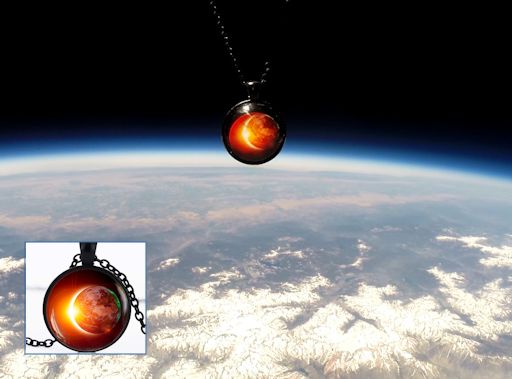
The payload contained more just like it. If you buy one now for $79.95, we will fly it back to the stratosphere during the Great American Solar Eclipse on August 21, 2017, where it will be enveloped by the Moon's cool shadow above our launch site in Oregon. No additional charge! Just make a note in the COMMENTS BOX of the shopping cart: "Please fly my pendant into the eclipse!" Each pendant comes with a greeting card showing the jewelry in flight and telling the story of its journey to the stratosphere and back again.
More items from the edge of space may be found in the Earth to Sky Store. All proceeds support atmospheric radiation monitoring and hands-on STEM education.
Far Out Gifts: Earth to Sky Store
All proceeds support hands-on STEM education
NOCTILUCENT GRAVITY WAVES: Shining electric-blue in the night sky, noctilucent clouds (NLCs) look alien. That's because they are. The clouds are seeded by meteor smoke from outer space. Wisps of summertime water vapor rise from the surface of our planet and wrap themselves around the debris of meteors disintegrating in Earth's upper atmosphere, in turn forming icy NLCs. On July 1st and 4th, photographer Adrien Mauduit in Alberta, Canada, captured a remarkable display:
"In this gorgeous 4K video, you can see the different fine structures that appear in NLCs: Waves, billows, knots, bands, and veritable storms revealed themselves in a manner I will never forget!" says Mauduit. "You might think they look like the waves of the ocean or the bottom of a pool; indeed that's exactly what this wondrous natural spectacle looks like."
In fact, they are gravity waves--that is, waves of pressure and temperature rippling away from powerful thunderstorms in Earth's lower atmosphere. Gravity does not vary inside the waves. They get their name from the fact that gravity acts as a restoring force that tries to restore equilibrium to up-and-down moving air. Gravity waves can propagate all the way from Earth's surface up to the mesosphere, where they imprint themselves on the the forms of noctilucent clouds.
Mauduit's video of these waves is among the best we've ever seen. He is currently monitoring NLCs from the remote town of High Level, Canada, in support of Project PoSSUM--a NASA-funded citizen science project. Participants receive suborbital astronaut training while they study NLCs from the un-pressurized cabin of a high-flying research aircraft. Mauduit's cameras were on the ground supplementing the ones on the plane.
Realtime Noctilucent Cloud Photo Gallery