JUNO UPDATE: NASA's Juno spacecraft swooped over Jupiter's Great Red Spot on July 10th only 9000 km away. No spacecraft has ever been so close, and researchers have no idea what Juno's high-resolution cameras will reveal looking down the eye of the biggest storm in the Solar System. NASA says the first photos will be released on July 14th at this URL. Stay tuned for something fantastic.
BIG SUNSPOT FACES EARTH: Five days after it first appeared, AR2665 has finally rotated into geoeffective position. The huge sunspot is directly facing Earth. Click to view a movie of the sunspot's progression from NASA's Solar Dynamics Observatory:

AR2665 is by far the biggest sunspot of 2017, stretching more than 120,000 km from end to end. Moreover, it has an unstable 'beta-gamma' magnetic field that harbors energy for M-class explosions. Any eruptions today would be squarely Earth-directed.
For the past 24 hours AR2665 has been strangely quiet--a sign of impotence? Or the calm before the storm? Amateur astronomers with solar telescopes are encouraged to monitor developments.
Realtime Space Weather Photo Gallery
RECTANGULAR MOON: When the full Moon rose over Casco Bay in Maine on July 9th, longtime skywatcher John Stetson expected to see the usual lunar disk. Instead, he photographed a strange lunar rectangle. "The rising Moon looked like an iceberg ... faint and shaped like a giant block of ice," he says.

What happened? Atmospheric optics expert Les Cowley explains:
"John says '..the Moon looked like an iceberg.' That's appropriate because this mirage is a result of cold water. The cold sea offshore of Maine cooled the air above it. Above that was warmer air – a temperature inversion and the stuff of mock-mirages. The Moon's rays passing through it bend and twist into several moon images, some upright some inverted. They combine together into the rectangular 'iceberg.'"
Realtime Space Weather Photo Gallery
SOLAR ECLIPSE SPACE PENDANTS: Would you like to support our Solar Eclipse Balloon Network? Here's one way: Buy a space pendant. This solar eclipse-themed necklace flew to the stratosphere on July 2, 2017, attached to the payload of an Earth to Sky Calculus space weather balloon:
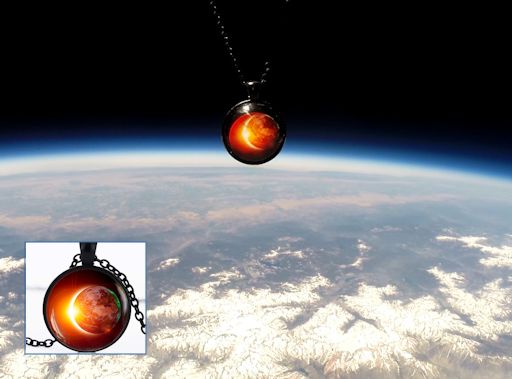
The payload contained more just like it. If you buy one now for $79.95, we will fly it back to the stratosphere during the Great American Solar Eclipse on August 21, 2017, where it will be enveloped by the Moon's cool shadow above our launch site in Oregon. No additional charge! Just make a note in the COMMENTS BOX of the shopping cart: "Please fly my pendant into the eclipse!" Each pendant comes with a greeting card showing the jewelry in flight and telling the story of its journey to the stratosphere and back again.
More items from the edge of space may be found in the Earth to Sky Store. All proceeds support atmospheric radiation monitoring and hands-on STEM education.
Far Out Gifts: Earth to Sky Store
All proceeds support hands-on STEM education
Realtime Noctilucent Cloud Photo Gallery