CHANCE OF FLARES: Big sunspot AR2665 has decayed a little during the past 24 hours. Nevertheless, it still has an unstable magnetic field that poses a threat for moderately strong solar flares. NOAA forecasters say there is a 25% chance of M-class flares on July 12th. Any explosions would be geoeffective as the sunspot is directly facing our planet. Free: Solar Flare Alerts
PHOTOGENIC SUNSPOT: Bruno Boni de Oliveira of Manhattan, New York, has an unusual hobby. "For months I've been observing airplanes flying through the sun on their way to Newark airport," he explains. "However, I've never been successful in capturing the perfect shot because the sun is usually too bright for a proper exposure." That is, until yesterday:

"On July 11th, summer haze and NYC pollution allowed me properly expose the sun at a good angle for the busy air traffic route, just a few minutes before the sunset," says Boni de Oliveira. "As I focused, surprise: There was a sunspot! I quickly checked Spaceweather.com to find out it was the huge AR2665."
The size of AR2665 (it stretches more than 100,000 km from end to end) makes it an unusually photogenic sunspot. Photographers around the world have been catching it in all kinds of optics--sometimes on purpose, sometimes not. Browse the photo gallery for snapshots.
Realtime Space Weather Photo Gallery
A GIGANTIC JET OVER CHINA: Think of them as sprites on steroids: Gigantic Jets are lightning-like discharges that spring from the tops of thunderstorms, reaching all the way to the ionosphere some 80 km overhead. They're enormous and powerful. On July 4th, an all-sky camera in the Guangdong Meteor Observation Network detected this specimen over southern China:

"We have detected sprites before, but never a Gigantic Jet. It was fantastic," says Lyrics Shum, an astronomer who works with the Network. "According to our calculations, it stretched from an altitude of 15 km at the bottom to more than 87 km on top, and it lasted 0.32 seconds." The instigating storm was located offshore over the South China Sea.
"Gigantic Jets are much more rare than sprites," says Oscar van der Velde, a member of the Lightning Research Group at the Universitat Politècnica de Catalunya. "While sprites were discovered in 1989 and have since been photographed by the thousands, it was not until 2001-2002 that Gigantic Jets were first recorded from Puerto Rico and Taiwan." Only a few dozen Gigantic Jets have ever been seen, mostly over open ocean.
Amateur astronomers, you can contribute to Gigantic Jet research. Check your local weather radar map for storms just over the horizon, point your meteor cameras in that direction, and click. Gigantic Jets might not be as rare as we think.

Realtime Space Weather Photo Gallery
SOLAR ECLIPSE SPACE PENDANTS: Would you like to support our Solar Eclipse Balloon Network? Here's one way: Buy a space pendant. This solar eclipse-themed necklace flew to the stratosphere on July 2, 2017, attached to the payload of an Earth to Sky Calculus space weather balloon:
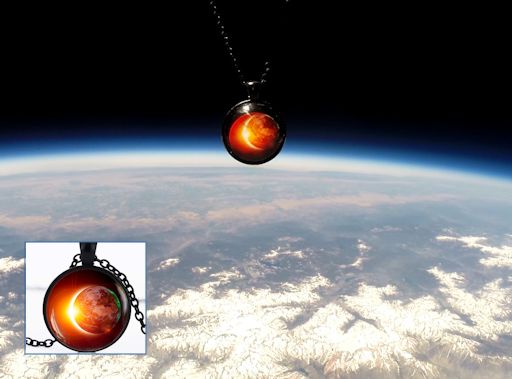
The payload contained more just like it. If you buy one now for $79.95, we will fly it back to the stratosphere during the Great American Solar Eclipse on August 21, 2017, where it will be enveloped by the Moon's cool shadow above our launch site in Oregon. No additional charge! Just make a note in the COMMENTS BOX of the shopping cart: "Please fly my pendant into the eclipse!" Each pendant comes with a greeting card showing the jewelry in flight and telling the story of its journey to the stratosphere and back again.
More items from the edge of space may be found in the Earth to Sky Store. All proceeds support atmospheric radiation monitoring and hands-on STEM education.
Far Out Gifts: Earth to Sky Store
All proceeds support hands-on STEM education
Realtime Noctilucent Cloud Photo Gallery