ALMOST-CERTAIN GEOMAGNETIC STORMS: NOAA forecasters say there is a 75% chance of geomagnetic storms on July 16th when a CME is expected to hit Earth's magnetic field. Moderately strong G2-class storms on July 16th could intensify to strong G3-class storms on July 17th as Earth passes through the CME's magnetized wake. High latitude sky watchers should be alert for auroras in the nights ahead. Free: Aurora Alerts


DEPARTING SUNSPOT: Big sunspot AR2665 is rotating toward the sun's western limb, turning away from Earth. "It is putting on quite a show as it departs," says Mike Taormina, who sends this picture from Malta, New York:

AR2665 still poses a threat for solar flares and CMEs, but future eruptions won't likely be Earth directed. Nevertheless, this sunspot will still affect our planet in the days ahead. A CME it hurled toward us two days ago is due to arrive on July 16th, sparking high-latitude auroras and moderately-strong geomagnetic storms. Free: Aurora Alerts
Realtime Space Weather Photo Gallery
SOLAR ECLIPSE SPACE PENDANTS: Would you like to support our Solar Eclipse Balloon Network? Here's one way: Buy a space pendant. This solar eclipse-themed necklace flew to the stratosphere on July 2, 2017, attached to the payload of an Earth to Sky Calculus space weather balloon:
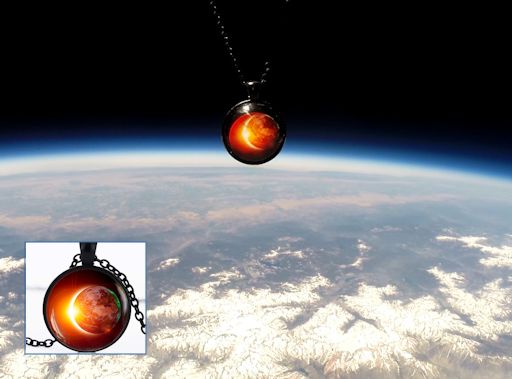
The payload contained more just like it. If you buy one now for $79.95, we will fly it back to the stratosphere during the Great American Solar Eclipse on August 21, 2017, where it will be enveloped by the Moon's cool shadow above our launch site in Oregon. No additional charge! Just make a note in the COMMENTS BOX of the shopping cart: "Please fly my pendant into the eclipse!" Each pendant comes with a greeting card showing the jewelry in flight and telling the story of its journey to the stratosphere and back again.
More items from the edge of space may be found in the Earth to Sky Store. All proceeds support atmospheric radiation monitoring and hands-on STEM education.
Far Out Gifts: Earth to Sky Store
All proceeds support hands-on STEM education
STRONG SOLAR FLARE AND CME: After days of suspenseful quiet, huge sunspot AR2665 finally erupted on July 14th (0209 UT), producing a powerful and long-lasting M2-class solar flare. Extreme ultraviolet telescopes onboard NASA's Solar Dynamics Observatory recorded the blast:

Remarkably, the explosion persisted for more than two hours, producing a sustained fusillade of X-rays and energetic protons that ionized the upper layers of Earth's atmosphere. Shortwave radio blackouts were subsequently observed over the Pacific Ocean and especially around the Arctic Circle. This map from NOAA shows the affected geographic regions.

Of even greater interest is the coronal mass ejection (CME). The explosion hurled a bright CME away from the blast site, and it appears to be heading for Earth:

This expanding cloud will likely reach our planet on July 16th, possibly sparking geomagnetic storms and high-latitude auroras when it arrives. Free: Aurora Alerts