BLANK SUN: Giant sunspot AR2665 has rotated onto the far side of the sun. It is gone, leaving behind ... nothing. The face of the sun is blank. With the sunspot number back at zero, the sun's march toward Solar Minimum has resumed. Free: Solar Flare Alerts
CME SWEEPS ASIDE COSMIC RAYS: On July 16th, a CME hit Earth's magnetic field, sparking two days of geomagnetic storms and beautiful southern auroras. The solar storm cloud also swept aside some of the cosmic rays currently surrounding Earth. Spaceweather.com and the students of Earth to Sky Calculus launched a space weather balloon to the stratosphere hours after the CME arrived. We detected a 7% decrease in X-rays and gamma-rays (two tracers of secondary cosmic rays). Neutron monitors in the Arctic and Antarctic recorded similar decrements. For instance, these data from the Bartol Research Institute show a nearly 8% drop in cosmic ray neutrons reaching the South Pole:


This is called a "Forbush Decrease," named after physicist Scott E. Forbush who first described it in the 20th century. Wherever CMEs go, cosmic rays are deflected by magnetic fields inside the solar storm clouds. As a result, when solar activity is high, cosmic radiation around Earth is relatively low--a yin-yang relationship that holds throughout all phases of the solar cycle.
Lately, cosmic rays around Earth have been intensifying as the solar cycle plunges toward minimum. The CME of July 16th reversed that trend--but only for a few days. Solar activity has returned to low levels and cosmic rays are on the rise again. Stay tuned for more radiation from deep space.
Realtime Space Weather Photo Gallery
NORTHERN CORONAL HOLE: A hole in the sun's atmosphere has opened up and it is spewing solar wind into space. NASA's Solar Dynamics Observatory is monitoring the structure, which sprawls across nearly half of the sun's northern hemisphere:

This is a coronal hole (CH), a region where the sun's magnetic field peels back and allows solar wind to escape. A stream of solar wind flowing from this hole is expected to reach Earth on July 21st, bringing a 40% chance of geomagnetic activity. High-latitude sky watchers should be alert for auroras when the solar wind arrives. Free: Aurora Alerts
SOLAR ECLIPSE SPACE PENDANTS: Would you like to support our Solar Eclipse Balloon Network? Here's one way: Buy a space pendant. This solar eclipse-themed necklace flew to the stratosphere on July 2, 2017, attached to the payload of an Earth to Sky Calculus space weather balloon:
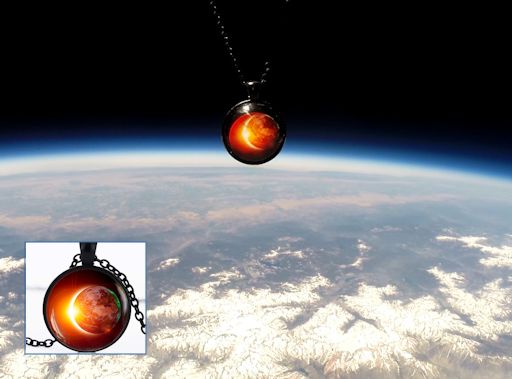
The payload contained more just like it. If you buy one now for $79.95, we will fly it back to the stratosphere during the Great American Solar Eclipse on August 21, 2017, where it will be enveloped by the Moon's cool shadow above our launch site in Oregon. No additional charge! Just make a note in the COMMENTS BOX of the shopping cart: "Please fly my pendant into the eclipse!" Each pendant comes with a greeting card showing the jewelry in flight and telling the story of its journey to the stratosphere and back again.
More items from the edge of space may be found in the Earth to Sky Store. All proceeds support atmospheric radiation monitoring and hands-on STEM education.
Far Out Gifts: Earth to Sky Store
All proceeds support hands-on STEM education