SLIGHT CHANCE OF STORMS: For the 4th day in a row, Earth is inside a stream of solar wind flowing from a large hole in the sun's atmosphere. The steady pressure of this stream is doing little, however, to disturb our planet's magnetic field. NOAA forecasters say the chance of a geomagnetic storm on July 24th is only 15%. Free: Aurora Alerts

MASSIVE EXPLOSION ON THE FARSIDE OF THE SUN: On Sunday July 23rd, a spectacular CME emerged from the farside of the sun. Coronagraphs onboard the orbiting Solar and Heliospheric Observatory (SOHO) tracked the fast-moving cloud as it billowed into space:

NASA's STEREO-A spacecraft, which has a partial view of the sun's farside, identified the source of the blast as active sunspot AR2665, familiar to readers of Spaceweather.com who watched the behemoth cross the Earthside of the sun earlier this month. STEREO-A observed an intense flash of extreme UV radiation from the sunspot's magnetic canopy:

The intensity of the flash suggests (but does not prove) that the underlying flare might have been the most intense kind: X-class.
If this explosion had occurred 2 weeks ago when the huge sunspot was facing Earth, we would be predicting strong geomagnetic storms in the days ahead. Instead, the CME is racing away from our planet ... and directly toward Mars. Compared to Earth, the Red Planet is currently on the opposite side of the sun, and apparently in the crosshairs of this CME. Mars rovers Curiosity and Opportunity might be observing the effects of a solar storm later this week.
Coincidentally, yesterday's farside explosion occurred on the 5th anniversary of another significant farside event: The Solar Superstorm of July 23, 2012. That superstorm, which has been compared to the historic Carrington Event of 1859, could have caused widespread power blackouts if it had not missed our planet.
Sunspot AR2665 will be back on the Earthside of the sun a little more than a week from now. If the sunspot remains active, it could bring a new round of geomagnetic storms and auroras to our planet in early August. Stay tuned. Free: Solar Flare Alerts
Realtime Space Weather Photo Gallery
SPRITES AND COSMIC RAYS: Last Friday night, cameras in Czechia recorded a magnificent display of sprites leaping up from a thunderstorm in neighboring Austria. Photographer Martin Popek of Nýdek, Czechia, selected this specimen from many frames he recorded:

"The storm was about 390km away," says Popek, "and the sprite was huge. It stretched 50 km to 90 km above the ground below."
Sometimes called "space lightning," sprites are a true space weather phenomenon. They inhabit the upper atmosphere alongside auroras, meteors and noctilucent clouds. Some researchers believe they are linked to cosmic rays: subatomic particles from deep space striking the top of Earth's atmosphere produce secondary electrons that, in turn, could provide the spark that triggers sprites.
The link to cosmic rays is particularly interesting at this time. Despite a brief reduction in cosmic rays last week caused by the sweeping action of a passing CME, cosmic rays are intensifying. For the past two years, space weather balloons have observed a steady increase in deep space radiation penetrating our atmosphere. This increase is largely due to the decline of the solar cycle. Flagging solar wind pressure and weakening sunspot magnetic fields allow more cosmic rays into the inner solar system--a trend which is expected to continue for years to come. These changes could add up to more sprites.
Although sprites have been seen for at least a century, most scientists did not believe they existed until after 1989 when sprites were photographed by cameras onboard the space shuttle. Now "sprite chasers" routinely photograph sprites from their own homes. "I used up a Watec 910HX security camera with UFOCapture software to catch my sprites," says Popek. Give it a try!
SOLAR ECLIPSE SPACE PENDANTS: Would you like to support our Solar Eclipse Balloon Network? Here's one way: Buy a space pendant. This solar eclipse-themed necklace flew to the stratosphere on July 2, 2017, attached to the payload of an Earth to Sky Calculus space weather balloon:
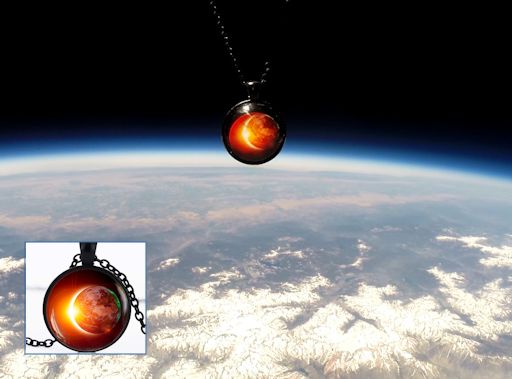
The payload contained more just like it. If you buy one now for $79.95, we will fly it back to the stratosphere during the Great American Solar Eclipse on August 21, 2017, where it will be enveloped by the Moon's cool shadow above our launch site in Oregon. No additional charge! Just make a note in the COMMENTS BOX of the shopping cart: "Please fly my pendant into the eclipse!" Each pendant comes with a greeting card showing the jewelry in flight and telling the story of its journey to the stratosphere and back again.
More items from the edge of space may be found in the Earth to Sky Store. All proceeds support atmospheric radiation monitoring and hands-on STEM education.
Far Out Gifts: Earth to Sky Store
All proceeds support hands-on STEM education
Realtime Noctilucent Cloud Photo Gallery