ANIMATED SOLAR ECLIPSE MAPS: The Great American Solar Eclipse is less than one month away. How much of the sun will be covered over your home town? A great way to find out: Animated eclipse maps created by science-artist Larry Koehn. On his web site, there are individual maps for all 50 US states as well as little-known eclipse zones in Canada and Europe. Check it out!
"WHITE SUNSPOT": Sunspot numbers have dropped to zero this week as dark cores associated with sunspot activity have vanished. Instead of dark spots, the sun has a light spot. NASA's Solar Dynamics Observatory photographed this sprawling "white sunspot" on July 25th:

The correct name of this phenomenon is "faculae." It is a cousin of sunspots.
Regular dark sunspots are magnetic islands on the surface of the sun. Magnetic fields in these areas are typically thousands of times stronger than Earth's magnetic field. Sunspot magnetic fields are so strong, they block the flow of heat from the nuclear furnace below. They appear dark because they are relatively cool compared to their surroundings.
Faculae are also made of magnetic fields. However, the magnetism of faculae is concentrated in much smaller bundles than in sunspots. Instead of blocking heat from below, they essentially form corridors that allow us to see into sun's hot interior, creating an apparent bright spot on the surface of the sun.
These bright structures are more common than you might think. During the peak of a sunspot cycle, faculae actually win out over sunspots and make the sun appear slightly (about 0.1%) brighter at Solar Maximum than at Sunspot Minimum. Free: Solar Flare Alerts
Realtime Space Weather Photo Gallery
AURORA-LIKE GLOW OVER IRAN: On July 23rd, Iranian photographer Omid Ghiasoddin pressed the legs of a camera tripod through the crusty surface of the desert outside the town of Damghan. It was dark, and he set his optics for a long exposure to record the Milky Way bisecting the sky overhead. He recorded that--and something more:

"The sky was corrugated with waves of red and green," says Ghiasoddin. "They looked like auroras, but they were not."
Ghiasoddin's fisheye lens captured a fine display of atmospheric airglow. Airglow is aurora-like phenomenon caused by chemical reactions in the upper atmosphere. People seldom notice the glow, because it is usually very dim, but it can be photographed on almost any clear dark night, anywhere in the world.
Airglow is typically green, the color of light from oxygen atoms some 90 km to 100 km above Earth's surface. However, the display Ghiasoddin recorded is mainly red. The ruddy hue comes from OH. These neutral molecules (not to be confused with the OH- ion found in aqueous solutions) exist in a thin layer 85 km high where gravity waves impress the red glow with a dramatic rippling structure.
Realtime Airglow Photo Gallery
SOLAR ECLIPSE SPACE PENDANTS: Would you like to support our Solar Eclipse Balloon Network? Here's one way: Buy a space pendant. This solar eclipse-themed necklace flew to the stratosphere on July 2, 2017, attached to the payload of an Earth to Sky Calculus space weather balloon:
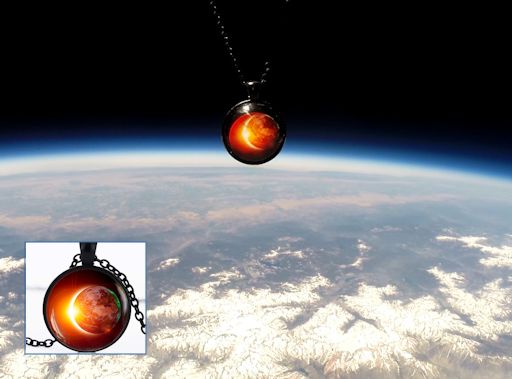
The payload contained more just like it. If you buy one now for $79.95, we will fly it back to the stratosphere during the Great American Solar Eclipse on August 21, 2017, where it will be enveloped by the Moon's cool shadow above our launch site in Oregon. No additional charge! Just make a note in the COMMENTS BOX of the shopping cart: "Please fly my pendant into the eclipse!" Each pendant comes with a greeting card showing the jewelry in flight and telling the story of its journey to the stratosphere and back again.
More items from the edge of space may be found in the Earth to Sky Store. All proceeds support atmospheric radiation monitoring and hands-on STEM education.
Far Out Gifts: Earth to Sky Store
All proceeds support hands-on STEM education
Realtime Noctilucent Cloud Photo Gallery