ANIMATED SOLAR ECLIPSE MAPS: The Great American Solar Eclipse is less than one month away. How much of the sun will be covered over your home town? A great way to find out: Animated eclipse maps created by science-artist Larry Koehn. On his web site, there are individual maps for all 50 US states as well as little-known eclipse zones in Canada and Europe. Check it out!
GIGANTIC JETS OVER HAWAII: Every night, the Gemini cloudcam atop Mauna Kea in Hawaii monitor storms approaching some of the world's largest telescopes. It often captures bright bolts of lightning lancing down to the ground below the towering dormant volcano. On July 24th it captured something lancing up:

"This amazing lightning-like phenomenon is known as a Gigantic Jet," says Frankie Lucena of Puerto Rico, who processed the video. "They are related to sprites, but more powerful and easier to see with the naked eye."
Cloudcam video caught at least three of these jets springing from the tops of a powerful growing thunderstorm. The tallest of them reached all the way to the ionosphere some 80 km overhead.
"Gigantic Jets are much more rare than sprites," says Oscar van der Velde, a member of the Lightning Research Group at the Universitat Politècnica de Catalunya. "While sprites were discovered in 1989 and have since been photographed by the thousands, it was not until 2001-2002 that Gigantic Jets were first recorded from Puerto Rico and Taiwan." Only a few dozen Gigantic Jets have ever been seen, mostly over open ocean.

Sometimes called "space lightning," Gigantic Jets and their cousins the sprites are true space weather phenomena. They inhabit the upper atmosphere alongside auroras, meteors and noctilucent clouds. Some researchers believe they are linked to cosmic rays: subatomic particles from deep space striking the top of Earth's atmosphere produce secondary electrons that could, in turn, provide the spark for these upward bolts.
The link to cosmic rays is particularly interesting at this time. For the past two years, space weather balloons have observed a steady increase in deep space radiation penetrating our atmosphere. This increase is largely due to the decline in the solar cycle. Flagging solar wind pressure and weakening sunspot magnetic fields allow more cosmic rays into the inner solar system--a trend which is expected to continue for for years to come. These changes could add up to more Gigantic Jets in the future. Stay tuned!
SOLAR ECLIPSE SPACE PENDANTS: Would you like to support our Solar Eclipse Balloon Network? Here's one way: Buy a space pendant. This solar eclipse-themed necklace flew to the stratosphere on July 2, 2017, attached to the payload of an Earth to Sky Calculus space weather balloon:
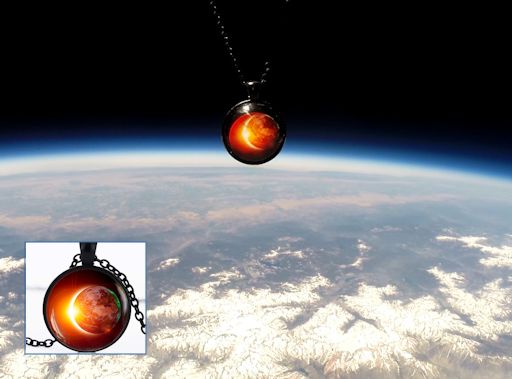
The payload contained more just like it. If you buy one now for $79.95, we will fly it back to the stratosphere during the Great American Solar Eclipse on August 21, 2017, where it will be enveloped by the Moon's cool shadow above our launch site in Oregon. No additional charge! Just make a note in the COMMENTS BOX of the shopping cart: "Please fly my pendant into the eclipse!" Each pendant comes with a greeting card showing the jewelry in flight and telling the story of its journey to the stratosphere and back again.
More items from the edge of space may be found in the Earth to Sky Store. All proceeds support atmospheric radiation monitoring and hands-on STEM education.
Far Out Gifts: Earth to Sky Store
All proceeds support hands-on STEM education
"WHITE SUNSPOT": Sunspot numbers have dropped to zero this week as dark cores associated with sunspot activity have vanished. Instead of dark spots, the sun has a light spot. NASA's Solar Dynamics Observatory photographed this sprawling "white sunspot" on July 25th:

The correct name of this phenomenon is "faculae." It is a cousin of sunspots.
Regular dark sunspots are magnetic islands on the surface of the sun. Magnetic fields in these areas are typically thousands of times stronger than Earth's magnetic field. Sunspot magnetic fields are so strong, they block the flow of heat from the nuclear furnace below. They appear dark because they are relatively cool compared to their surroundings.
Faculae are also made of magnetic fields. However, the magnetism of faculae is concentrated in much smaller bundles than in sunspots. Instead of blocking heat from below, they essentially form corridors that allow us to see into sun's hot interior, creating an apparent bright spot on the surface of the sun.
These bright structures are more common than you might think. During the peak of a sunspot cycle, faculae actually win out over sunspots and make the sun appear slightly (about 0.1%) brighter at Solar Maximum than at Sunspot Minimum. Free: Solar Flare Alerts
Realtime Space Weather Photo Gallery
Realtime Noctilucent Cloud Photo Gallery