HERE COMES THE SOLAR WIND: A high-speed stream of solar wind flowing from a hole in the sun's atmosphere is expected to reach Earth on July 31st. NOAA forecasters estimate a 40% chance of minor geomagnetic storms when the solar wind arrives. High-latitude sky watchers should be alert for auroras, especially in the southern hemisphere where winter darkness favors visibility. Free: Aurora Alerts
METEOR ACTIVITY INCREASES: Meteor activity is increasing as Earth enters an intersection of comet debris streams. Debris stream #1 belongs to an ancient comet that broke apart thousands of years ago (related to modern-day comet 96P/Machholz). It is the source of the annual southern Delta Aquariid (SDA) meteor shower. Last night, a NASA all-sky camera at the Allegheny Observatory near Pittsburgh recorded this SDA fireball streaking over Pennsylvania:

This is 1 of 8 SDA fireballs over the United States detected by NASA cameras on the night of July 30-31--and more are expected in the nights ahead. The southern Delta Aquariid meteor shower typically peaks for an entire week centered on July 30th.
Debris stream #2 is more important: it belongs to behemoth comet 109P/Swift-Tuttle, source of the annual Perseid meteor shower. Although we are only entering the outskirts of this debris stream, early Perseids are already rivaling the southern Delta Aquariids. NASA cameras spotted 6 Perseid fireballs during the night of July 30-31, including this one over the same Pennsylvania observatory:

Perseid counts will climb impressively as we approach the shower's maximum during the nights around August 12th. Contrary to some inaccurate news reports, it won't be the brightest meteor shower in recorded history, but it should be nice, with dozens of Perseids per hour visible in bright moonlight. Stay tuned for shooting stars. Free: Meteor Shower Alerts
SOLAR ECLIPSE VIEWING GLASSES: Get ready for the Great American Solar Eclipse on Aug. 21st! Earth to Sky's safe solar glasses will allow you to view any phase of the upcoming eclipse without fear of damage to your eyes. The Family Pack includes 3 pairs of glasses and costs only $29.95. And there's a bonus. They have all been to the edge of space:
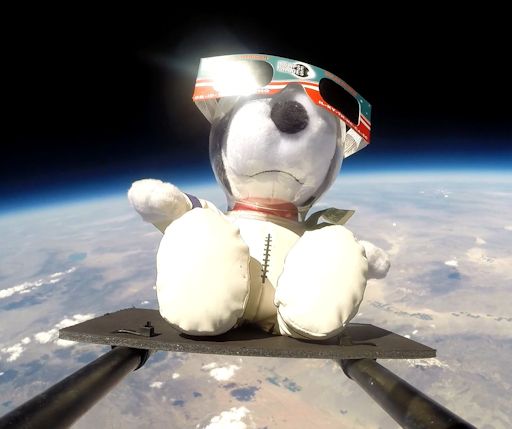
On June 23, 2017, the students of Earth to Sky Calculus flew a payload-full of solar glasses to the stratosphere onboard a high-altitude space weather balloon. The glasses ascended more than 95,000 feet above the Sierra Nevada mountains of central California before parachuting back to Earth.
Each Family Pack of solar eclipse glasses comes with a unique gift card showing the glasses floating at the top of Earth's atmosphere. The interior of the card tells the story of the flight and confirms that these items have been to the edge of space and back again.
More items from the edge of space may be found in the Earth to Sky Store. All proceeds support our Solar Eclipse Balloon Network and hands-on STEM education.
Far Out Gifts: Earth to Sky Store
All proceeds support hands-on STEM education
NOCTILUCENT CLOUDS FROM SPACE: This week, sky watchers near the Arctic Circle have reported nightly displays of bright noctilucent clouds. The silvery ripples of NLCs look amazing from the ground, but they look even better from space. NASA's AIM spacecraft took this picture of the entire Arctic surrounded by an electric-blue glow on July 24th:

Regular readers of Spaceweather.com have been waiting for this image since June. Normally, AIM transmits pictures of NLCs every day, but the regular flow of data was interrupted months ago. The reason has to do with the spacecraft's orbit. Since AIM was launched in 2007, its orbit has been precessing--that is, slowly rotating with respect to the planet below. Eventually, accumulated changes in AIM's orbital elements required a new way of pointing the spacecraft's instruments. Mission controllers have been working on that problem all summer long--and it has finally been solved.
"We are thrilled to be back in business," says Prof. Cora Randall, a member of the AIM science team at the University of Colorado's Department of Atmospheric and Oceanic Sciences. "Our orbit will continue to evolve, but at this point we believe that we know how to control the pointing under the anticipated orbit parameters."
NLCs are, essentially, clouds of frosted meteor smoke. They form when wisps of summertime water vapor rise toward the top of Earth's atmosphere. Water molecules stick to the microscopic debris of disintegrated meteoroids, assembling themselves into tiny crystals of ice that glow beautifully in sunlight at the edge of space.
Thanks to the efforts of the AIM team, you can see these strange clouds not only from Earth, but also from Earth orbit. AIM images are published every day right here on Spaceweather.com.

Realtime Noctilucent Cloud Photo Gallery
Realtime Space Weather Photo Gallery