PERSEID METEOR SHOWER UPDATE: Earth is moving deeper into the debris stream of Comet 109P/Swift-Tuttle, source of the annual Perseid meteor shower. Last night, NASA cameras detected 11 Perseid fireballs over the USA, a rate that will increase sharply in the nights ahead. Forecasters expect the meteor shower to peak on Aug. 11-13 with dozens of Perseids per hour visible in bright moonlight. Sky maps: Aug. 11, 12, 13. Photos: meteor gallery.


GEOMAGNETIC STORM WATCH (G2-CLASS): NOAA forecasters say there is an 80% (not a typo!) chance of polar geomagnetic storms on Aug. 4th when a solar wind stream is expected to envelop Earth's magnetic field. The wind is flowing from a canyon-shaped hole in the sun's atmosphere, shown here in an extreme ultraviolet image from NASA's Solar Dynamics Observatory:

This is a coronal hole (CH), a region where the sun's magnetic field peels back and allows gaseous material to escape. The resulting solar wind is traveling toward us faster than ~600 km/s. Geomagnetic storm levels could reach G2-category (moderately strong) during the late hours of Aug. 4th, subsiding to G1-category (minor) on Aug. 5th. High-latitude sky watchers should be alert for auroras mixed with waxing gibbous moonlight. Free: Aurora Alerts


SOLAR ECLIPSE PENDANTS: Would you like to support our Solar Eclipse Balloon Network? Here's one way: Buy a space pendant. This solar eclipse-themed necklace flew to the stratosphere on July 2, 2017, attached to the payload of an Earth to Sky Calculus space weather balloon:
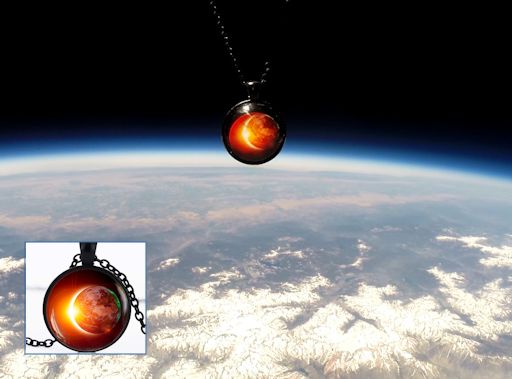
The payload contained more just like it. If you buy one now for $89.95, we will fly it back to the stratosphere during the Great American Solar Eclipse on August 21, 2017, where it will be enveloped by the Moon's cool shadow above our launch site in Oregon. No additional charge! Just make a note in the COMMENTS BOX of the shopping cart: "Please fly my pendant into the eclipse!" Each pendant comes with a greeting card showing the jewelry in flight and telling the story of its journey to the stratosphere and back again.
More items from the edge of space may be found in the Earth to Sky Store. All proceeds support atmospheric radiation monitoring and hands-on STEM education.
Far Out Gifts: Earth to Sky Store
All proceeds support hands-on STEM education
IT'S BACK: Old sunspot AR2665 has returned, and it is a much-decayed version of its former self. NASA's Solar Dynamics Observatory photographed AR2665 emerging over the sun's eastern limb on Aug. 2nd:

The sunspot's primary dark core is only about 1/5th the size of the entire sunspot group in its early-July heyday. In fact, the region's dominant feature now is a sprawl of bright magnetic froth known as "plage." This type of magnetic structure does not typically give rise to flares.
Despite the sunspot's apparent decline, it is notable that only 5 days ago AR2665 produced a significant farside CME. So there may be some explosive potential remaining in the sunspot's magnetic field. Free: Solar Flare Alerts

Note: Per longstanding tradition, sunspots that travel around the backside of the sun receive a new name when they reappear. Old sunspot AR2665 is therefore re-numbered AR2670.
Realtime Space Weather Photo Gallery