SOLAR WIND STORM: As predicted, Earth has entered a stream of solar wind blowing around our planet faster than 700 km/s. First contact with the stream did not produce a geomagnetic storm. Nevertheless, polar geomagnetic storms (G1- and G2-class) remain possible on Aug. 4th and 5th as our planet moves through this region of space. Free: Aurora Alerts


NOCTILUCENT CLOUDS: NASA's AIM satellite is monitoring a luminous ring of electric-blue around Earth's north pole. The glow comes from noctilucent clouds (NLCs). These are, essentially, clouds of frosted meteor smoke floating at the interface between our planet's atmosphere and space. In recent days, cloudy tendrils have reached down into northern Europe, filling the night sky with silvery ripples. Ronny Tertnes sends this picture from Bergen, Norway:


"There were an amazing amount of bright noctilucent clouds just after midnight on August 3rd," says Tertnes. "They appeared high above a dark mass of dissipating storm clouds--a fine contrast."
Indeed, Tertnes picture illustrates the difference between ordinary clouds (low-hanging and dark in the night sky) vs. noctilucent clouds (glowing brightly even at midnight from their rarefied domain more than 80 km above Earth's surface). The former is a denizen of Earth, the latter a relative of space. More of these amazing clouds may be seen in the NLC photo gallery:
Realtime Noctilucent Cloud Photo Gallery
SOLAR ECLIPSE PENDANTS: Would you like to support our Solar Eclipse Balloon Network? Here's one way: Buy a space pendant. This solar eclipse-themed necklace flew to the stratosphere on July 2, 2017, attached to the payload of an Earth to Sky Calculus space weather balloon:
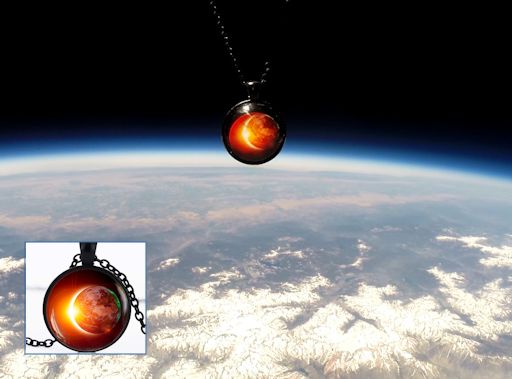
The payload contained more just like it. If you buy one now for $89.95, we will fly it back to the stratosphere during the Great American Solar Eclipse on August 21, 2017, where it will be enveloped by the Moon's cool shadow above our launch site in Oregon. No additional charge! Just make a note in the COMMENTS BOX of the shopping cart: "Please fly my pendant into the eclipse!" Each pendant comes with a greeting card showing the jewelry in flight and telling the story of its journey to the stratosphere and back again.
More items from the edge of space may be found in the Earth to Sky Store. All proceeds support atmospheric radiation monitoring and hands-on STEM education.
Far Out Gifts: Earth to Sky Store
All proceeds support hands-on STEM education
LONELY SUNSPOT: The sun is plunging toward a deep Solar Minimum, and this is making sunspots lonely. Last night in Nîmes, France, Philippe Tosi photographed sunspot AR2670 as the sun set behind the hills of his hometown. It was all by itself:

"Alone on the otherwise blank disk of the sun, sunspot AR2670 was clearly visible in this picture," says Tosi. "It was a lovely sunset."
AR2670 is the corpse of old sunspot AR2665, a former behemoth that sparked geomagnetic storms in mid-July when it first crossed the face of the sun. Even then, the sunspot was all by itself, unattended by other dark cores that typically pepper the sun during more active phases of the solar cycle. If the decay of AR2670 continues apace, it will soon be gone as well, leaving the sun completely blank. Stay tuned for Solar Minimum.
Realtime Space Weather Photo Gallery