SOLAR WIND, SUBSIDING: Earth is exiting a stream of fast-moving solar wind that sparked bright auroras over Canada when it first arrived three days ago. NOAA forecasters say there is a 25% chance of minor geomagnetic storms on Aug. 7th as the solar wind speed drops below 500 km/s. Free: Aurora Alerts

LUNAR ECLIPSE: When the full Moon rose over Europe tonight, it wasn't its usual self. The normally bright lunar disk was dipped in shadow. "It was a partial lunar eclipse," says Sven Melchert, who photographed the event from Stuttgart, Germany:

"On a lazy summer evening, folks met at a viewpoint to wait for the eclipsed moon rising over the treeline,"says Melchert. "I caught it first with 1000 mm focal length, then switched over to 300 mm to better show the full scene."

The Moon grazed the shadow of our planet for nearly two hours, giving sky watchers in Europe, Asia, and Australia a leisurely view of the eclipse. At maximum, about 25% of the full Moon's terrain was darkened. Browse the realtime photo gallery for more views from the eclipse zone:

Realtime Eclipse Photo Gallery
SOLAR ECLIPSE PENDANTS: Would you like to support our Solar Eclipse Balloon Network? Here's one way: Buy a space pendant. This solar eclipse-themed necklace flew to the stratosphere on July 2, 2017, attached to the payload of an Earth to Sky Calculus space weather balloon:
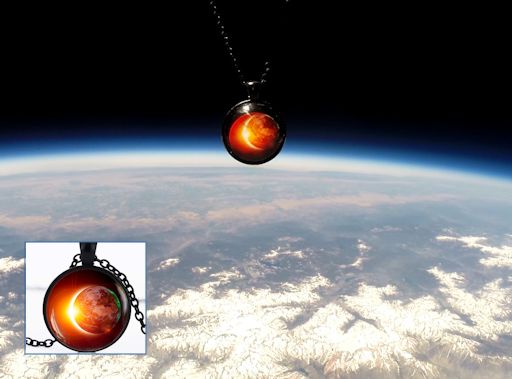
The payload contained more just like it. If you buy one now for $89.95, we will fly it back to the stratosphere during the Great American Solar Eclipse on August 21, 2017, where it will be enveloped by the Moon's cool shadow above our launch site in Oregon. No additional charge! Just make a note in the COMMENTS BOX of the shopping cart: "Please fly my pendant into the eclipse!" Each pendant comes with a greeting card showing the jewelry in flight and telling the story of its journey to the stratosphere and back again.
More items from the edge of space may be found in the Earth to Sky Store. All proceeds support atmospheric radiation monitoring and hands-on STEM education.
Far Out Gifts: Earth to Sky Store
All proceeds support hands-on STEM education
LUNAR FOGBOW: Last night in La Coruna, Spain, Oscar Blanco went outside with a friend to photograph the waxing full Moon. It was a foggy night, and moonbeams were lancing through the fog. He looked up from his camera and saw a ghostly arc above his companion:

"It was a lunar fogbow," he says. "I quickly took its picture using my Sony A7s."
Fogbows are close cousins of rainbows, and they are formed in essentially the same way: light bounces in and out of water droplets to produce a luminous arc. The difference is droplet size. Large raindrops make rainbows. The same type of reflection produces a fogbow, except fog droplets are much smaller. Small droplets don't separate the colors of sunlight as widely as large raindrops do. In a fogbow, therefore, the colors are smeared together, producing a ghostly-white arc.
Realtime Space Weather Photo Gallery