THE NEXT SOLAR WIND STREAM: Earth is exiting one solar wind stream. Another is due to arrive on Aug. 11-12. Solar wind buffeting Earth's magnetic field on those dates could provide a shimmering green backdrop for Perseid meteors at near-Arctic latitudes. Free: Aurora Alerts
LUNAR ECLIPSE: When the full Moon rose over Europe last night, it wasn't its usual self. The normally bright lunar disk was dipped in shadow--a lunar eclipse. Elias Chasiotis photographed the Moon hanging over the ancient Greek temple of Poseidon at Sounion, Greece:

"The temple was open to the public and crowded with people who gathered to enjoy the eclipse," says Chasiotis.
The Moon grazed the shadow of our planet for nearly two hours, giving sky watchers in Europe, Asia, Africa and Australia a leisurely view of the event. At maximum, about 25% of the full Moon's terrain was darkened. Browse the realtime photo gallery for more views from the eclipse zone:

Realtime Eclipse Photo Gallery
PERSEID METEOR SHOWER: The full Moon is bright. So are Perseid fireballs. On Aug. 7th, a NASA meteor camera at the Kitt Peak National Observatory caught this Perseid meteoroid disintegrating over Arizona, easily visible in glaring moonlight:

According to images triangulated from multiple cameras, the meteoroid hit Earth's atmosphere traveling 61 km/s (136,000 mph) and disintegrated 82 km above the ground. This is, interestingly, very close to the altitude where summertime wisps of water vapor crystalize around specks of meteor smoke to form noctilucent clouds.
In recent nights, a growing number of these fireballs have been seen streaking over the USA. NASA cameras counted more than 30 so far this week. This is a sign that our planet is moving deeper into a stream of debris from comet 109P/Swift-Tuttle, source of the annual Perseid meteor shower. Forecasters expect the shower to peak during the nights of Aug. 11-13 with perhaps dozens of meteors per hour streaking through the moonlight. Enjoy the show. Sky maps: Aug. 11, 12, 13.


SOLAR ECLIPSE PENDANTS: Would you like to support our Solar Eclipse Balloon Network? Here's one way: Buy a space pendant. This solar eclipse-themed necklace flew to the stratosphere on July 2, 2017, attached to the payload of an Earth to Sky Calculus space weather balloon:
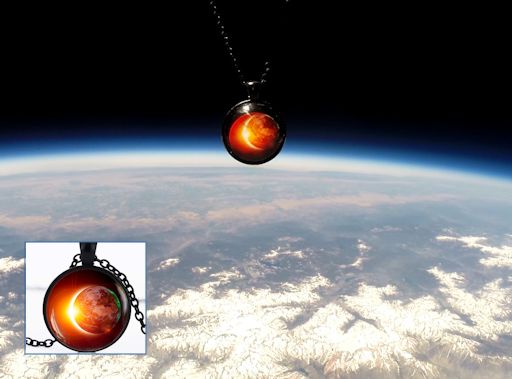
The payload contained more just like it. If you buy one now for $89.95, we will fly it back to the stratosphere during the Great American Solar Eclipse on August 21, 2017, where it will be enveloped by the Moon's cool shadow above our launch site in Oregon. No additional charge! Just make a note in the COMMENTS BOX of the shopping cart: "Please fly my pendant into the eclipse!" Each pendant comes with a greeting card showing the jewelry in flight and telling the story of its journey to the stratosphere and back again.
More items from the edge of space may be found in the Earth to Sky Store. All proceeds support atmospheric radiation monitoring and hands-on STEM education.
Far Out Gifts: Earth to Sky Store
All proceeds support hands-on STEM education
Realtime Space Weather Photo Gallery