CASSINI DIVES TOWARD SATURN: Next month, NASA's Cassini spacecraft will end its 13-year mission to Saturn by plunging into the body of the ringed planet. But first.... Cassini is going to skim the atmosphere of Saturn five times. This will alter the spacecraft's orbit in preparation for its suicide plunge while giving researchers an opportunity for point-blank study of the planet's gases. The first graze occurs on Aug. 14th. Get the full story from JPL.
A HOLE IN THE SUN'S ATMOSPHERE: A hole has opened in the sun's atmosphere and it is turning toward Earth. NASA's Solar Dynamics Observatory is monitoring the structure, which straddles the sun's equator just behind sunspot AR2670:

This is a "coronal hole", a region where the sun's magnetic field has peeled back and allowed gaseous material to escape. A stream of solar wind flowing from this hole should reach our planet during the early hours of August 12th. Enhanced magnetic fields at the leading edge of the stream will interact with our planet's magnetosphere, possibly sparking mild geomagnetic storms.
Coincidentally, the solar wind will arrive during the peak of the Perseid meteor shower. High-latitude sky watchers might detect the green glow of auroras in their photos of disintegrating meteoroids. Free: Aurora Alerts
SOLAR ECLIPSE IN A VEGETABLE STEAMER: During the Great American Solar Eclipse on Aug. 21, 2017, only a narrow slice of the USA will experience totality--the magical moment when the disk of the Moon completely covers the sun. The rest of the country will see a partial eclipse. But wait. How do you actually see it? Believe it or not, you probably already own a partial solar eclipse viewer. Just go into your kitchen and find the vegetable steamer. John Stetson of Maine demonstrates:

"During the eclipse on the 21st, sunbeams projected through holes in the steamer will appear as crescents," says Stetson. "It will be a good day to walk around with your vegetable steamer."
"The Chinese were the first to record the use of pinhole projection to observe eclipses in 500 BCE," he adds. "At the beginning of Western Civilization, Aristotle also wrote about this phenomenon."
Don;t have a vegetable steamer? Colanders work, too! Even a tree will do the trick. Sunbeams lancing through gaps in the leafy canopy form crescent shaped spots on sidewalks and other surfaces. "Here is my son, Charley, standing behind a bush on June 10, 2002 during a partial eclipse," says Stetson. "Crescents may be seen projected onto his shirt."
Realtime Eclipse Photo Gallery
SOLAR ECLIPSE PENDANTS: Would you like to support our Solar Eclipse Balloon Network? Here's one way: Buy a space pendant. This solar eclipse-themed necklace flew to the stratosphere on July 2, 2017, attached to the payload of an Earth to Sky Calculus space weather balloon:
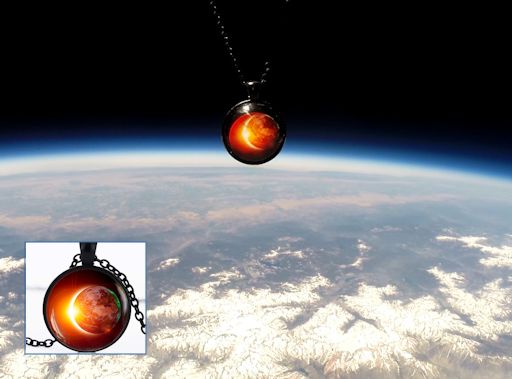
The payload contained more just like it. If you buy one now for $89.95, we will fly it back to the stratosphere during the Great American Solar Eclipse on August 21, 2017, where it will be enveloped by the Moon's cool shadow above our launch site in Oregon. No additional charge! Just make a note in the COMMENTS BOX of the shopping cart: "Please fly my pendant into the eclipse!" Each pendant comes with a greeting card showing the jewelry in flight and telling the story of its journey to the stratosphere and back again.
More items from the edge of space may be found in the Earth to Sky Store. All proceeds support atmospheric radiation monitoring and hands-on STEM education.
Far Out Gifts: Earth to Sky Store
All proceeds support hands-on STEM education
Realtime Space Weather Photo Gallery