AURORAS DURING THE PERSEID METEOR SHOWER? NOAA forecasters say there is a 40% chance of minor geomagnetic storms on Aug. 12th when a solar wind stream is expected to hit Earth's magnetic field. This could provide a shimmering green backdrop for photos of Perseid meteors at high latitudes. The G1-class storm, if it occurs, would happen just as the meteor shower is peaking. Free: Aurora Alerts

PERSEID FIREBALLS THIS WEEKEND: Earth is passing through a stream of debris from huge Comet 109P/Swift-Tuttle, source of the annual Perseid meteor shower. If forecasts are correct, the shower will peak this weekend, and it should be rich in fireballs. A fireball is a very bright meteor, at least as bright as Jupiter or Venus. NASA research shows the Perseid meteor shower produces more fireballs than any other meteor shower. Piotr Majewski photographed this specimen disintegrating over Grodztwo, Poland, exactly one year ago:

"The annual Perseid maximum is about to begin," says Majewski. "We're going to need a lot of fireballs like this one to see the shower in bright moonlight."
Indeed, lunar interference will be a problem. Glare from a waning gibbous Moon will wipe out all but the brightest Perseids during the hours before dawn when the shower is usually most active. Fortunately, Perseids are the 'fireball champions' of annual meteor showers. Here are the data:

Since 2008, the Perseids have produced more fireballs than any other annual meteor shower. The Geminids are a close second, but they are not as bright as the Perseids. For reasons having to do with the speed and composition of their meteoroids, Geminid fireballs are on average about a magnitude fainter than those in the Perseids.
Observing tips: This weekend, keep an eye on the sky between the hours of 10:30 PM to 4:30 AM local time. Before midnight the meteor rate will start out low, then increase as the night wears on, peaking before sunrise when the constellation Perseus is high in the sky. For every bright fireball that streaks out of Perseus, there will be dozens more ordinary meteors struggling to be seen in the moonlight. Place yourself in the moon shadow of a tall building to improve their visibility. Sky maps: Aug. 11, 12, 13.


SOLAR ECLIPSE PENDANTS: Would you like to support our Solar Eclipse Balloon Network? Here's one way: Buy a space pendant. This solar eclipse-themed necklace flew to the stratosphere on July 2, 2017, attached to the payload of an Earth to Sky Calculus space weather balloon:
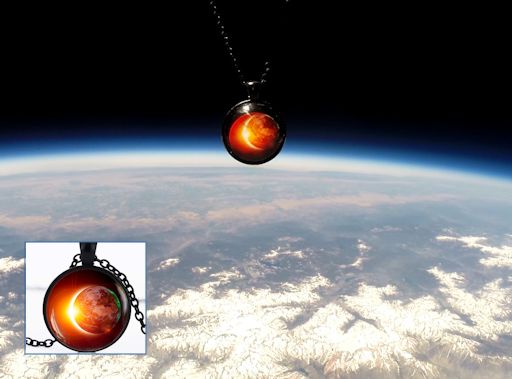
The payload contained more just like it. If you buy one now for $89.95, we will fly it back to the stratosphere during the Great American Solar Eclipse on August 21, 2017, where it will be enveloped by the Moon's cool shadow above our launch site in Oregon. No additional charge! Just make a note in the COMMENTS BOX of the shopping cart: "Please fly my pendant into the eclipse!" Each pendant comes with a greeting card showing the jewelry in flight and telling the story of its journey to the stratosphere and back again.
More items from the edge of space may be found in the Earth to Sky Store. All proceeds support atmospheric radiation monitoring and hands-on STEM education.
Far Out Gifts: Earth to Sky Store
All proceeds support hands-on STEM education
WEIRD WAYS TO OBSERVE THE SOLAR ECLIPSE: During the Great American Solar Eclipse on Aug. 21, 2017, only a narrow slice of the USA will experience totality--the magical moment when the disk of the Moon completely covers the sun. The rest of the country will see a partial eclipse. The sun, still blindingly bright, will turn into a crescent as the Moon passes in front of it off-center. How do you safely observe this phenomenon? Believe it or not, you probably already own a solar eclipse viewer. It's in your kitchen. John Stetson of Maine demonstrates:

"It's a vegetable steamer," explains Stetson. "During the eclipse on the 21st, sunbeams projected through holes in the steamer will appear as crescents."
"The Chinese were the first to record the use of pinhole projection to observe eclipses in 500 BCE," he adds. "At the beginning of Western Civilization, Aristotle also wrote about this phenomenon."
Looking through his kitchen in Brisbane, Australia, Duncan Waldron found something else that works. "Try a water biscuit," he suggests. "With smaller holes, you'll see more detail of the bright crescent Sun."

This proves that you have have your eclipse and eat it, too.
Anything with pinholes or tiny gaps can serve this purpose. Colanders are ideal. Even a tree will do the trick. Sunbeams lancing through gaps in the leafy canopy form crescent shaped spots on sidewalks and other surfaces. "Here is my son, Charley, standing behind a bush on June 10, 2002 during a partial eclipse," says Stetson. "Crescents may be seen projected onto his shirt."
Realtime Space Weather Photo Gallery
Realtime Noctilucent Cloud Photo Gallery