THE SOLAR WIND HAS ARRIVED: As predicted, a stream of high-speed solar wind is blowing around Earth today. The source of the stream is a hole in the sun's atmosphere. So far, the steady pressure of the wind has done little to disturb our planet's magnetic field. NOAA forecasters estimate a 40% chance of geomagnetic storms during the next 24 hours. Free: Aurora Alerts

METEORS VS. THE MOON: The Perseid meteor shower is peaking this weekend as Earth passes through a stream of debris from Comet 109P/Swift-Tuttle. Unfortunately, there's a bright Moon out. Some meteors are being overwhelmed by the glare. Some, but not all. Alan Dyer this sends this image of 19 Perseids he saw last night over a moonlit wheat field near Gleichen, Alberta, Canada:

"The Perseids were battling the Moon last night!" says Dyer. "This is a composite of 19 images: one for the foreground and sky and one meteor, and 18 for other meteors layered in using Lighten mode and masked to reveal just the meteors."
"The radiant point in Perseus is just left of centre. M31 is right of centre; Cassiopeia is above centre," he points out. "As usual, there is one imposter satellite above the radiant looking like a meteor moving in the right direction, but with a uniform trail that gives it away as a satellite."
The shower continues tonight. Observing tips: Keep an eye on the sky between the hours of 10:30 PM to 4:30 AM local time. Before midnight the meteor rate will start out low, then increase as the night wears on, peaking before sunrise when the constellation Perseus is high in the sky. For every bright fireball that streaks out of Perseus, there will be dozens more ordinary meteors struggling to be seen in the moonlight. Place yourself in the moon shadow of a tall building to improve their visibility. Sky maps: Aug. 12, 13.


WEIRD WAYS TO OBSERVE THE ECLIPSE: During the Great American Solar Eclipse on Aug. 21, 2017, most of the USA will experience a partial eclipse. This means the bright surface of the sun will be only partially covered; the crescent shaped-part that sticks out from behind the Moon will be just as bright and blinding as ever. How do you observe such a thing? The answer many be found in your pantry:

"Try a water biscuit," suggests Duncan Waldron of Brisbane, Australia. "Tiny holes in the cracker project very nice images of the crescent sun."
Anything with tiny holes can be used to witness the eclipse. Other kitchen items that work are vegetable steamers and colanders (spaghetti strainers).
Or, just go outside and look at the ground. Beneath any leafy tree, you might be surprised to find hundreds of crescent-shaped sunbeams dappling the grass. Overlapping leaves create a myriad of natural little pinhole cameras, each one casting an image of the crescent-sun onto the ground beneath the canopy.

No trees? Try this trick: Criss-cross your fingers waffle-style and let the sun shine through the matrix of holes. You can cast crescent suns on sidewalks, driveways, friends, cats and dogs—you name it. This opens up a seldom-tapped well of possibilities for hand shadows, like the crescent-eyed turkey shown above.
Realtime Space Weather Photo Gallery
THESE PENDANTS HAVE TOUCHED SPACE: On April 15, 2017, the students of Earth to Sky Calculus flew a payload-full of heart-shaped Venus pendants to the stratosphere onboard a high-altitude helium balloon. Here's one, 111,550 feet above the Sierras of central California:
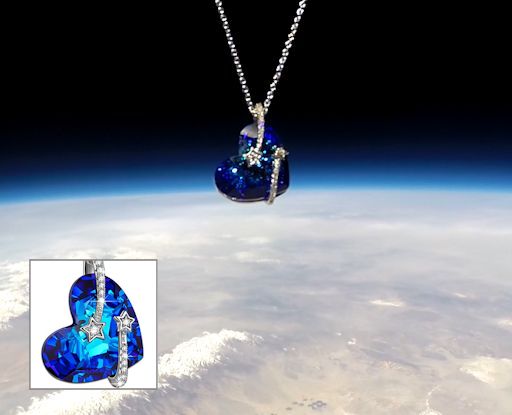
These blue jewels make great birthday and Christmas gifts--and you have have one for $129.95. Each glittering pendant comes with a greeting card showing the jewelry in flight and telling the story of its journey to the stratosphere and back again.
More items from the edge of space may be found in the Earth to Sky Store. All proceeds support our Solar Eclipse Balloon Network and hands-on STEM education.
Far Out Gifts: Earth to Sky Store
All proceeds support hands-on STEM education
Realtime Noctilucent Cloud Photo Gallery