A NEW SUNSPOT EMERGES: Watch this movie. You just witnessed the emergence of new sunspot AR2671 as recorded by extreme ultraviolet telescopes onboard NASA's Solar Dynamics Observatory. The growing sunspot is crackling with C-class solar flares and throwing moon-sized clouds of plasma into space. If the active region continues to develop, it could become a significant source of space weather in the days ahead. Free: Solar Flare Alerts
WHY GO TO THE PATH OF TOTALITY? On Aug. 21, 2017, every square inch of the USA will experience a solar eclipse. In most places, the eclipse will be partial--that is, the Moon will cross the sun off-center leaving a crescent shaped portion of the solar disk exposed. Is it really worth the trip to the path of totality when you can stay home and see the partial eclipse? Pulitzer prize winner Annie Dillard, who witnessed both types of eclipses in 1979, compared them as follows:
"A partial eclipse is very interesting. It bears almost no relation to a total eclipse. Seeing a partial eclipse bears the same relation to seeing a total eclipse as kissing a man does to marrying him, or as flying in an airplane does to falling out of an airplane."
Indeed, during the minutes of totality, the whole world changes. Saying that day turns into night barely scratches the surface of it. The shadow of the Moon lances down to Earth from a quarter million miles away. On one end is you; on the other end is a million square miles of dusty lunar terrain. You're connected, and you can feel the cold.

Image Credit & Copyright: Tunç Tezel (TWAN), Alkim Ün
Darkness inside the path of totality has an alien quality. Because the shadow is only 70 miles wide, you can see daylight at the edges even while you stand in the dark core. This distant scattered light produces a slight reddish glow and unusual shadow effects. Many birds stop singing, daytime flower blossoms begin to close as if for the night, and bees return to their hives.
"What you see in an eclipse is entirely different from what you know," says Dillard, whose brilliant essay "Total Eclipse" is a must-read for anyone deciding whether to stay home ... or have their minds blown.
Realtime Eclipse Photo Gallery
GEOMAGNETIC STORM WATCH: NOAA forecasters say there is a 55% chance of G1-class geomagnetic storms on Aug. 16th increasing to 70% on Aug. 17th as Earth moves into a stream of fast-moving solar wind. The wind is flowing from a large hole in the sun's northern atmosphere:


This is a coronal hole (CH)--a region where the sun's magnetic field peels back and allows solar wind to escape. Solar wind is flowing from this hole as fast as 700 km/s (1.6 million mph). High-latitude sky watchers might see auroras, especially during the hours around local midnight on Aug. 16-17. Free: Aurora Alerts
THESE PENDANTS HAVE TOUCHED SPACE: On April 15, 2017, the students of Earth to Sky Calculus flew a payload-full of heart-shaped Venus pendants to the stratosphere onboard a high-altitude helium balloon. Here's one, 111,550 feet above the Sierras of central California:
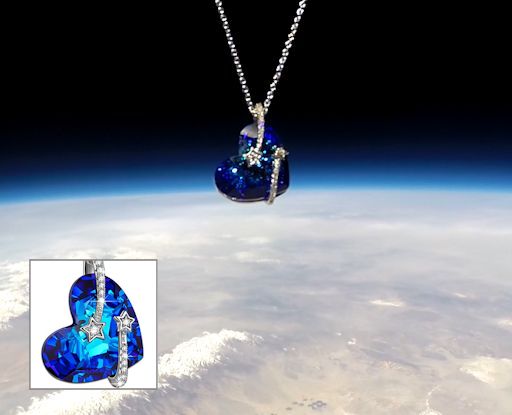
These blue jewels make great birthday and Christmas gifts--and you have have one for $129.95. Each glittering pendant comes with a greeting card showing the jewelry in flight and telling the story of its journey to the stratosphere and back again.
More items from the edge of space may be found in the Earth to Sky Store. All proceeds support our Solar Eclipse Balloon Network and hands-on STEM education.
Far Out Gifts: Earth to Sky Store
All proceeds support hands-on STEM education
Realtime Noctilucent Cloud Photo Gallery