SOLAR WIND SPARKS AURORAS: Minor G1-class geomagnetic storms are underway on Aug. 17th as Earth enters a stream of solar wind flowing from a hole in the sun's atmosphere. First contact with the stream produced this display over Denali National Park in Alaska:


"The lights were mostly faint, but there were occasional moments of bright color and movement," says photographer Jeff Zylland. "These were our first auroras of the approaching fall season."
Auroras have also been sighted in New Zealand and northern-tier US states such as Washington and Montana. NOAA forecasters estimate a 65% chance that these minor storms could continue through August 18th. High-latitude sky watchers should remain alert for auroras. Free: Aurora Alerts
PREDICTING THE ECLIPSE: During a total eclipse, one of the most mesmerizing sights is the sun's ghostly corona. Gossamer streamers of gas in the sun's outer atmosphere suddenly become visible when the disk of the Moon blocks the glaring body of the sun. NASA-supported researchers at Predictive Science Inc. have just issued a computer model showing how the corona should look to the human eye on Aug.21st, the date of the Great American Solar Eclipse:

"The sun's outer atmosphere is not a featureless layer of gas," says Pete Riley, a solar physicist at the company. "It is sculpted into beautiful, dynamic shapes by the sun's magnetic field." Riley and colleagues including Zoran Mikic and Cooper Downs figured out how to calculate and predict those shapes.
"Every day, NASA's Solar Dynamics Observatory measures magnetism at the surface of the sun," explains Mikic, who led the modeling effort. "We take the data and extrapolate it into the atmosphere using a computer running magnetohydrodynamic (MHD) codes."

Magnetic fields in the sun's atmosphere, calculated by the Predictive Science MHD code [more]
The result is a physics-based prediction of what people and cameras could see within the path of totality. "We are eager to find out how well our model results match reality," says Riley. "Ultimately, this may yield new insight into the complex physical processes that heat the solar corona and accelerate the solar wind."
Riley invites readers to return to their web site after the eclipse for a comparison of the predictions with actual observations. "Enjoy the eclipse!" he says.
Realtime Space Weather Photo Gallery
SOLAR ECLIPSE PENDANTS: Would you like to support our Solar Eclipse Balloon Network? Here's one way: Buy a space pendant. This solar eclipse-themed necklace flew to the stratosphere on July 2, 2017, attached to the payload of an Earth to Sky Calculus space weather balloon:
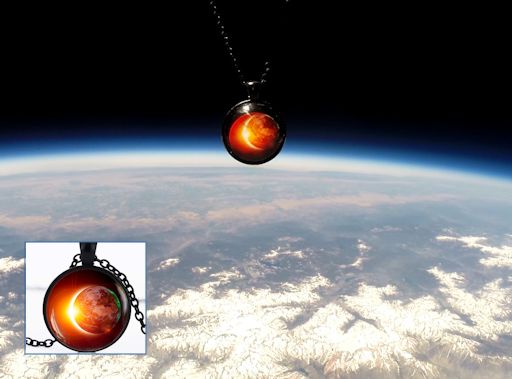
The payload contained more just like it. If you buy one now for $99.95, we will fly it back to the stratosphere during the Great American Solar Eclipse on August 21, 2017, where it will be enveloped by the Moon's cool shadow above our launch site in Oregon. No additional charge! Just make a note in the COMMENTS BOX of the shopping cart: "Please fly my pendant into the eclipse!" Each pendant comes with a greeting card showing the jewelry in flight and telling the story of its journey to the stratosphere and back again.
More items from the edge of space may be found in the Earth to Sky Store. All proceeds support atmospheric radiation monitoring and hands-on STEM education.
Far Out Gifts: Earth to Sky Store
All proceeds support hands-on STEM education
WHY GO TO THE PATH OF TOTALITY? On Aug. 21, 2017, every square inch of the USA will experience a solar eclipse. In most places, the eclipse will be partial--that is, the Moon will cross the sun off-center leaving only a crescent-shaped portion of the solar disk exposed. Is it really worth the trip to the path of totality when you can see most of the sun covered from the comfort of your own home? Pulitzer prize winner Annie Dillard witnessed both types of eclipse in 1979, and her comparison might help you make up your mind:
"A partial eclipse is very interesting. It bears almost no relation to a total eclipse. Seeing a partial eclipse bears the same relation to seeing a total eclipse as kissing a man does to marrying him, or as flying in an airplane does to falling out of an airplane."
During the minutes of totality, the whole world changes. Saying that day turns into night barely scratches the surface of it. The shadow of the Moon lances down to Earth from a quarter million miles away. On one end is you; on the other end is a million square miles of dusty lunar terrain. You're connected, and you can feel the cold.

Image Credit & Copyright: Tunç Tezel (TWAN), Alkim Ün
Darkness inside the path of totality has an alien quality. Because the shadow is only 70 miles wide, you can see daylight at the edges even while you stand in the dark core. This distant scattered light produces a slight reddish glow and unusual shadow effects. Many birds stop singing, daytime flower blossoms begin to close as if for the night, and bees return to their hives.
"What you see in an eclipse is entirely different from what you know," says Dillard, whose brilliant essay "Total Eclipse" is a must-read for anyone deciding whether to stay home ... or have their minds blown.
Realtime Eclipse Photo Gallery