SPACE WEATHER SERVICE ALERT: On Monday, Aug. 21st, during the Great American Solar Eclipse, Spaceweather.com and the students of Earth to Sky Calculus plan to launch as many as a dozen space weather balloons into the Moon's shadow. Floating high above the path of totality, cameras will snap pictures while cosmic ray sensors map radiation levels. Because webmaster Dr. Tony Phillips is leading one of the launch teams, regular updates to Spaceweather.com might not take place on Aug. 20th and 21st. The consolation prize will be unique data and photos, post-eclipse. Sorry for the interruption! Browse: Realtime Eclipse Photo Gallery
AS THE ECLIPSE NEARS, SOLAR ACTIVITY INCREASES: Only a few weeks ago, it seemed that the sun would be quiet and featureless when the Moon eclipsed it on Aug. 21st. Solar Minimum was in full swing. This weekend, however, the sun is welcoming the eclipse with a burst of renewed activity. "As the Moon approaches the sun, our nearest star is extending a friendly hand towards it," says Dave Eagle who sends this picture from Higham Ferrers, England:

"There is a huge prominence on the sun's eastern limb. If you are in the total eclipse path set your clock to greet this awesome spectacle on Monday," he says.
And that's just for starters. In addition, a remarkably-long sunspot group is sprawling across the solar disk. AR2671 stretches 140,000 miles from end to end, almost twice as wide as the planet Jupiter. Bill Hrudey sends this picture of the behemoth from the Cayman Islands:

Amateur astronomers watching the eclipse through safe solar telescopes will have no trouble seeing the rugged edge of the Moon cut across this impressive sunspot, eclipsing one dark core after another. If we're really lucky, the sunspot will explode. AR2671 has a 'beta-gamma' magnetic field that harbors energy for M-class solar flares. Free: Solar Flare Alerts
Realtime Space Weather Photo Gallery
SOLAR ECLIPSE PENDANTS: Would you like to support our Solar Eclipse Balloon Network? Here's one way: Buy a space pendant. This solar eclipse-themed necklace flew to the stratosphere on July 2, 2017, attached to the payload of an Earth to Sky Calculus space weather balloon:
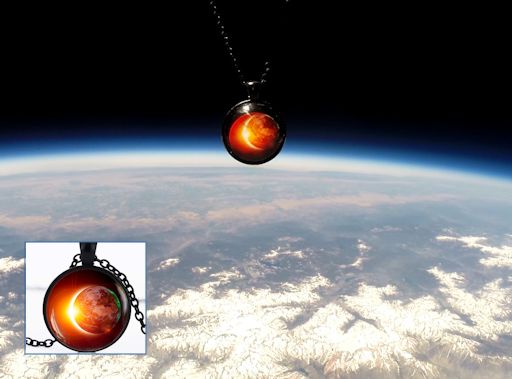
The payload contained more just like it. If you buy one now for $99.95, we will fly it back to the stratosphere during the Great American Solar Eclipse on August 21, 2017, where it will be enveloped by the Moon's cool shadow above our launch site in Oregon. No additional charge! Just make a note in the COMMENTS BOX of the shopping cart: "Please fly my pendant into the eclipse!" Each pendant comes with a greeting card showing the jewelry in flight and telling the story of its journey to the stratosphere and back again.
More items from the edge of space may be found in the Earth to Sky Store. All proceeds support atmospheric radiation monitoring and hands-on STEM education.
Far Out Gifts: Earth to Sky Store
All proceeds support hands-on STEM education
WHY GO TO THE PATH OF TOTALITY? On Aug. 21, 2017, every square inch of the USA will experience a solar eclipse. In most places, the eclipse will be partial--that is, the Moon will cross the sun off-center leaving only a crescent-shaped portion of the solar disk exposed. Is it really worth the trip to the path of totality when you can see most of the sun covered from the comfort of your own home? Pulitzer prize winner Annie Dillard witnessed both types of eclipse in 1979, and her comparison might help you make up your mind:
"A partial eclipse is very interesting. It bears almost no relation to a total eclipse. Seeing a partial eclipse bears the same relation to seeing a total eclipse as kissing a man does to marrying him, or as flying in an airplane does to falling out of an airplane."
During the minutes of totality, the whole world changes. Saying that day turns into night barely scratches the surface of it. The shadow of the Moon lances down to Earth from a quarter million miles away. On one end is you; on the other end is a million square miles of dusty lunar terrain. You're connected, and you can feel the cold.

Image Credit & Copyright: Tunç Tezel (TWAN), Alkim Ün
Darkness inside the path of totality has an alien quality. Because the shadow is only 70 miles wide, you can see daylight at the edges even while you stand in the dark core. This distant scattered light produces a slight reddish glow and unusual shadow effects. Many birds stop singing, daytime flower blossoms begin to close as if for the night, and bees return to their hives.
"What you see in an eclipse is entirely different from what you know," says Dillard, whose brilliant essay "Total Eclipse" is a must-read for anyone deciding whether to stay home ... or have their minds blown.
Realtime Eclipse Photo Gallery