GEOMAGNETIC STORM WATCH (G3-CLASS): A CME hurled toward Earth by sunspot AR2673 on Sept.4th is due to arrive later today. NOAA forecasters say the CME's impact could spark moderately-strong G2-class geomagnetic storms with isolated periods of strong G3-class storming on Sept. 6th and 7th. High-latitude sky watchers should be alert for auroras in bright moonlight. Free: Aurora Alerts


MAJOR X-CLASS SOLAR FLARE: On Sept. 6th at 1202 UT, sunspot AR2673 unleashed a major X9.3-class solar flare--the strongest solar flare in more than a decade. X-rays and UV radiation from the blast ionized the top of Earth's atmosphere, causing a strong shortwave radio blackout over Europe, Africa and the Atlantic Ocean: blackout map.


Above: The extreme UV flash from today's X9-class flare. Credit: Solar Dynamics Observatory
The explosion also produced a CME, shown here in a movie from NASA's STEREO-A spacecraft. (The fast moving star-like object in the STEREO-A movie is the planet Mercury.) NOAA analysts are still modeling the trajectory of the CME to determine whether or not it is Earth-directed.
Many readers are asking about the historic context of this event. How epic is it? Answer: This is a decade-class flare. A list of the most powerful solar flares recorded since 1976 ranks today's flare at #14, tied with a similar explosion in 1990. Compared to the iconic Carrington Event of 1859, or even the more recent Halloween storms of 2003, this event is relatively mild. Modern power grids, telecommunications, and other sun sensitive technologies should weather the storm with little difficulty.
On the other hand, sky watchers could see some fantastic auroras before the week is over. And ham radio operators will surely be noticing strange propagation effects as the sun exerts its influence on our planet's ionosphere.Stay tuned for updates.
Realtime Space Weather Photo Gallery
ONE. BIG. SUNSPOT. The source of today's major flare is huge sunspot AR2673, shown here in a Sept. 5th photo taken by amateur astronomer Philippe Tosi of Nîmes, France:

How big is AR2673? An image of Earth has been inserted for scale. The largest of AR2673's dark cores are as wide as our entire planet, and they are surrounded by dozens of smaller cores as big as continents. Amateur astronomers with safely-filtered solar telescopes will have no trouble seeing this behemoth.
Overarching the complex collection of spots is a tangled magnetic canopy that harbors energy for strong solar flares. NOAA forecasters estimate a 75% chance of M-flares and a 25% chance of X-flares on Sept. 6th. Stay tuned for more explosions... Free: Solar Flare Alerts
ROSE QUARTZ CRYSTAL ECLIPSE PENDANTS: On Aug. 21st during the Great American Solar Eclipse, the students of Earth to Sky Calculus launched 11 space weather balloons from the path of totality. They aimed to photograph the Moon's shadow from the stratosphere--and they succeeded. As a fundraiser, some of the balloons carried jewelry. Here is a rose quartz crystal pendant entering the Moon's shadow more than 90,000 feet above the Malheur National Forest in eastern Oregon:
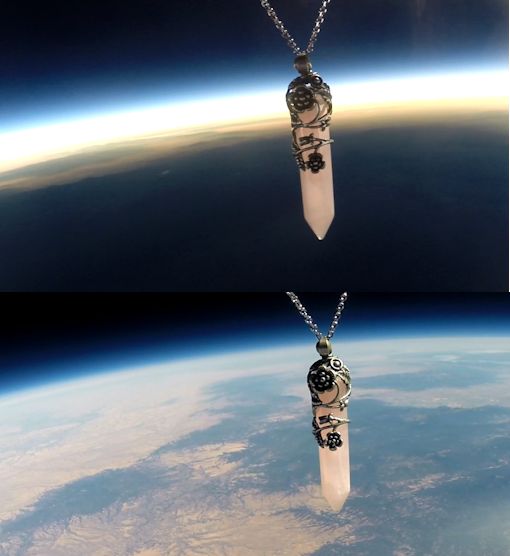
During the 2.5 hour flight, the pendants were wrapped in the Moon's shadow for more than two minutes, experiencing a spooky darkness colder than -50 C.
You can have one for $149.95. Each crystal pendant comes with a unique gift card showing the jewelry passing through the Moon's shadow and floating at the top of Earth's atmosphere. The interior of the card tells the story of the flight and confirms that this gift has been to the edge of space and back again.
Far Out Gifts: Earth to Sky Store
All proceeds support hands-on STEM education