SPACECRAFT CRASHING INTO SATURN: Almost 20 years after it left Earth, NASA's Cassini spacecraft is about to end its mission to Saturn by plunging into the atmosphere of the ringed planet. A new video from NASA recaps the spacecraft's discoveries and previews the incredible photos Cassini might take--just before it turns into a fireball. Impact date: Sept.15th. Stay tuned!
MAJOR SOLAR FLARE AND RADIATION STORM: Departing sunspot AR2673 erupted again on Sept.10th (1606 UT), producing a major X8-class solar flare. Protons accelerated toward Earth by the explosion are swarming around our planet now, causing a moderately strong solar radiation storm. (continued below)

NASA Solar Dynamics Observatory recorded the flare's extreme UV flash
A pulse of ultraviolet and X-radiation from the flare ionized the top of Earth's atmosphere, triggering a shortwave radio blackout over the Americas (blackout map #1). That blackout is now subsiding. However, an even stronger blackout of shortwave radio communications around the poles is still underway (blackout map #2). Stay tuned for updates about this significant event.


Realtime Space Weather Photo Gallery
EXTREME AURORAS OVER ALASKA: During the late hours of Sept. 7th, a CME hit Earth's magnetic field. It was fast-moving debris from a monster X9-class solar flare the day before. By the time night fell in Alaska, a severe (G4-class) geomagnetic storm was in progress. "The auroras blew their top off until the break of dawn on Sept. 8th," says Todd Salat who photographed the display from the Knik River Valley:


"For three hours I could barely keep up with the dynamic 360° show," says Salat. "It was a great Rorschach test of reflective patterns in the Knik River."
During a normal geomagnetic storm, auroras are seen in only one US state: Alaska. This time, however, sky watchers saw them in at least 18: Alaska, Maine, Connecticut, New York, Kentucky, Massachusetts, Illinois, Minnesota, Delaware, Michigan, North Carolina, Ohio, Iowa, Maryland, Virginia, Vermont, South Dakota and, believe it or not, Arkansas. That was a severe storm, indeed. Browse the gallery for many more sightings. Free: Aurora Alerts
GOODBYE SUNSPOT, SEE YOU IN 2 WEEKS: Sunspot AR2673 materialized with shocking speed on Sept. 3rd. Three days later it unleashed the strongest solar flare in more than a decade, an X9.3-class eruption that hurled a CME directly at Earth. Now this memorable sunspot is about to disappear. Maximilian Teodorescu of Magurele, Romania, photographed it approaching the sun's western limb:

"AR2673 is preparing for departure," says Teodorescu. "As it goes towards the limb its shape is distorted like the hot air distorts far away objects during the summer days."
Later today, the sunspot will go around the bend, commencing a 2-week journey across the backside of the sun. Will it still be as potent when it reappears 14 days from now? Stay tuned for updates as the sun turns.
Realtime Space Weather Photo Gallery
ROSE QUARTZ CRYSTAL ECLIPSE PENDANTS: On Aug. 21st during the Great American Solar Eclipse, the students of Earth to Sky Calculus launched 11 space weather balloons from the path of totality. They aimed to photograph the Moon's shadow from the stratosphere--and they succeeded. As a fundraiser, some of the balloons carried jewelry. Here is a rose quartz crystal pendant entering the Moon's shadow more than 90,000 feet above the Malheur National Forest in eastern Oregon:
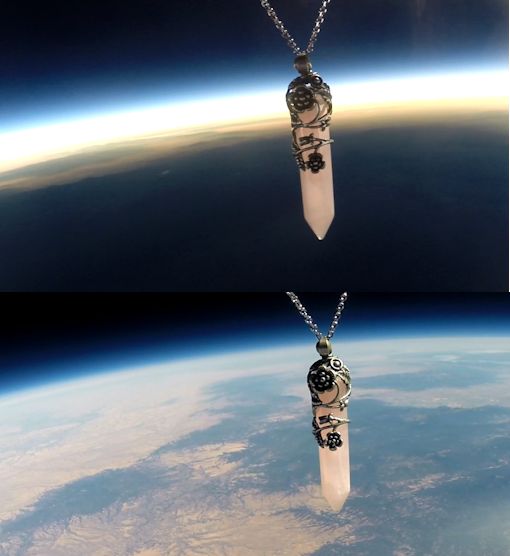
During the 2.5 hour flight, the pendants were wrapped in the Moon's shadow for more than two minutes, experiencing a spooky darkness colder than -50 C.
You can have one for $149.95. Each crystal pendant comes with a unique gift card showing the jewelry passing through the Moon's shadow and floating at the top of Earth's atmosphere. The interior of the card tells the story of the flight and confirms that this gift has been to the edge of space and back again.
Far Out Gifts: Earth to Sky Store
All proceeds support hands-on STEM education