GEOMAGNETIC STORM PREDICTED: NOAA forecasters say there is a 60% chance of moderately strong (G2-class) geomagnetic storms on Sept. 13th. That's when a CME hurled into space by yesterday's powerful X8-class solar flare could deliver a glancing blow to Earth's magnetic field. In the United States, auroras could appear as low as New York to Wisconsin to Washington state. Free: Aurora Alerts

SOLAR RADIATION STORM AND GROUND LEVEL EVENT: On Sept. 10th, departing sunspot AR2673 erupted, producing a powerful X8-class solar flare. The explosion propelled a CME into space and accelerated a swarm of energetic protons toward Earth. Both are visible in this coronagraph movie from the Solar and Heliospheric Observatory (SOHO):

The many specks in this movie are not stars--they are solar protons striking SOHO's digital camera. On Sept. 11th these protons are still streaming past our planet, causing a moderately strong (S2-class) solar radiation storm.

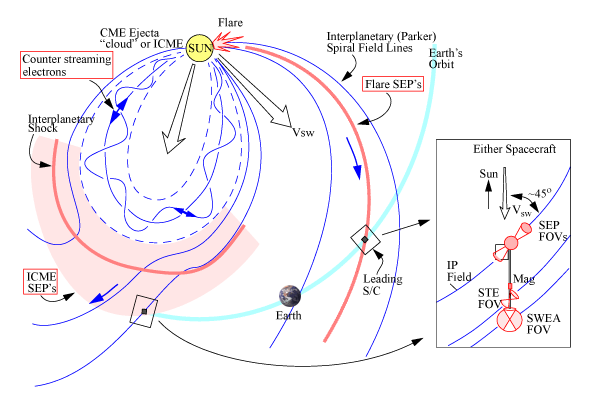
When it exploded on Sept. 10th, sunspot AR2673 was on the sun's western limb. It turns out, this is a special location: The sun's western limb is magnetically well-connected to Earth. Look at this diagram. Magnetic fields spiraling back from the blast site led directly to our planet, funneling these energetic protons Earthward for the ongoing radiation storm.
Normally, solar radiation storms are held at bay by our planet's magnetic field and upper atmosphere. On Sept.10th, however, there was a "ground level event" (GLE). Neutron monitors in the Arctic and Antarctic detected a surge of particles reaching all the way down to Earth's surface. These data, for instance, from the Bartol Research Institute's South Pole Neutron Monitor clearly show the GLE:
 :
"Radiation levels jumped about 6%," reports Clive Dyer, a visiting Professor at the University of Surrey Space Centre. "In historical terms, it was a relatively small one -- only about one thousandth as strong as the event of 23 Feb 1956, which is the largest measured."
Nevertheless, it could have made itself felt at aviation altitudes. Dyer says that "passengers flying on high-latitude routes at 40,000 feet could have absorbed an extra 10 microSieverts of radiation," approximately doubling the usual dose on such a flight.
GLEs are somewhat rare. "Since measurements began around 1942 there have now been 73 events detected by ground level radiation monitors," he adds. "The Sept.10, 2017, event is of interest because it demonstrates the need for continual vigilance even during Solar Minimum."
Realtime Space Weather Photo Gallery
ROSE QUARTZ CRYSTAL ECLIPSE PENDANTS: On Aug. 21st during the Great American Solar Eclipse, the students of Earth to Sky Calculus launched 11 space weather balloons from the path of totality. They aimed to photograph the Moon's shadow from the stratosphere--and they succeeded. As a fundraiser, some of the balloons carried jewelry. Here is a rose quartz crystal pendant entering the Moon's shadow more than 90,000 feet above the Malheur National Forest in eastern Oregon:
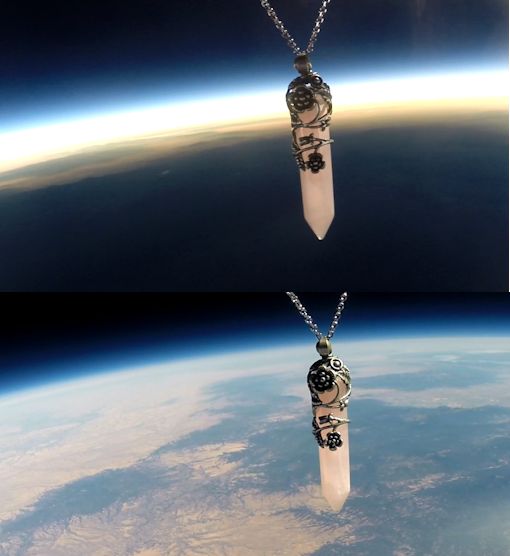
During the 2.5 hour flight, the pendants were wrapped in the Moon's shadow for more than two minutes, experiencing a spooky darkness colder than -50 C.
You can have one for $149.95. Each crystal pendant comes with a unique gift card showing the jewelry passing through the Moon's shadow and floating at the top of Earth's atmosphere. The interior of the card tells the story of the flight and confirms that this gift has been to the edge of space and back again.
Far Out Gifts: Earth to Sky Store
All proceeds support hands-on STEM education
EXTREME AURORAS OVER ALASKA: During the late hours of Sept. 7th, a CME hit Earth's magnetic field. It was fast-moving debris from a monster X9-class solar flare the day before. By the time night fell in Alaska, a severe (G4-class) geomagnetic storm was in progress. "The auroras blew their top off until the break of dawn on Sept. 8th," says Todd Salat who photographed the display from the Knik River Valley:


"For three hours I could barely keep up with the dynamic 360° show," says Salat. "It was a great Rorschach test of reflective patterns in the Knik River."
During a normal geomagnetic storm, auroras are seen in only one US state: Alaska. This time, however, sky watchers saw them in at least 18: Alaska, Maine, Connecticut, New York, Kentucky, Massachusetts, Illinois, Minnesota, Delaware, Michigan, North Carolina, Ohio, Iowa, Maryland, Virginia, Vermont, South Dakota and, believe it or not, Arkansas. That was a severe storm, indeed. Browse the gallery for many more sightings. Free: Aurora Alerts