GOODBYE, CASSINI: NASA's Cassini spacecraft will dive into Saturn on Friday, Sept. 15th, ending its 13-year mission of discovery as a fireball in the planet's cloud tops. The death plunge ensures that Saturn's moons (in particular Enceladus, with its subsurface ocean and signs of hydrothermal activity) remain pristine for future exploration. Get the full story from JPL.
SOLAR WIND SPARKS GEOMAGNETIC STORM: Earth is entering a stream of high-speed solar wind flowing from a hole in the sun's atmosphere, and this has sparked a moderately strong (G2-class) geomagnetic storm on Sept. 14th. Glen Wurden witnessed first contact with the stream from the window seat of an airplane flying over Greenland:


"I used a blanket to block reflected light from the window," says Wurden, "and captured the lights with a 1 second exposure on my Nikon D600 (ISO25000)."
This solar wind stream contains knots of south-pointing magnetism. Such magnetic structures can open a crack in Earth's magnetosphere, allowing solar wind to enter, "throwing fuel on the fire" of the ongoing storm. If the storm continues, high-latitude sky watchers could see auroras after local nightfall on Sept. 14/15.
In England, magnetic fields at ground level have been shaking back and forth in response to the solar wind. Stuart Green's backyard magnetometer in Preston, UK, shows the geomagnetic storm in action:

"I record geomagnetic activity using a home built/ home designed magnetometer," explains Green. "The sensor is buried in my garden about 0.5m below the surface in an East/West orientation to allow very sensitive (sub nanotesla) measurements of magnetic declination during geomagnetic storms. The plot shows the change in magnetic flux density in nanotesla occurring between readings every few minutes."
When Green sees such "squiggles" on his magnetograh, it is usually a good sign that high-latitude auroras are in the offing. "Aurora watchers look out and look up!" he says. Free: Aurora Alerts
ROSE QUARTZ CRYSTAL ECLIPSE PENDANTS: On Aug. 21st during the Great American Solar Eclipse, the students of Earth to Sky Calculus launched 11 space weather balloons from the path of totality. They aimed to photograph the Moon's shadow from the stratosphere--and they succeeded. As a fundraiser, some of the balloons carried jewelry. Here is a rose quartz crystal pendant entering the Moon's shadow more than 90,000 feet above the Malheur National Forest in eastern Oregon:
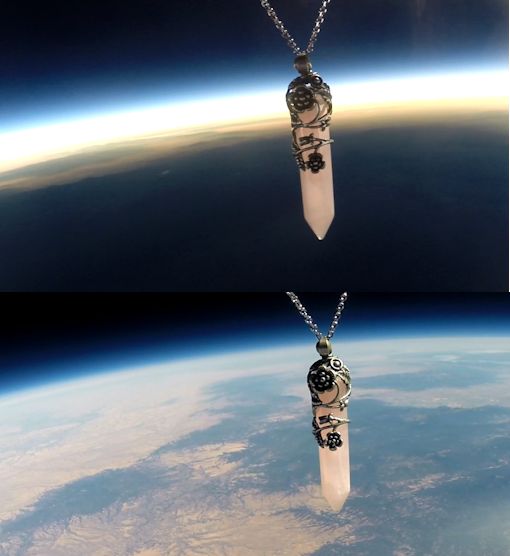
During the 2.5 hour flight, the pendants were wrapped in the Moon's shadow for more than two minutes, experiencing a spooky darkness colder than -50 C.
You can have one for $149.95. Each crystal pendant comes with a unique gift card showing the jewelry passing through the Moon's shadow and floating at the top of Earth's atmosphere. The interior of the card tells the story of the flight and confirms that this gift has been to the edge of space and back again.
Far Out Gifts: Earth to Sky Store
All proceeds support hands-on STEM education
GLANCING-BLOW CME SPARKS AURORAS: A coronal mass ejection (CME) from the sun hit Earth's magnetic field on Sept. 12th. It was just a glancing blow, but, sometimes, a glancing blow is all you need. Shortly after the off-course CME arrived, Sacha Layos photographed this display of auroras over the Goldstream Valley near Fairbanks, Alaska:

The source of the CME was departing sunspot AR2673. On Sept. 10th. the monster sunspot exploded one last time with a powerful X8-class solar flare that hurled a massive CME into space. The bulk of the storm cloud missed our planet when it passed by on Sept. 12/13, but the CME was so potent, even its outskirts were geoeffective.
Realtime Space Weather Photo Gallery