MORNING PLANETS: Set your alarm for dawn. Venus, Mars, Mercury and the crescent Moon are lined up in the morning sky, putting on a beautiful show for people who look east before sunrise. Sky maps: Sept. 17, 18, 19, 20.


PICKET FENCE AURORAS: The solar wind around Earth is blowing faster than 650 km/s--an electrified gale that has sparked intermittent bright auroras around the poles since it commenced three days ago. On Sept. 15th, Catalin Tapardel observed these luminous forms over Kakwa, Alberta, Canada:

"What a treat!" says Tapardel. "I spent more than 30 minutes watching these [green columns] moving across the sky, dancing, pulsating in the same time."
Known as "picket fence auroras," the vertical rays Tapardel witnessed trace lines of magnetic force connecting Earth to space. Luminous columns show where beams of energetic particles are guided toward Earth's upper atmosphere by magnetic fields. "The combination of picket fence auroras and the Milky Way resembled angel's wings," says Tapardel.
More auroras are in the offing as the solar wind continues to blow. NOAA forecasters say there is a 60% chance of G1-class geomagnetic storms in the next 24 hours. Monitor the photo gallery for sightings. Free: Aurora Alerts

PHYSICS OF AN EXPLODING SPACE WEATHER BALLOON: This month, the students of Earth to Sky Calculus have been launching space weather balloons at a frenetic pace, more than half a dozen so far. Their goal: To monitor the effect of September's surprising solar flares on Earth's upper atmosphere. At the apex of every flight, the balloon explodes and the payload parachutes back to Earth. On Sept. 13th, a new upward-facing camera photographed the pop:

This image illustrates recent findings about the physics of exploding balloons. In Oct. 2015, researchers Sébastien Moulinet and Mokhtar Adda-Bedia of the Ecole Normale Supérieure published a Physical Review Letter entitled "Popping Balloons: A Case Study of Dynamical Fragmentation." In it, they reported the results of a series of fun yet informative laboratory experiments in which one balloon after another was popped and analyzed.
Basically, there are two ways a balloon can pop: along a single seam (the "opening regime") or along many tears (the "fragmentation regime"). This video shows the two regimes in action. Which way the balloon decided to pop depends on the stress in the rubber membrane. When the stress is low, it can be relieved with a single tear, but when the stress is high, many tears are required to do the job.
Clearly, space weather balloons explode in the fragmentation regime. This is hardly a surprise. When space weather balloons are launched, they measure no more than 6 to 8 feet in diameter. By the time they reach the stratosphere, they have stretched into a sphere as wide as a house. That's a lot of tension to release! More information about this research is available from the American Physical Society.
Realtime Space Weather Photo Gallery
ROSE QUARTZ CRYSTAL ECLIPSE PENDANTS: On Aug. 21st during the Great American Solar Eclipse, the students of Earth to Sky Calculus launched 11 space weather balloons from the path of totality. They aimed to photograph the Moon's shadow from the stratosphere--and they succeeded. As a fundraiser, some of the balloons carried jewelry. Here is a rose quartz crystal pendant entering the Moon's shadow more than 90,000 feet above the Malheur National Forest in eastern Oregon:
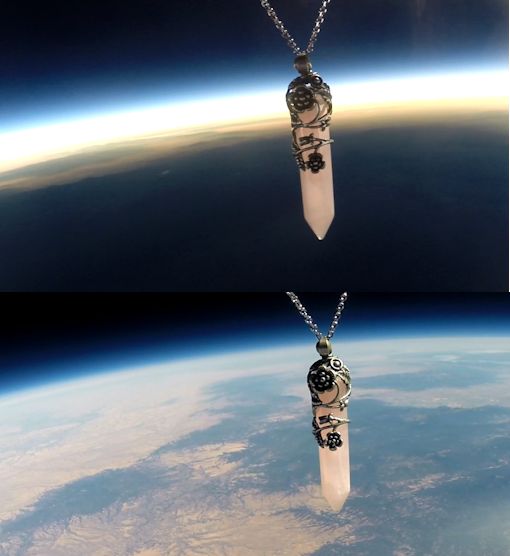
During the 2.5 hour flight, the pendants were wrapped in the Moon's shadow for more than two minutes, experiencing a spooky darkness colder than -50 C.
You can have one for $149.95. Each crystal pendant comes with a unique gift card showing the jewelry passing through the Moon's shadow and floating at the top of Earth's atmosphere. The interior of the card tells the story of the flight and confirms that this gift has been to the edge of space and back again.
Far Out Gifts: Earth to Sky Store
All proceeds support hands-on STEM education