MORNING CONJUNCTION: Set your alarm for dawn. Venus and Mars are converging for a close encounter, appearing low in the east just before the morning sun. At closest approach on Thursday, Oct 5th, the bright Goddess of Love and the dimmer God of War will lie no more than 0.25 degrees apart. Take a look! It's a nice way to begin the day. Sky Maps: Oct. 4th, 5th, 6th.


SOLAR ECLIPSE IN THE STRATOSPHERE: On Aug. 21st during the Great American Solar Eclipse, the students of Earth to Sky Calculus launched 11 space weather balloons from the path of totality. They aimed to photograph the Moon's shadow from the stratosphere--and they succeeded. Looking down from a point more than 100,000 feet above Earth's surface, this GoPro video shows the inky-black shadow of the Moon darkening a 70-mile-wide patch of Wyoming and Nebraska:
This video was assembled and edited by filmmaker Ginger Perez, a founding student member of Earth to Sky Calculus. The payload was sponsored by the Southern Maine Community College with Maine students joining the launch team as space weather balloon "trainees."
Our next solar eclipse mission is already set: We plan to launch space weather balloons from Chile into a total eclipse on July 2, 2019. That one will be a sunset eclipse with the sun low on the horizon during the flight. The teams are looking forward to photographing the Moon's stretched-out shadow fringed by lovely sunset colors. Stay tuned for that!
Far Out Gifts: Earth to Sky Store
All proceeds support hands-on STEM education
STEVE, THE MYSTERIOUS AURORAL ARC: A strong geomagnetic storm was brewing in the skies above Alberta, Canada, on Sept. 27th when photographer Alan Dyer looked up and saw a ribbon of purple light arcing cross the sky. It was the mysterious aurora known as "Steve":

"The Steve arc appeared for only about 20 minutes, starting at 10:45 pm MDT, during a lull in the main display," says Dyer, who captured the arc in a 6-shot, 360o panorama.
For many years, northern sky watchers have reported this luminous form occasionally dancing among regular auroras. It was widely called a "proton arc" until researchers pointed out that protons probably had nothing to do with it. So members of the Alberta Aurora Chasers group gave it a new name: "Steve."
"We seem to be ideally located in the Canadian Prairies for sighting Steve, as we often get the main aurora to our north, placing Steve overhead or to our south," notes Dyer.

No one fully understands the underlying physics of the purple ribbon. One of the European Space Agency's Swarm satellites flew straight through Steve during a previous apparition. Data revealed a relatively hot river of gas, about 25 km wide, flowing rapidly through Earth's outer atmosphere. "Steve seems to be a thermal emission from hot flowing gas rather than from precipitating electrons," says Dyer, "but his origin and nature are still mysterious." Free: Aurora Alerts
Realtime "Steve" Photo Gallery
Realtime Space Weather Photo Gallery
ROSE QUARTZ CRYSTAL ECLIPSE PENDANTS: On Aug. 21st during the Great American Solar Eclipse, the students of Earth to Sky Calculus launched 11 space weather balloons from the path of totality. As a fundraiser, some of the balloons carried jewelry, such as this rose quartz crystal pendant floating inside the Moon's shadow more than 90,000 feet above Oregon's Malheur National Forest:
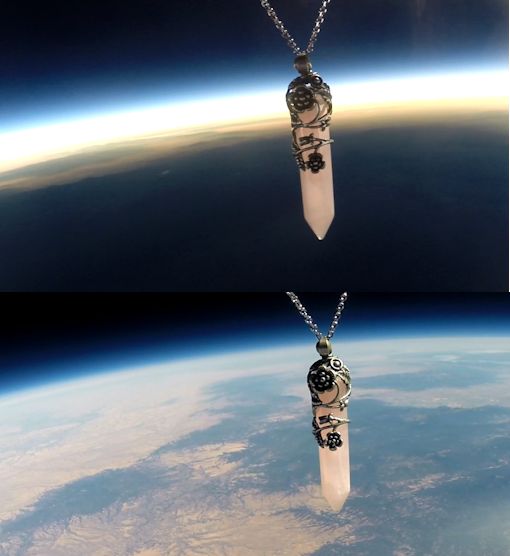
During the 2.5 hour flight, the pendants were wrapped in the Moon's shadow for more than two minutes, experiencing a spooky darkness colder than -50 C.
You can have one for $149.95. Each crystal pendant comes with a unique gift card showing the jewelry passing through the Moon's shadow and floating at the top of Earth's atmosphere. The interior of the card tells the story of the flight and confirms that this gift has been to the edge of space and back again.
Far Out Gifts: Earth to Sky Store
All proceeds support hands-on STEM education