DRACONID METEOR SHOWER: This weekend, Oct. 7th and 8th, Earth is passing through a network of dusty filaments shed by Comet 21P/Giacobini-Zinner, source of the annual Draconid meteor shower. Forecasters say sky watchers could see a few slow meteors per hour on Saturday and Sunday nights while the head of Draco the Dragon is above the horizon. Hours between sunset and midnight are good times to look. Sky map.

MOONLIT AURORAS: A minor stream of solar wind brushed Earth's magnetic field on Oct. 7th. The resulting auroras were expected to be no match for the luminous Harvest Moon ... except that they were. "What a display!" says Colin Palmer, who sends this picture from Tromso, Norway:

"Moonlit clouds framed the auroras very nicely," he says. "The Moon was 94% illuminated, but lunar glare was not a problem."
Tromso, Norway is just that kind of place. Located inside the Arctic Circle, almost directly underneath Earth's auroral oval, Tromso and its residents witness flickering outbursts of Northern Lights even when no geomagnetic storm is underway. Minor solar wind streams can spark major displays. (Take that, Harvest Moon.) Free: Aurora Alerts
SOLAR WIND STREAM APPROACHES EARTH: A hole has opened in the sun's atmosphere and solar wind is spewing from the ragged gap faster than 600 km/s. The structure stretches more than 350,000 km southward from the sun's north pole:
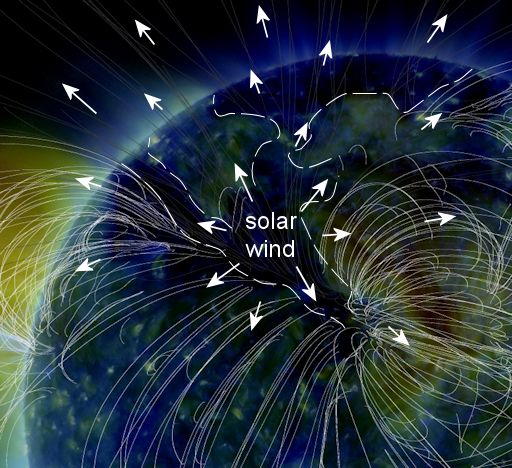
This is a coronal hole, a region where the sun's magnetic field opens up and allows solar wind to escape. The emerging stream of gaseous material is expected to reach Earth during the late hours of Oct. 10th or Oct. 11th, bringing with it a chance of polar geomagnetic storms. Arctic sky watchers should be alert for auroras mid-week. Free: Aurora Alerts
Realtime Space Weather Photo Gallery
SOLAR ECLIPSE IN THE STRATOSPHERE: On Aug. 21st during the Great American Solar Eclipse, the students of Earth to Sky Calculus launched 11 space weather balloons from the path of totality. They aimed to photograph the Moon's shadow from the stratosphere--and they succeeded. Looking down from a point more than 100,000 feet above Earth's surface, this GoPro video shows the inky-black shadow of the Moon darkening a 70-mile-wide patch of Wyoming and Nebraska:
This video was assembled and edited by filmmaker Ginger Perez, a founding student member of Earth to Sky Calculus. The payload was sponsored by the Southern Maine Community College with Maine students joining the launch team as space weather balloon "trainees."
Our next solar eclipse mission is already set: We plan to launch space weather balloons from Chile into a total eclipse on July 2, 2019. That one will be a sunset eclipse with the sun low on the horizon during the flight. The teams are looking forward to photographing the Moon's stretched-out shadow fringed by lovely sunset colors. Stay tuned for that!
Far Out Gifts: Earth to Sky Store
All proceeds support hands-on STEM education