GEOMAGNETIC STORM PREDICTED (G1-CLASS): NOAA forecasters say there is a 65% chance of G1-class geomagnetic storms on Oct. 11th when a stream of solar wind makes contact with Earth's magnetic field. The solar wind is flowing from a hole in the sun's atmosphere with peak speeds greater than 600 km/s. Arctic sky watchers should be alert for auroras mixed with waning Harvest moonlight. Free: Aurora Alerts


WEEKEND METEORS AND AURORAS: Over the weekend, Earth passed through two streams of cosmic stuff--a minor stream of solar wind and a dusty stream of meteoroids from Comet 21P/Giacobini-Zinner. On Sunday morning, Oct. 8th, Adrien Mauduit saw the effects of both from the window of an airplane flying off the coast of Greenland:
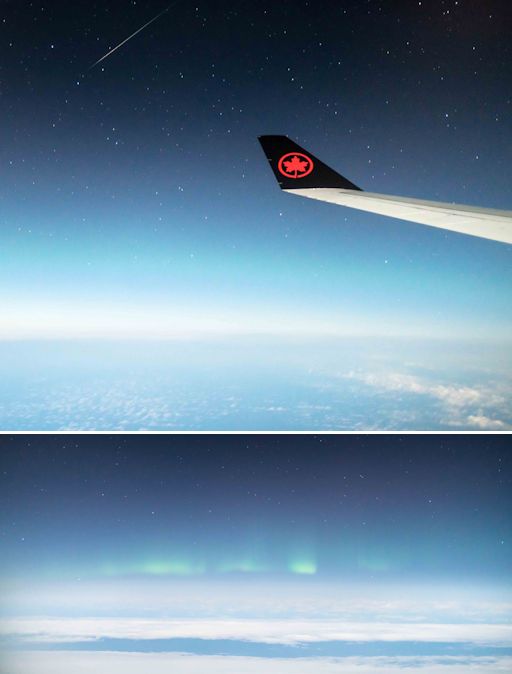
"I was about 40,000 feet above the Atlantic ocean, flying from Canada to Europe at 1 am local time when the auroras appeared," says Mauduit. "The Harvest Moon was washing everything out, but against all odds, a beautiful cyan arc spread across the sky. Occasionally meteors streaked across the geomagnetic display--probably from Comet Giacobini-Zinner, source of the Draconid meteor shower."
"When I'm flying at night near the Arctic, I always take the north window seat and have my cameras ready," he adds. "You can always see tons of stuff on a plane at night, you just have to look out the window!"
STRANGE RAINBOW: Jon Larsen was driving home east of Spearfish, South Dakota, last Friday morning when he saw a rainbow. "There was something wrong with it," he says. "I grabbed my camera and zoomed in for a closer look." This is what he saw:
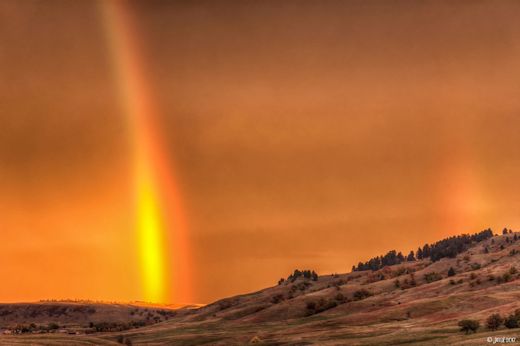
"The rainbow's primary red band had separated from the rest!" says Larsen.
What happened? Atmospheric optics expert Les Cowley says there are at least two ways that rainbows can be distorted in this way:
First, by hot air: "This rainbow over Adelaide, Australia, was bent by columns of rising hot city air, but no cities appear to be near Jon Larsen's rainbow," says Cowley.
Second, by mixed-up raindrops: "Rainbows can appear distorted when there are differences in the size of the raindrops along lines of sight to different parts of the bow. Small drops give broader bows."
The second explanation is probably correct. Larsen notes that "strong surface winds were blowing rain shafts around." These strong winds may have segregated raindrops into layers of different size--small drops being blown about more easily than large ones--giving the 'bow a strange appearance, indeed.
Realtime Space Weather Photo Gallery
SOLAR ECLIPSE IN THE STRATOSPHERE: On Aug. 21st during the Great American Solar Eclipse, the students of Earth to Sky Calculus launched 11 space weather balloons from the path of totality. They aimed to photograph the Moon's shadow from the stratosphere--and they succeeded. Looking down from a point more than 100,000 feet above Earth's surface, this GoPro video shows the inky-black shadow of the Moon darkening a 70-mile-wide patch of Wyoming and Nebraska:
This video was assembled and edited by filmmaker Ginger Perez, a founding student member of Earth to Sky Calculus. The payload was sponsored by the Southern Maine Community College with Maine students joining the launch team as space weather balloon "trainees."
Our next solar eclipse mission is already set: We plan to launch space weather balloons from Chile into a total eclipse on July 2, 2019. That one will be a sunset eclipse with the sun low on the horizon during the flight. The teams are looking forward to photographing the Moon's stretched-out shadow fringed by lovely sunset colors. Stay tuned for that!
Far Out Gifts: Earth to Sky Store
All proceeds support hands-on STEM education