GEOMAGNETIC STORM IN PROGRESS: A G1-class geomagnetic storm is underway on Oct. 11th as Earth moves deeper into a stream of fast-moving solar wind. "The sun's light has barely left the sky and we are already seeing powerful auroras dance above Abisko National Park in Sweden," reports Chad Blakley of Lights over Lapland. "Our live webcam is broadcasting the show." Free: Aurora Alerts

SOLAR WIND SPARKS AURORAS ... MORE TO COME: The solar wind causing today's display of polar auroras is coming from a hole in the sun's atmosphere. First contact with the gaseous material during the early hours of Oct. 11th caused a bright display of auroras that wowed air travelers flying near the Arctic Circle. Marc Swanson took this picture from the window seat of a commercial air flight from Denver to Reykavik:


"The display first became visible near the Canadian border and continued, with some pauses, all the way to landing in Iceland," says Swanson. "So cool!"
NOAA forecasters say there is a 70% chance of additional G1-storms during the next 24 hours, as Earth moves deeper into the stream of solar wind. Arctic sky watchers should remain alert for auroras. Free: Aurora Alerts
THESE CRYSTALS HAVE TOUCHED SPACE: On Aug. 21st during the Great American Solar Eclipse, the students of Earth to Sky Calculus launched 11 space weather balloons from the path of totality and filmed the shadow of the Moon from the stratosphere. As a fundraiser, some of the balloons carried jewelry--like this:
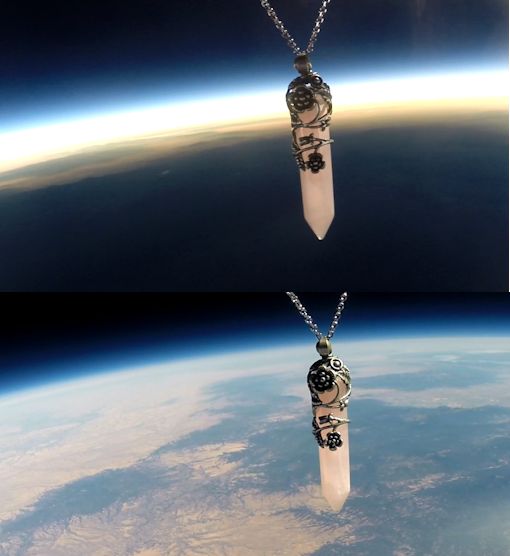
During the 2.5 hour flight, this rose quartz crystal eclipse pendant was wrapped in the Moon's shadow for more than two minutes, experiencing a spooky darkness colder than -50 C.
You can have one for $149.95. Each crystal pendant comes with a unique gift card showing the jewelry passing through the Moon's shadow and floating at the top of Earth's atmosphere. The interior of the card tells the story of the flight and confirms that this gift has been to the edge of space and back again.
Far Out Gifts: Earth to Sky Store
All proceeds support hands-on STEM education
ASTEROID TO BUZZ EARTH TONIGHT: House-sized asteroid 2012 TC4 is approaching Earth today for a close encounter only 1/8th the distance to the Moon. At closest approach, the space rock will skim just outside Earth's zone of geosynchronous communications satellites and be visible in telescopes as small as 8-inches (observing tips). Alberto Quijano Vodniza, of Pasto, Colombia, made this movie of the faint asteroid moving among the stars on Oct. 11th:

There's no chance of a collision. "We know the orbit of 2012 TC4 well enough to be absolutely certain that it won't hit Earth," says Paul Chodas, manager of the Center for Near-Earth Object Studies at JPL,"but we haven't established its exact path just yet."
To get a better handle on the asteroid's orbit (and possible future encounters), an international network of telescopes will monitor 2012 TC4 as it goes by. Pinging the asteroid with its Goldstone radar, NASA hopes to learn much about the space rock's physical properties. The space agency will even exercise some aspects of its planetary defense systems.
Asteroids of this size are numerous in the solar system, and Earth is a frequent target. The last time an asteroid akin to 2012 TC4 hit Earth was barely more than 4 years ago. On Feb. 15, 2013, a previously undiscovered asteroid ripped through the atmosphere over Chelyabinsk, Russia. Shock waves knocked onlookers off their feet and shattered windows in hundreds of buildings. Years later, meteorite hunters are still finding pieces of the "Chelyabinsk asteroid" that rained down after its 17m-wide body disintegrated in the atmosphere.
Tracking house-sized asteroids is important, and tonight astronomers will have a front row seat as one passes by. Got a picture of 2012 TC4? Submit it here!
Realtime Space Weather Photo Gallery