ASTEROID NEAR MISS: As expected, house-sized asteroid 2012 TC4 sailed past Earth last night, unnervingly close yet doing no harm as it passed just outside our planet's zone of geosynchronous communications satellites. If such an asteroid did strike, it would explode in the atmosphere causing shock waves capable of shattering windows and knocking people to the ground. Maybe next time. NASA will use data gathered during the flyby to refine the asteroid's orbit and predict future encounters. Browse: Asteroid Photo Gallery.
GEOMAGNETIC STORMS IN PROGRESS: Minor G1-class geomagnetic storms are underway on Oct. 12th as Earth moves through a stream of fast-moving solar wind. "Last night, Northern Lights exploded above the Lofoten Islands of Norway," reports Eric Fokke. His photo shows green lights not only in the sky, but also on the ground, where auroras reflected from the beach's damp sand:


"For hours, auroras were dancing in the sky and around a rising moon," says Fokke. "It was beautiful."
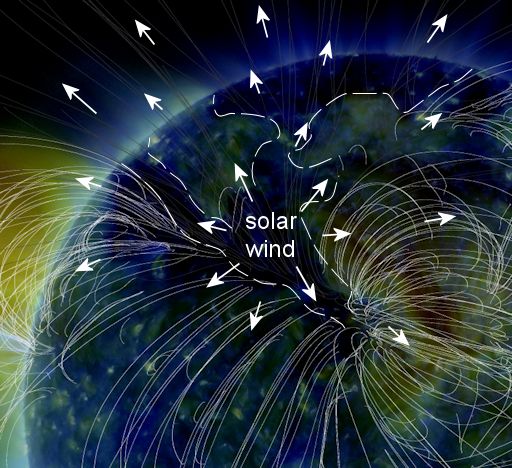
The solar wind responsible for these lights is flowing from a hole in the sun's atmosphere. Earth is expected to remain inside the spray of electrified gas for another 24 to 48 hours. If magnetic activity intensifies to category G2, as NOAA forecasters say could happen on Oct. 13th, auroras might descend to US states as far south as New York and Idaho. Free: Aurora Alerts

MAGNETIC UNREST IN ENGLAND: In England, magnetic fields at ground level have been shaking back and forth in response to the solar wind. Stuart Green's backyard magnetometer in Preston, UK, shows the geomagnetic storm in action:

"It's always wonderful to see the impact of a geomagnetic storm on my magnetometer here in the UK," says Green. "The chart clearly shows the arrival of a high-speed solar wind stream on Oct. 11th. Magnetic unrest intensified over the following 24hrs to create a G1-class geomagnetic storm."
The squiggles in Green's chart represent changes in the local magnetic field caused by the buffeting of solar wind high overhead. "The sensor is buried in my garden about 0.5 meters below the surface in an East/West orientation," he explains. "This allows very sensitive (sub nanotesla) measurements of magnetic declination during geomagnetic storms. The plot shows the change in magnetic flux density in nanotesla occurring between readings every few minutes."
Realtime Space Weather Photo Gallery
THESE CRYSTALS HAVE TOUCHED SPACE: On Aug. 21st during the Great American Solar Eclipse, the students of Earth to Sky Calculus launched 11 space weather balloons from the path of totality and filmed the shadow of the Moon from the stratosphere. As a fundraiser, some of the balloons carried jewelry--like this:
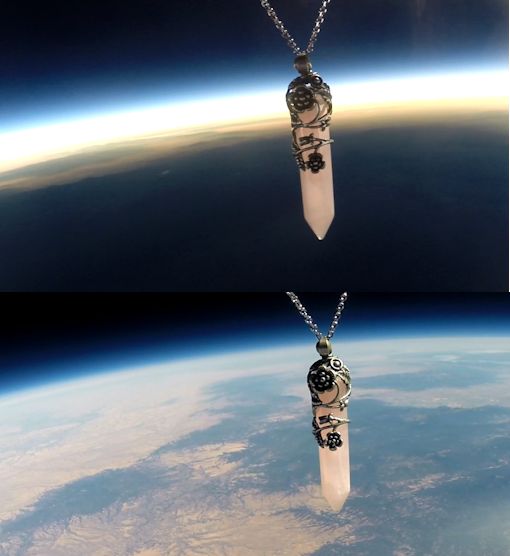
During the 2.5 hour flight, this rose quartz crystal eclipse pendant was wrapped in the Moon's shadow for more than two minutes, experiencing a spooky darkness colder than -50 C.
You can have one for $149.95. Each crystal pendant comes with a unique gift card showing the jewelry passing through the Moon's shadow and floating at the top of Earth's atmosphere. The interior of the card tells the story of the flight and confirms that this gift has been to the edge of space and back again.
Far Out Gifts: Earth to Sky Store
All proceeds support hands-on STEM education