SUBSIDING STORM: A 5-day stretch of polar geomagnetic storms is coming to an end as Earth exits a fast-moving stream of solar wind. The subsequent quiet won't last long. Geomagnetic activity is expected to return on Oct. 18th when Earth enters a new stream of solar wind. Arctic sky watchers should be alert for renewed auroras mid-week. Free: Aurora Alerts.
SPOTLESS SUN SPARKS BRIGHT AURORAS: The sun just did something ironic. For a whole week, Oct. 9th - 15th, the face of the sun was utterly blank. There were no sunspots and no solar flares; NOAA classified solar activity as "very low." At the same time, space weather was remarkably stormy. From Oct. 11th through 15th, not a single day went by without a geomagnetic storm. Here's what Tromsø, Norway, looked like on Oct. 13th:


"When I took this picture, we were experiencing our 3rd day in a row with bright auroras," says Markus Varik, a tour guide in Tromsø. "The auroras were so intense, it was often pointless to take a photo because of overexposure. Our guests were so exited after the tour, they needed to head to a local pub to let some steam out before being able to fall asleep."
Similar stories poured in from Sweden, Iceland, Canada, Finland and Alaska. In the USA's "lower 48", Northern Lights descended as far south as Michigan, Minnesota, Wyoming, and Washington--all without a single sunspot.
What happened? This:

This is a coronal hole, a place in the sun's atmosphere where the magnetic field peels back and allows solar wind to escape. Solar wind spewing from this hole hit Earth's magnetic field on Oct. 11th. It mimicked the effect of a CME (a cloud of gas hurled toward us by an exploding sunspot), rattling our planet's magnetic field and lighting up polar regions with beautiful lights. Five days of G1- and G2-class geomagnetic storms ensued.


In Preston, England, aerospace engineer Stuart Green captured the "rattling" of Earth's magnetic field on his backyard magnetometer, buried a half-meter beneath the surface of his garden. Click on the image to see the full 5 days of geomagnetic storming:

"Passing in two main waves, solar wind flowing from the coronal hole sparked beautiful auroras around both poles and clearly disturbed our local magnetic field," he says. "The activity now appears to be subsiding ahead of the next wave heading our way in the coming days."
Coronal holes are present throughout the solar cycle, even during Solar Minimum when sunspots are scarce, and they are a key reason why space weather never stops. Stay tuned for more!
PYRAMID FLIES THROUGH SOLAR STORM: On Sept. 10, 2017, giant sunspot AR2673 exploded, producing an X8-class solar flare. The powerful blast accelerated a stream of electrons and protons toward Earth. By the time the particles arrived, this crystal pyramid was waiting for them at the top of Earth's atmosphere:
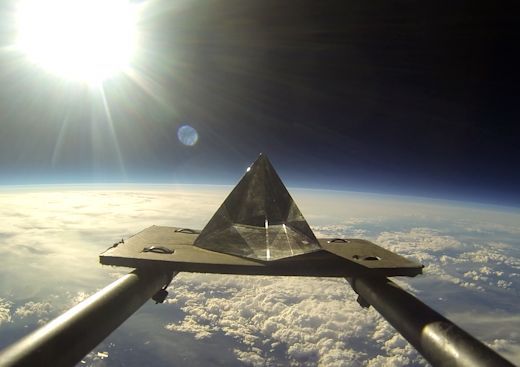
What was it doing up there? It hitched a ride onboard a space weather balloon, launched by the students of Earth to Sky Calculus to measure radiation from the flare. In addition to the pyramid (flown for fundraising), the balloon's payload carried an array of X-ray/gamma-ray detectors, cameras, temperature/pressure sensors, GPS altimeters and, of course, extra pyramids.
You can have one for $119.95. Each pyramid comes with a unique gift card showing the crystal floating at the top of Earth's atmosphere. The interior of the card tells the story of the flight and confirms that this gift has been to the edge of space and back again.
Far Out Gifts: Earth to Sky Store
All proceeds support hands-on STEM education