CHANCE OF MAGNETIC STORMS THIS WEEK: NOAA forecasters say there is a 45% chance of polar geomagnetic storms on Oct. 18th and 19th when Earth enters a new stream of solar wind. The New Moon will provide a velvety-dark backdrop for auroras around the Arctic Circle. Free: Aurora Alerts.
HURRICANE + DESERT DUST = WEIRD SKIES: For the past two days, sky watchers in parts of Europe have reported strange colors in the daytime sky. "There's a red glow overhead and the sun looks like a big Orange," says Vincent Phillips, who sends this picture from Hale village near Liverpool UK:

"This is apparently due to ex-hurricane Ophelia, which dragged up tropical air and dust from the Sahara desert when it battered the western UK earlier this week," says Phillips. "The air is full of fine dust. We had several inbound flights into Liverpool Airport declare emergencies after strange smells in cockpits of aircraft yesterday."
Atmospheric optics expert Les Cowley adds his own report: "I was driving near London yesterday afternoon and I experienced the strange skies at first hand. At first the sky was yellowish orange with the sun showing through as a blurred and lurid red. But quite unlike a sunset color. Gradually the sun was fully obscured and at 3pm headlights were needed. The sky was an unearthly yellow red."
"Given that over the last few days the U.K. has had unseasonably high temperatures and southerly winds associated partly with Ophelia, I think that fine dust/sand carried from the Sahara was the culprit," says Cowley.
Similar reports are coming in from the Netherlands, Germany, and other parts of the UK, as forest fires in the Iberian peninsula add their ash to the desert dust, intensifying the phenomenon. Browse the realtime photo gallery for sightings.
Realtime Space Weather Photo Gallery
SPOTLESS SUN SPARKS BRIGHT AURORAS: The sun just did something ironic. For a whole week, Oct. 9th - 15th, the face of the sun was utterly blank. There were no sunspots and no solar flares; NOAA classified solar activity as "very low." At the same time, space weather was remarkably stormy. From Oct. 11th through 15th, not a single day went by without a geomagnetic storm. This is what the sky looked like outside Fairbanks, Alaska, on Oct. 12th:


"It was an all-night, all-sky display that gave me 'aurora neck,' a stiff neck from spending 10 straight hours looking up!" says Todd Salat, who took the picture. "The reflection from Olnes Pond doubled our viewing pleasure."
Similar stories poured in from Sweden, Iceland, Norway, Canada, and Finland. In the USA, Northern Lights descended as far south as Michigan, Minnesota, Wyoming, and Washington--all without a single sunspot.
What happened? This:

This is a coronal hole, a place in the sun's atmosphere where the magnetic field peels back and allows solar wind to escape. Solar wind spewing from this hole hit Earth's magnetic field on Oct. 11th. It mimicked the effect of a CME (a cloud of gas hurled toward us by an exploding sunspot), rattling our planet's magnetic field and lighting up polar regions with beautiful lights. Five days of G1- and G2-class geomagnetic storms ensued.


In Preston, England, aerospace engineer Stuart Green captured the "rattling" of Earth's magnetic field on his backyard magnetometer, buried a half-meter beneath the surface of his garden. Click on the image to see the full 5 days of geomagnetic storming:

"Passing in two main waves, solar wind flowing from the coronal hole sparked beautiful auroras around both poles and clearly disturbed our local magnetic field," he says. "The activity now appears to be subsiding ahead of the next wave heading our way in the coming days."
Coronal holes are present throughout the solar cycle, even during Solar Minimum when sunspots are scarce, and they are a key reason why space weather never stops. Stay tuned for more!
PYRAMID FLIES THROUGH SOLAR STORM: On Sept. 10, 2017, giant sunspot AR2673 exploded, producing an X8-class solar flare. The powerful blast accelerated a stream of electrons and protons toward Earth. By the time the particles arrived, this crystal pyramid was waiting for them at the top of Earth's atmosphere:
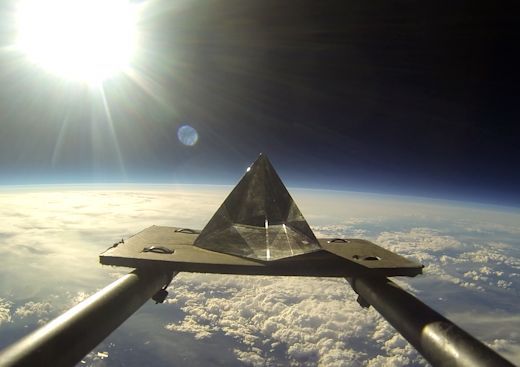
What was it doing up there? It hitched a ride onboard a space weather balloon, launched by the students of Earth to Sky Calculus to measure radiation from the flare. In addition to the pyramid (flown for fundraising), the balloon's payload carried an array of X-ray/gamma-ray detectors, cameras, temperature/pressure sensors, GPS altimeters and, of course, extra pyramids.
You can have one for $119.95. Each pyramid comes with a unique gift card showing the crystal floating at the top of Earth's atmosphere. The interior of the card tells the story of the flight and confirms that this gift has been to the edge of space and back again.
Far Out Gifts: Earth to Sky Store
All proceeds support hands-on STEM education