CO-ROTATING INTERACTION REGION: NOAA forecasters estimate a 55% chance of polar geomagnetic storms on Oct. 21st when a co-rotating interaction region (CIR) is expected to hit Earth's magnetic field. CIRs are transition zones between fast- and slow-moving solar wind streams. Solar wind plasma piles up in these regions, producing density gradients and shock waves that do a good job of sparking auroras. Free: Aurora Alerts.
TWO PLANETS AND A SOLAR STORM: Yesterday, Oct. 18th, something behind the eastern edge of the sun exploded. A massive cloud of plasma (CME) raced away from the blast site -- right into a bright conjunction. Jupiter and Mercury were less than 1o apart when the CME passed by:
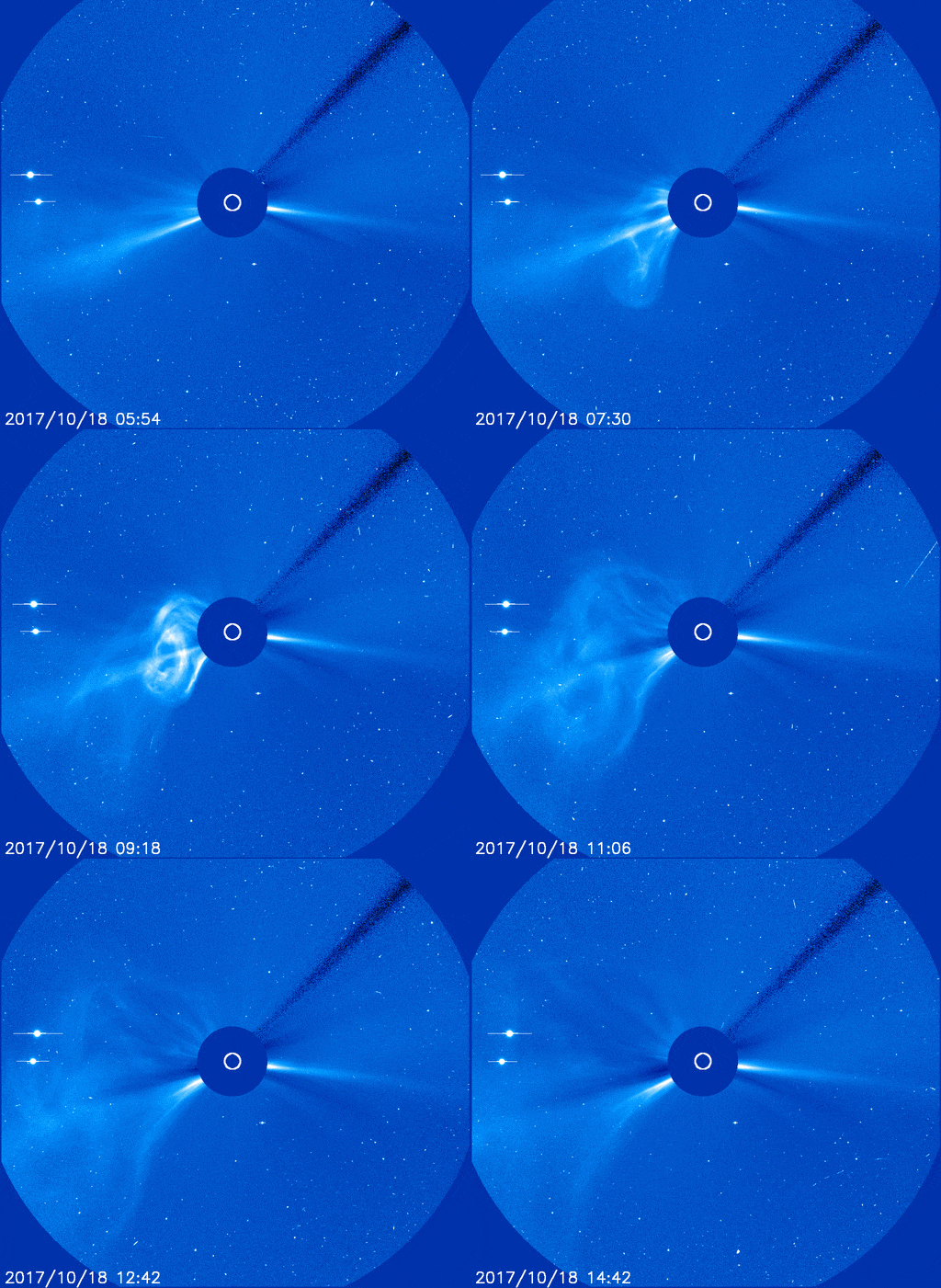
Credit: The Solar and Heliospheric Observatory (SOHO)
If this meeting of planets happened in the night sky, it would have been widely observed. Because it was so close to the glaring sun, no human could see it. Only the orbiting Solar and Heliospheric Observatory, with its sun-blocking coronagraph, could record such a scene.
The CME missed everything. It sailed wide of Mercury, Jupiter, and Earth as well. Forecasters expect no geomagnetic storms as a result of the blast.
Realtime Space Weather Photo Gallery
WHAT IS THAT OBJECT CIRCLING EARTH? In 2016, astronomers discovered an object loosely circling Earth. Named "2016 HO3," the faint speck of light travels around the sun alongside our planet, always at least 38 times as far away as the Moon. What is it? Astronomers at the University of Arizona recently used the Large Binocular Telescope on Mount Graham to learn more about 2016 HO3, and they have an answer. Scroll past the video to learn more.
It's an asteroid, no more than 100 meters across, as opposed to, say, a burned out rocket booster or other piece of Apollo space junk.
"Our observations show that HO3 rotates once every 28 minutes and is made of materials similar to asteroids," says University of Arizona professor Vishnu Reddy who led the research team.
One way to visualize HO3's orbit is by picturing a hula hoop dancer — the sun in this analogy — twirling two hoops around the hips at the same time, ever so slightly out of sync. While it orbits the sun, the object makes yearly loops around the Earth. As a result, the object appears to orbit the Earth, but it is not gravitationally bound to our planet.
"We refer to it as a quasi-satellite of Earth," says Paul Chodas of JPL. "One other asteroid -- 2003 YN107 -- followed a similar orbital pattern for a while over 10 years ago, but it has since departed our vicinity. This asteroid is much more locked onto us. Our calculations indicate 2016 HO3 has been a stable quasi-satellite of Earth for almost a century, and it will continue to follow this pattern as Earth's companion for centuries to come."
PYRAMID FLIES THROUGH SOLAR STORM: On Sept. 10, 2017, giant sunspot AR2673 exploded, producing an X8-class solar flare. The powerful blast accelerated a stream of electrons and protons toward Earth. By the time the particles arrived, this crystal pyramid was waiting for them at the top of Earth's atmosphere:
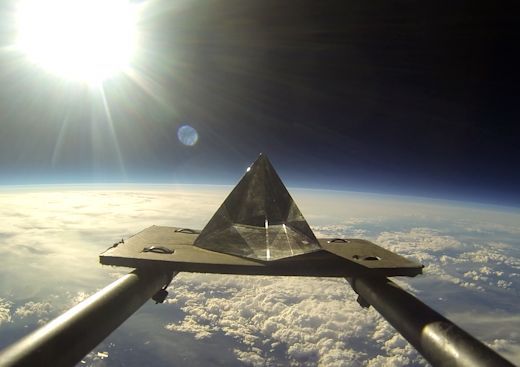
What was it doing up there? It hitched a ride onboard a space weather balloon, launched by the students of Earth to Sky Calculus to measure radiation from the flare. In addition to the pyramid (flown for fundraising), the balloon's payload carried an array of X-ray/gamma-ray detectors, cameras, temperature/pressure sensors, GPS altimeters and, of course, extra pyramids.
You can have one for $119.95. Each pyramid comes with a unique gift card showing the crystal floating at the top of Earth's atmosphere. The interior of the card tells the story of the flight and confirms that this gift has been to the edge of space and back again.
Far Out Gifts: Earth to Sky Store
All proceeds support hands-on STEM education