WANTED: TALES OF SPOOKY SPACE WEATHER: Have you ever been spooked by something you saw in the night sky? Maybe it was a ghoulish form in the aurora borealis, or the haunting glow of a rocket fuel dump--or something you couldn't figure out at all! In the spirit of Halloween, Spaceweather.com is reaching out to you, our readers, to share a spooky story about the night sky. Fill out this short survey, and your tale could end up on the front page of our web site as Halloween approaches. (Note: Image and audio files are accepted by the survey form.)
ATMOSPHERIC CANYON ON THE SUN: A large hole has opened in the sun's atmosphere, cleaving the Earth-facing side of the sun with a gaseous canyon more than 700,000 km long. This image, based on data from NASA's Solar Dynamics Observatory, shows the jagged structure directly facing Earth on Oct. 22nd:

This is a coronal hole--a region where the sun's magnetic field peels back and allows solar wind to escape. The solar wind emerging from this hole is blowing faster than 600 km/s and is expected to reach Earth during the late hours of Oct. 24th. NOAA forecasters say there is a 45% chance of polar geomagnetic storms on Oct. 24th, increasing to 80% on Oct. 25th. Arctic auroras are in the offing. Free: Aurora Alerts.
Realtime Space Weather Photo Gallery
WHAT IS IT ABOUT OCTOBER? "This October really seems to have been a special month here in Abisko, Sweden," reports aurora tour guide Oliver Wright. "We have seen auroras every night for the past two weeks. Last night I took a group out for Lights over Lapland and, although geomagnetic activity was nominally very low (Kp=1), we saw this amazing aurora directly overhead."

"What is it about October?" he wonders.
As a matter of fact, there is something special about October. Look at this. According to a study of 75 years of historical records, October is tied with March as the most geomagnetically disturbed month of the year. During these months around equinoxes, celestial geometry puts the magnetic field of the sun in position to link up with the magnetic field of Earth. This linkage allows even gentle gusts of solar wind to spark extravagant auroras.

October 2017 still has more than a week to go, and a potent stream of solar wind is approaching Earth. Estimated time of arrival: Oct. 24th. A good month for Northern Lights is about to get even better, so stay tuned. Free: Aurora Alerts.
OPALITE CRYSTAL SPACE PENDANT: On Oct. 15, 2017, the students Earth to Sky Calculus launched a space weather balloon from the Sierra Nevada mountains of central California. Its mission: to measure cosmic rays at the top of Earth's atmosphere. The payload carried an array of X-ray/gamma-ray detectors, GPS trackers, temperature/pressure sensors and, for fundraising, opalite crystals:
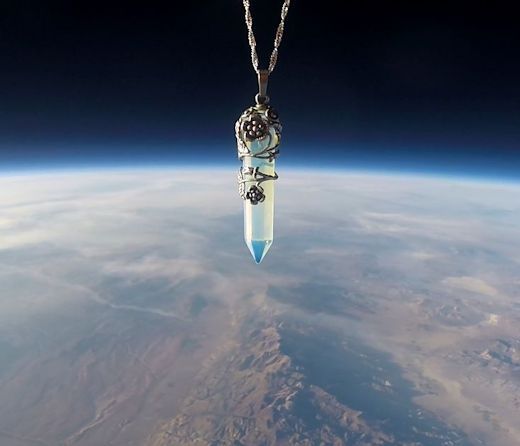
With a soothing blue glow that matches the otherworldly color of Earth's upper atmosphere, these crystals ascended to an altitude of 32 km (105,000 feet) where the balloon exploded. The payload parachuted back to Earth, landing in the Eureka Valley on the outskirts of Death Valley National Park.
You can have one for $119.95. Each necklace comes with a unique gift card showing the pendant floating at the top of Earth's atmosphere. The interior of the card tells the story of the flight and confirms that this gift has been to the edge of space and back again.
Far Out Gifts: Earth to Sky Store
All proceeds support hands-on STEM education