SUBSIDING STORMS: Earth is exiting a stream of fast-moving solar wind that sparked intermittent G1-class geomagnetic storms on Oct. 24-26. Arctic auroras and magnetic unrest should subside this weekend, but only temporarily. A new stream of solar wind is expected to arrive on Oct. 31-Nov. 1. Free: Aurora Alerts.

RUSSIAN ROCKET SPARKS 'BLUE AURORAS': Around the Arctic Circle, people see green auroras almost every night. It's nothing to write home about. Blue auroras, on the other hand, are very unusual. That's why this photo taken last night by Lights over Lapland tour guide Oliver Wright in Abisko, Sweden, is so remarkable:
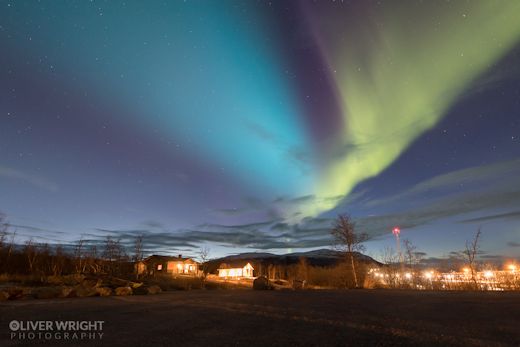
"It was totally blue," says Wright, a veteran guide who has witnessed hundreds of geomagnetic storms. "I've never seen anything quite like it!" In Tromso, Norway, Daniel Drelciuc saw it, too--"a big blue mass next to the classic green aurora," he says.
In auroras, blue is a sign of nitrogen. Energetic particles striking ionized molecular nitrogen (N2+) at very high altitudes can produce a cold azure glow, most often seen during intense geomagnetic storms. Last night, however, geomagnetic activity was not intense.
Maybe these weren't auroras--at least, not normal ones. Another theory is emerging for the blue apparition. On Oct. 26th, the Russian military staged a battle drill and test-launched a number of ballistic missiles from land, sea and air. At least one of them created a magnificent cloud of blue exhaust. Alexey Yakovlev photographed the display from Strezhevoy, Russia:

His photo looks so strange, you might think it is Photoshopped. It's real. A sequence of images on Yakovlev's Russian language social media page shows the cloud expanding naturally into the atmosphere.
The instigating missile may have been a Topol ICBM reportedly launched from the Plesetsk space center 800 km north of Moscow toward the Kura test range in Kamchatka. The flight path is about right for a sighting by Yakovlev. Moreover, when Russia test-launched the same type of missile last month, some sky watchers reported unusual clouds then, too.
Perhaps last night high altitude winds blew some of this blue exhaust west, visually mixing with geomagnetic auroras over Scandinavia. Wright notes that the blue and green lights were indeed moving independently, as if they came from different sources. "I'm leaning toward the rocket explanation," he says.
Stay tuned for updates as more information becomes available.
OPALITE CRYSTAL SPACE PENDANT: On Oct. 15, 2017, the students Earth to Sky Calculus launched a space weather balloon from the Sierra Nevada mountains of central California. Its mission: to measure cosmic rays at the top of Earth's atmosphere. The payload carried an array of X-ray/gamma-ray detectors, GPS trackers, temperature/pressure sensors and, for fundraising, opalite crystals:
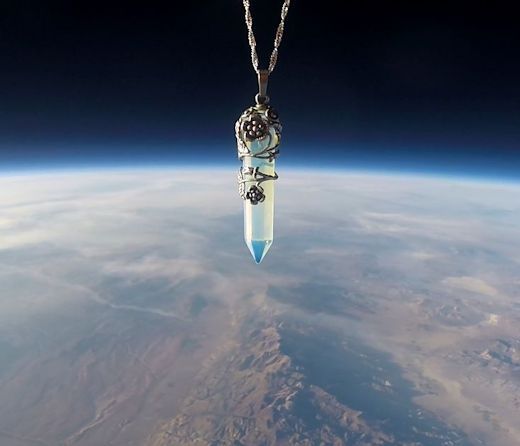
With a soothing blue glow that matches the otherworldly color of Earth's upper atmosphere, these crystals ascended to an altitude of 32 km (105,000 feet) where the balloon exploded. The payload parachuted back to Earth, landing in the Eureka Valley on the outskirts of Death Valley National Park.
You can have one for $119.95. Each necklace comes with a unique gift card showing the pendant floating at the top of Earth's atmosphere. The interior of the card tells the story of the flight and confirms that this gift has been to the edge of space and back again.
Far Out Gifts: Earth to Sky Store
All proceeds support hands-on STEM education
(UPDATED MOVIE) UNUSUAL COMET DIVES TOWARD THE SUN: Deep inside the orbit of Mercury, unusual comet 96P/Machholz is diving toward the sun today. At closest approach on Oct. 27th, it will swoop through the sun's gravity well just 0.12 AU from the star. Coronagraphs onboard the orbiting Solar and Heliospheric Observatory (SOHO) are monitoring the flyby:

Comet 96P does this every 5.24 years. It is a short period comet that experiences frequent blasts of solar heat. During a similar flyby in 2002, SOHO observed two tiny fragments ahead of the main nucleus. This means the comet may be actively evolving, and it could shed more pieces during this week's dive.
This is no ordinary comet. Its orbit connects it with a bewildering menagerie of other things in the solar system: Comet 96P is linked to as many as three meteor showers (the Daytime Arietids, Southern Delta Aquarids, and Quadrantids), two families of sungrazing comets, and an asteroid (2003 EH1). Millennia ago, the whole ensemble was probably part of the same parent object that exploded or fell apart.
Does this comet even belong to our own solar system? A scientific study published in 2008 found that 96P/Machholz has "extremely anomalous molecular abundances." Chemically speaking, it's not like other comets that have been studied in the same way. Perhaps it comes from another star system, flung into space and later captured by our own sun's gravity.
96P/Machholz will remain visible in SOHO coronagraphs from now until Oct. 30th. Check back often for updated images.