LONG-RANGE FORECAST: NOAA forecasters say that G2-class geomagnetic storms are possible on Nov. 9-10 when a relatively potent stream of solar wind reaches Earth. A last-quarter Moon should provide dark enough skies for easy visibility of Arctic auroras. Free: Aurora Alerts.

SPOOKY SPACE WEATHER: Last week, in the spirit of Halloween, we issued a call for tales of "spooky space weather"--that is, times when readers were spooked by things they saw in the night sky, especially auroras. Nicole Hastings of Upstate New York responded with a good one:
"When I was 5 years old, I remember driving with my parents to my Aunt's house for dinner," says Hastings. "It was winter, so night had fallen very early. I loved to watch the night sky, and I had my forehead pressed against the car window, staring up at the stars. Driving into the countryside, the light pollution of urban Binghamton NY began to fade and the sky turned black - only this time it didn't. There was a strange red specter following the car! At first, I thought it was beautiful; it danced in the sky like a playful spirit. I asked my mom what it was, but she didn't see it. She assured me that there was nothing in the sky."

Photo credit: Mike Hollingshead of Blair, Nebraska, during a geomagnetic storm on Oct. 24, 2011.
"Was I the only one who could see it?" she continues. "The beautiful red dancing specter turned into a terrifying crimson ghost that was taunting me. I had to be forcibly removed from the car and carried into my Aunt's house - kicking and screaming - for fear that the red ghost would steal me away. The moment I entered the house, I ran to the basement and kept my distance from every window. If I couldn't see it, then it couldn't see me. After a while I heard a whole bunch of excitement upstairs. My mom yelled from the top of the stairs - "Come see! The Aurora Borealis is visible!" Years later I haven't changed my habit of staring up into the sky to observe strange phenomena--including the ghoulish aurora, regardless of the fact that it still gives me the creeps."
Got a story of your own? Submit it here.
RUSSIAN WAR GAMES SPARK 'BLUE AURORAS': Around the Arctic Circle, people see green auroras almost every night. It's nothing to write home about. Blue auroras, on the other hand, are very unusual. That's why this photo taken on Oct. 26th by Oliver Wright in Abisko, Sweden, is so remarkable:
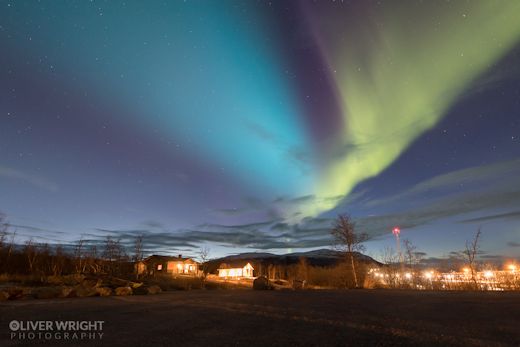
"It was totally blue," says Wright, a veteran aurora tour guide who has witnessed hundreds of geomagnetic storms. "I've never seen anything quite like it!" In Tromso, Norway, Daniel Drelciuc saw it, too--"a big blue mass next to the classic green aurora," he says.
In auroras, blue is a sign of nitrogen. Energetic particles striking ionized molecular nitrogen (N2+) at very high altitudes can produce a cold azure glow, most often seen during intense geomagnetic storms. On Oct. 26th, however, geomagnetic activity was not intense.
Maybe these weren't auroras, after all. Another theory is emerging for the blue apparition. On Oct. 26th, the Russian military staged a nuclear battle drill and test-launched a number of ballistic missiles from land, sea and air. At least one of them created a magnificent cloud of blue exhaust. Alexey Yakovlev photographed the display from Strezhevoy, Russia:

His photo looks so strange, you might think it is Photoshopped. It's real. A sequence of images on Yakovlev's Russian language social media page shows the cloud expanding naturally into the atmosphere.
The instigating missile may have been a Topol ICBM reportedly launched from the Plesetsk space center 800 km north of Moscow toward the Kura test range in Kamchatka. The flight path is about right for a sighting by Yakovlev. Moreover, when Russia test-launched the same type of missile last month, some sky watchers reported unusual clouds then, too.
Perhaps high altitude winds blew some of this blue exhaust west, visually mixing with geomagnetic auroras over Scandinavia. Wright notes that the blue and green lights were indeed moving independently, as if they came from different sources. "I'm leaning toward the rocket explanation," he says.
Stay tuned for updates as more information becomes available.
OPALITE CRYSTAL SPACE PENDANT: On Oct. 15, 2017, the students Earth to Sky Calculus launched a space weather balloon from the Sierra Nevada mountains of central California. Its mission: to measure cosmic rays at the top of Earth's atmosphere. The payload carried an array of X-ray/gamma-ray detectors, GPS trackers, temperature/pressure sensors and, for fundraising, opalite crystals:
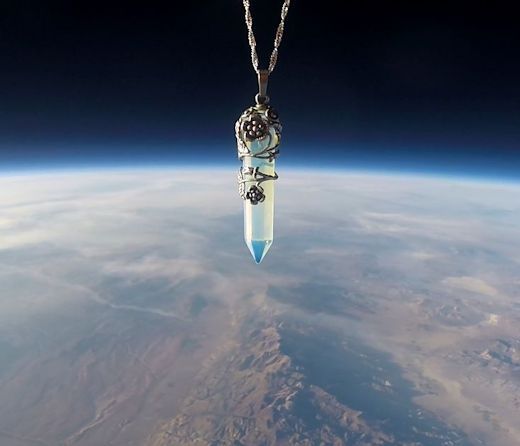
With a soothing blue glow that matches the otherworldly color of Earth's upper atmosphere, these crystals ascended to an altitude of 32 km (105,000 feet) where the balloon exploded. The payload parachuted back to Earth, landing in the Eureka Valley on the outskirts of Death Valley National Park.
You can have one for $119.95. Each necklace comes with a unique gift card showing the pendant floating at the top of Earth's atmosphere. The interior of the card tells the story of the flight and confirms that this gift has been to the edge of space and back again.
Far Out Gifts: Earth to Sky Store
All proceeds support hands-on STEM education